
China’s Trade With Africa
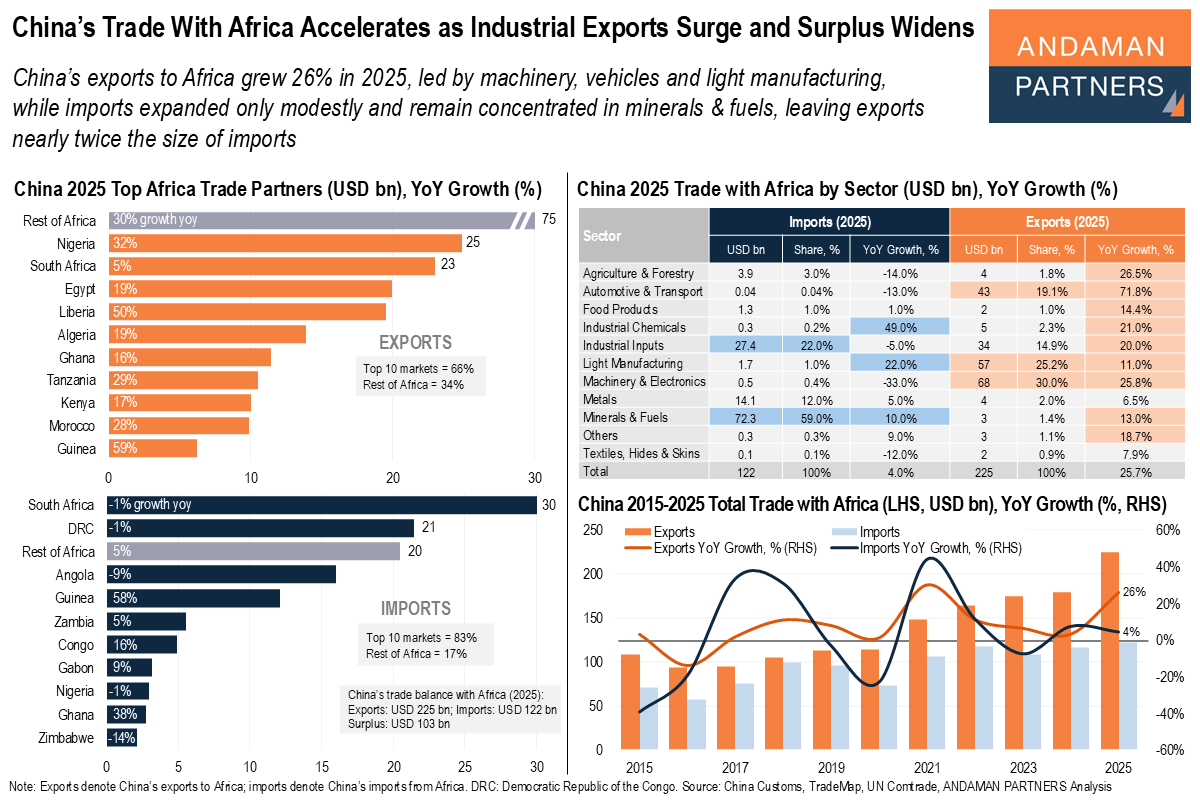
China’s exports to Africa grew 26% in 2025, led by machinery, vehicles and light manufacturing, while imports expanded only modestly and remain concentrated in minerals & fuels, leaving exports nearly twice the size of imports.
Trade between China and Africa accelerated sharply in 2025, driven primarily by a surge in Chinese exports of industrial goods. China’s exports to the continent grew 26% year-on-year to around USD 225 billion, while imports rose only modestly (4%) to roughly USD 122 billion. The result is a widening Chinese trade surplus of more than USD 100 billion, with exports now nearly twice the size of imports. The data underline how the China-Africa trade relationship continues to expand in scale while maintaining a clear structural asymmetry.
The composition of trade highlights the underlying drivers. Chinese exports to Africa are dominated by manufactured and industrial products, particularly machinery & electronics, vehicles, and light-manufactured goods. Together, these sectors account for almost 75% of China’s exports to the continent and have been a major engine of the 2025 growth surge. Rapid expansion in automotive and transport equipment exports in particular reflects China’s rising competitiveness in vehicles and industrial equipment across emerging markets.
By contrast, China’s imports from Africa remain heavily concentrated in natural resources. Minerals & fuels alone account for nearly 60% of Chinese imports from the continent, followed by industrial inputs (22%) and metals (12%). This reflects Africa’s continued role as a key supplier of energy and raw materials within China’s global supply chains.
Geographically, China’s exports are broadly diversified across African markets, with Nigeria, South Africa and Egypt among the largest destinations. Imports, however, are far more concentrated in a small group of resource-rich economies, led by South Africa, the Democratic Republic of Congo and Angola.
Overall, the data illustrate a deepening economic relationship built on complementary structures: Africa as a supplier of resources and China as a supplier of industrial goods. As China’s manufacturing sectors continue expanding into global markets, Africa is likely to remain an increasingly important destination for Chinese industrial exports. The scale of China’s demand also points to significant potential for African economies to expand and diversify their exports to the Chinese market over time.
Also by ANDAMAN PARTNERS:
ANDAMAN PARTNERS supports international business ventures and growth. We help launch global initiatives and accelerate successful expansion across borders. If your business, operations or project requires cross-border support, contact connect@andamanpartners.com.

ANDAMAN PARTNERS to Attend China Mining 2026 in Tianjin, China
ANDAMAN PARTNERS will attend the China Mining Conference and Exhibition in Tianjin, China, on 10-12 September 2026

ANDAMAN PARTNERS at the Singapore Institute of Directors Annual Conference 2026
ANDAMAN PARTNERS at the Singapore Institute of Directors Conference 2026 in Singapore on 28 August 2026

ANDAMAN PARTNERS Attended the Australia Governance Summit 2026 in Sydney
ANDAMAN PARTNERS Co-Founder Kobus van der Wath attended the Australia Governance Summit (AGS26) in Sydney, Australia.
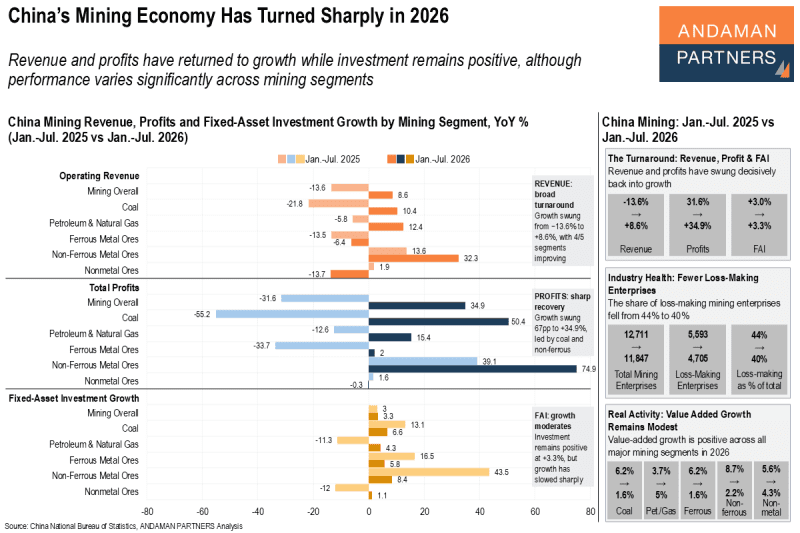
China’s Mining Economy Has Turned Sharply in 2026
Revenue and profits have returned to growth while investment remains positive, although performance varies significantly across segments
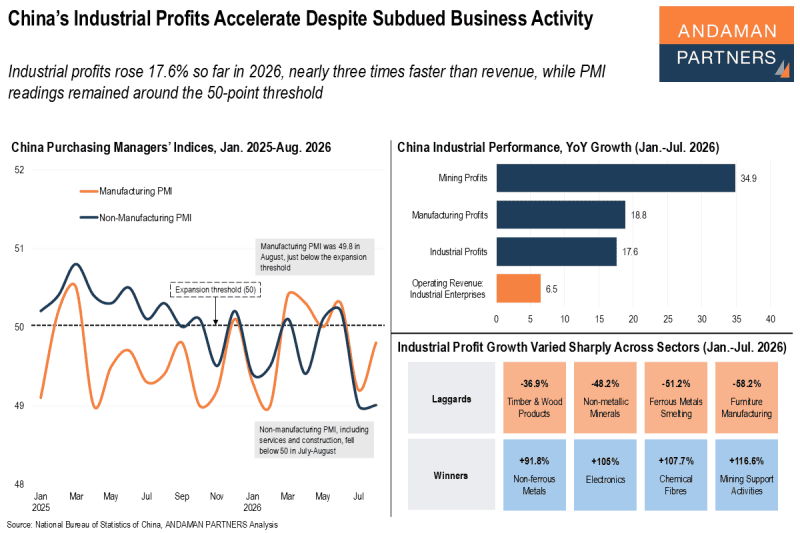
China’s Industrial Profits Accelerate Despite Subdued Business Activity
Industrial profits rose 17.6% so far in 2026, nearly three times faster than revenue, while PMI readings remained below 50
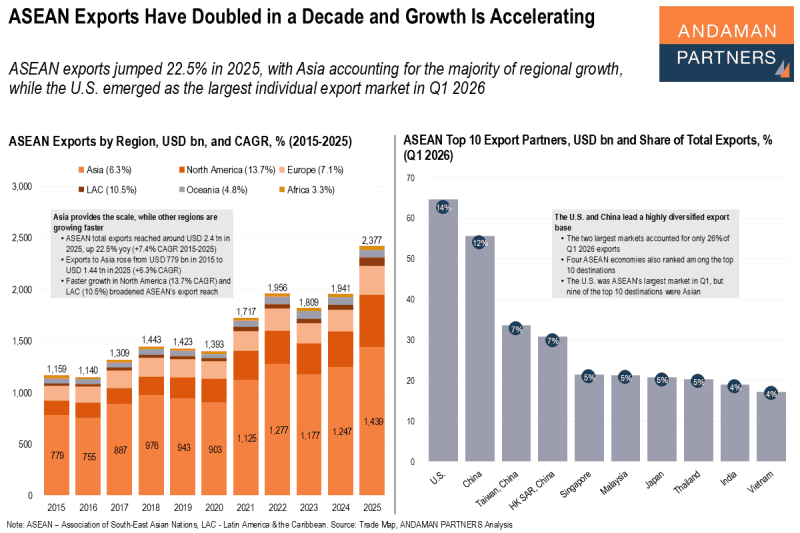
ASEAN Exports Have Doubled in a Decade, and Growth Is Accelerating
ASEAN exports jumped 22.5% in 2025, with Asia accounting for the majority of regional growth