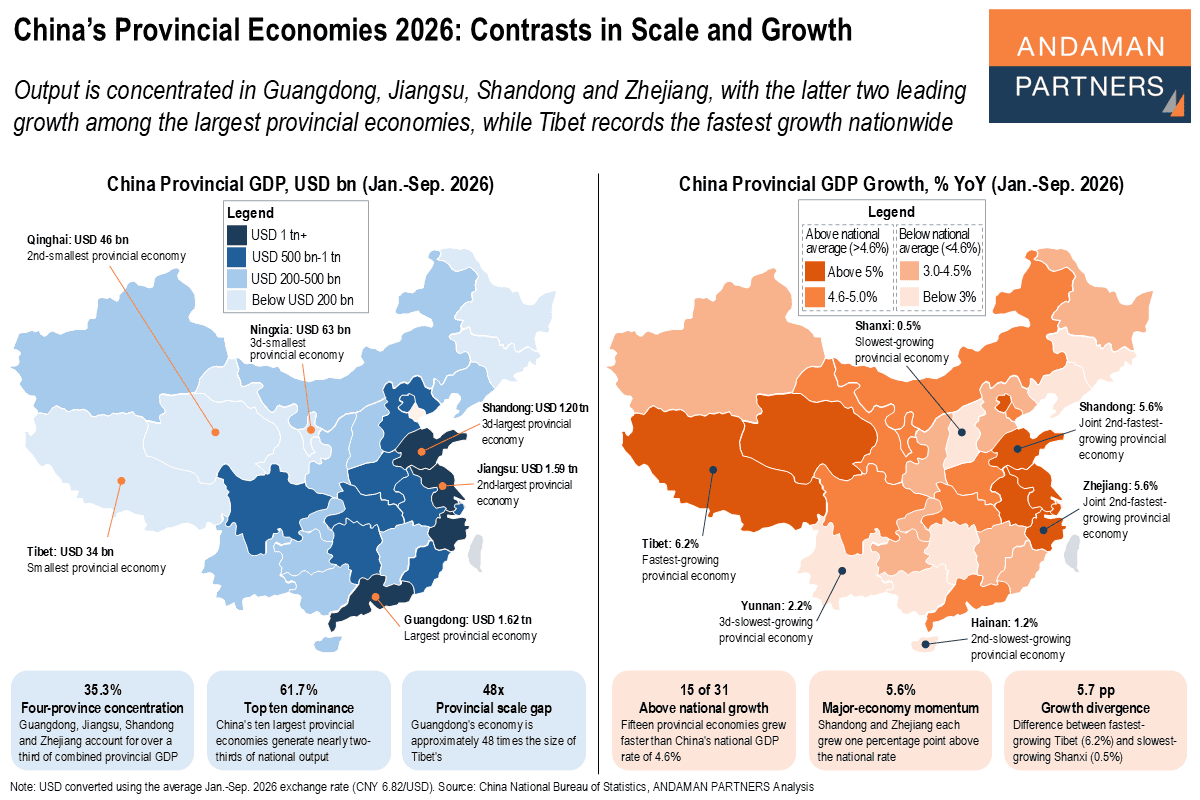
China’s provincial economies show striking economic concentration and increasingly uneven growth in the first nine months of 2026. Four provinces, Guangdong, Jiangsu, Shandong and Zhejiang, generated more than a third of China’s combined provincial GDP, while the ten largest economies accounted for nearly two-thirds. Yet as national GDP expanded by 4.6%, some of China’s established industrial and commercial centres outperformed, while others slowed sharply.
China’s eastern economic heartland remains dominant. Guangdong (USD 1.63 trillion) and Jiangsu (USD 1.59 trillion) remain the country’s two largest provincial economies, though their growth rates of 4.6% and 5.2%, respectively, tell different stories. Shandong (USD 1.21 trillion) and Zhejiang (USD 1.07 trillion) stand out, both expanding by 5.6%, a full percentage point above the national average. Shanghai, a USD 635 billion economy, also grew 5.5%, while Beijing (USD 593 billion) grew 5.2%. Anhui (USD 621 billion) continued to outperform at 5.3%, while Fujian (3.9%) and Jiangxi (3.5%) grew more slowly. Together, these figures illustrate the considerable differences in momentum even within China’s economically dominant eastern region.
Central China presents a mixed picture. Henan (USD 761 billion) and Hubei (USD 695 billion) remain major economic centres, growing by 5.0% and 4.7%, respectively. Hebei (USD 548 billion) expanded by 4.5%, close to the national average, while Hunan (USD 610 billion) managed only 2.8%. The contrast is particularly revealing: some of China’s substantial inland economies continue to expand at a healthy pace, while others are struggling to maintain momentum.
Western China combines relatively modest economic scale with some of the country’s sharpest growth contrasts. Sichuan, the region’s largest provincial economy at USD 764 billion, grew by 4.9%, while neighbouring Chongqing (USD 377 billion) expanded by 4.3%. Tibet recorded China’s fastest growth at 6.2% but has the smallest provincial economy at just USD 34 billion. Qinghai (5.1%), Gansu (5.0%) and Ningxia (5.0%) also exceeded the national growth rate, although their economic output remains comparatively small. Inner Mongolia (4.8%) performed slightly above the national average, while Xinjiang (4.2%), Guizhou (4.3%), Shaanxi (4.1%) and Guangxi (2.5%) grew more slowly. Yunnan, with a USD 359 billion economy, expanded by just 2.2%, illustrating the uneven performance across China’s western and southwestern provinces.
The northeast continues to grow more slowly. Liaoning, the region’s largest economy at USD 368 billion, grew by only 2.4%, while Jilin (USD 162 billion) also grew by 2.4% and Heilongjiang (USD 176 billion) grew by 3.0%. Elsewhere, Tianjin (USD 207 billion) grew by 4.8%, while Shanxi (USD 264 billion) registered the country’s slowest growth at just 0.5%. Hainan, with its distinct island economy, expanded by only 1.2%.
The broader picture shows enormous economic scale but increasingly differentiated momentum. Guangdong’s economy alone is approximately 48 times the size of Tibet’s, while the gap between the fastest- and slowest-growing provinces reaches 5.7 percentage points. Fifteen of China’s 31 mainland provincial-level economies grew faster than the national rate of 4.6%, with Guangdong matching it.
The results suggest that China’s economic trajectory cannot be understood through a single national growth figure. Its largest industrial and commercial provinces continue to anchor economic output, but the sources and pace of growth differ substantially across the country. For businesses and investors, understanding these provincial differences is increasingly important to understanding China itself.