Australia-China Trade Rebalancing
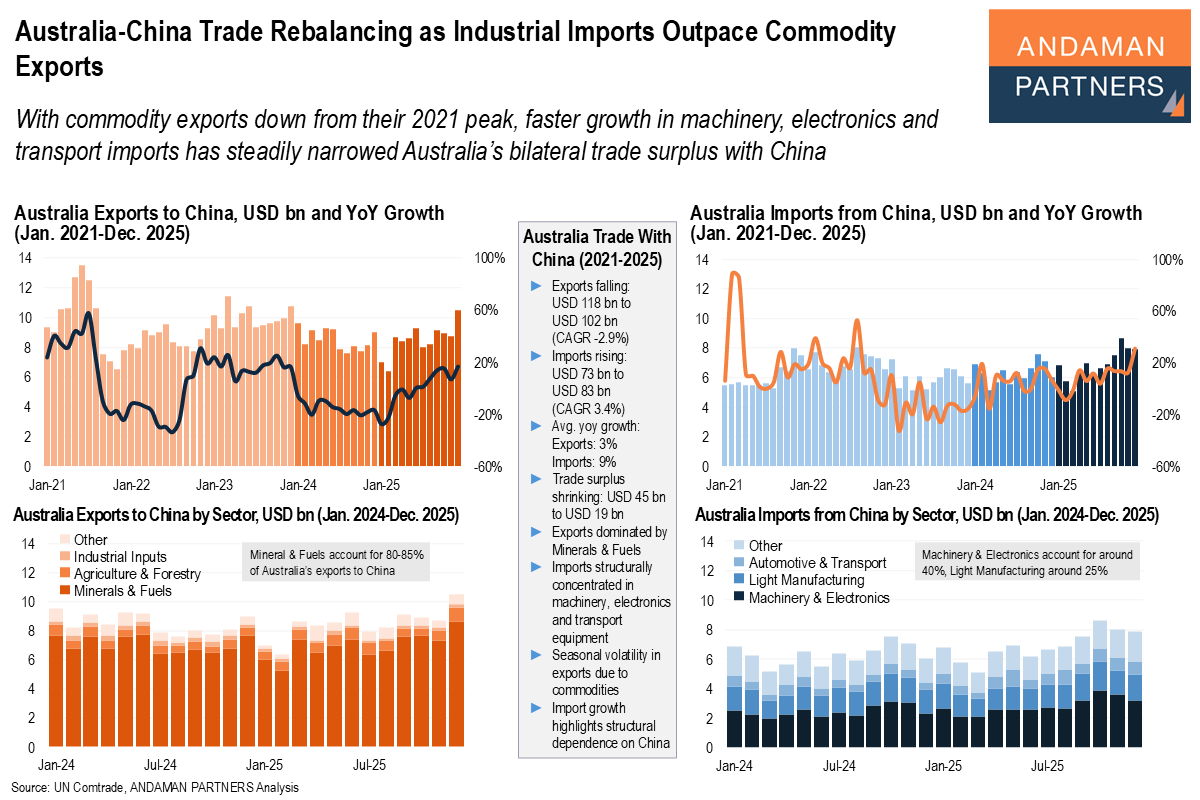
With commodity exports down from their 2021 peak, faster growth in machinery, electronics and transport imports has steadily narrowed Australia’s bilateral trade surplus with China.
Australia’s trade relationship with China is undergoing a measurable shift. While China remains Australia’s dominant commodity buyer, export values have declined from their 2021 peak of USD 118 billion to around USD 102 billion in 2025, reflecting softer commodity prices and cyclical volatility in minerals and fuels. Exports remain heavily concentrated, with 80-85% still accounted for by minerals and energy products, underscoring the structural nature of Australia’s resource exposure.
By contrast, imports from China have expanded more steadily, rising from USD 73 billion to USD 83 billion over the same period. Growth has been led by machinery, electronics and transport equipment, together accounting for roughly two-thirds of Australia’s imports from China. This divergence in momentum (declining commodity exports versus rising industrial imports) has materially compressed Australia’s bilateral trade surplus, from USD 45 billion to just USD 19 billion.
The result is not a diversification of Australia’s export base, but a rebalancing of the bilateral relationship driven by import growth. China remains central to Australia’s resource sector, while Australia remains reliant on China for high-value manufactured goods and industrial inputs. Bilateral trade continues to reflect a classic commodities-for-manufactures exchange, but with narrowing surplus buffers and growing sensitivity to shifts in both commodity demand and industrial supply chains.
Also by ANDAMAN PARTNERS:
ANDAMAN PARTNERS supports international business ventures and growth. We help launch global initiatives and accelerate successful expansion across borders. If your business, operations or project requires cross-border support, contact connect@andamanpartners.com.

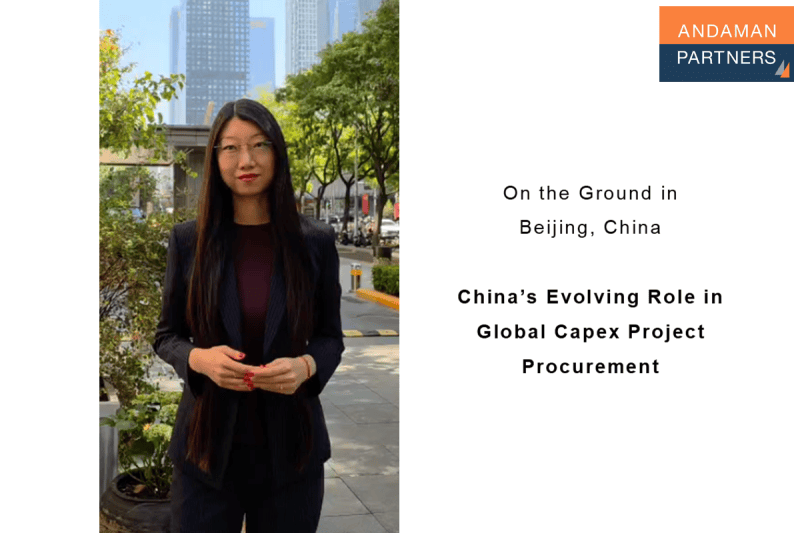
China’s Role in Global Capex Project Procurement by ANDAMAN PARTNERS Co-Founder Rachel Wu
Analysis by ANDAMAN PARTNERS Co-Founder Rachel Wu on how China’s role has evolved in global capex project procurement

ANDAMAN PARTNERS Co-Founder Rachel Wu to Deliver Talk at SEP Global Reunion 2026 in Shanghai, China
Rachel will deliver a talk at the event entitled ‘Two SEPers in the Family – Building in China for 20+ Years’

ANDAMAN PARTNERS to Attend Stanford Executive Programme Global Reunion 2026 in Shanghai, China
ANDAMAN PARTNERS will attend the SEP Global Reunion 2026 in Shanghai, China, from 28 October to 1 November 2026
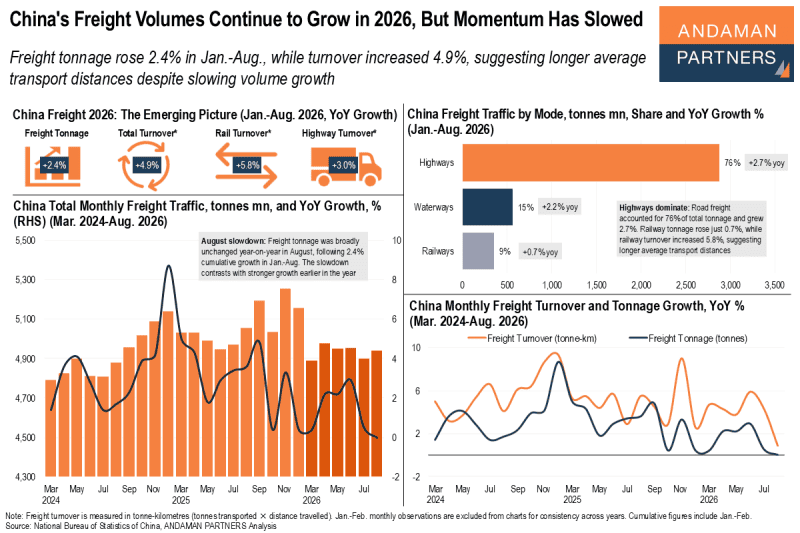
China’s Freight Volumes Continue to Grow in 2026, But Momentum Has Slowed
Freight tonnage rose 2.4% in Jan.-Aug., while turnover increased 4.9%, suggesting longer average transport distances
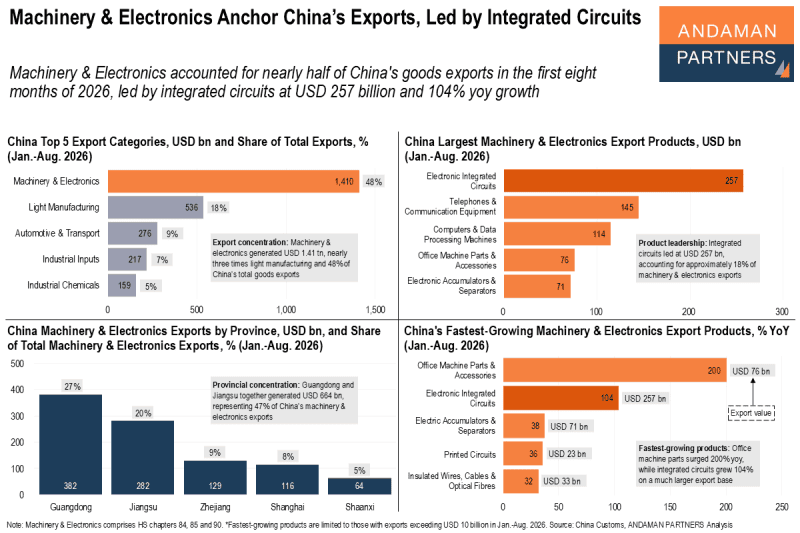
Machinery & Electronics Anchor China’s Exports, Led by Integrated Circuits
Machinery & Electronics accounted for nearly half of China’s goods exports in the first eight months of 2026, led by integrated circuits
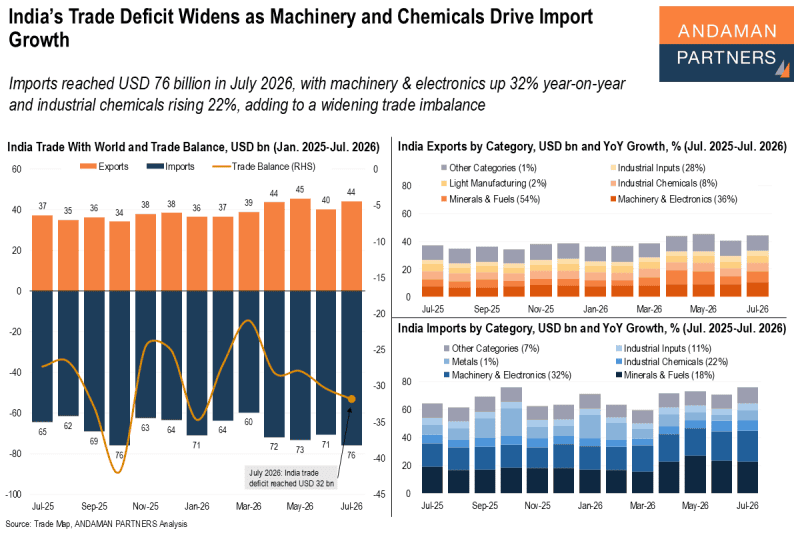
India’s Trade Deficit Widens as Machinery and Chemicals Drive Import Growth
Imports reached USD 76 billion in July 2026, with machinery & electronics up 32%, adding to a widening trade imbalance