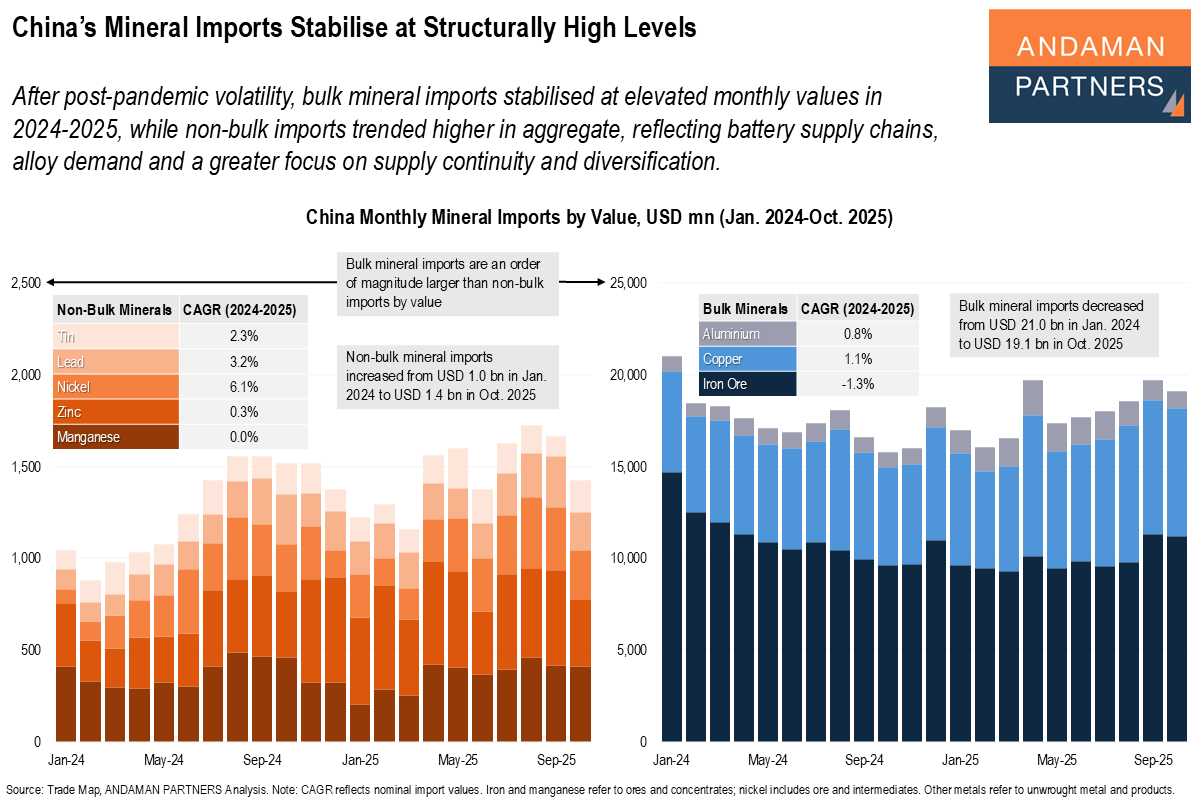

After post-pandemic volatility, bulk mineral imports stabilised at elevated monthly values in 2024-2025, while non-bulk imports trended higher in aggregate, reflecting battery supply chains, alloy demand and a greater focus on supply continuity and diversification.
After the sharp swings of the post-pandemic period, in 2024-2025, China’s mineral imports appear to have settled into a more stable, structurally elevated pattern. Bulk inputs such as iron ore and copper are now range-bound at high monthly values, signalling managed procurement rather than cyclical demand surges.
Non-bulk minerals have trended higher in aggregate, reflecting the growing pull of battery supply chains, alloy production and a stronger emphasis on supply continuity and diversification. Within this group, lead, tin and especially nickel stand out for their high value growth in 2024-2025, underscoring how targeted materials linked to electrification, specialty alloys and upstream control are gaining strategic weight even as headline industrial demand remains uneven.
Also by ANDAMAN PARTNERS:
ANDAMAN PARTNERS supports international business ventures and growth. We help launch global initiatives and accelerate successful expansion across borders. If your business, operations or project requires cross-border support, contact connect@andamanpartners.com.

ANDAMAN PARTNERS Attended the Australia Governance Summit 2026 in Sydney
ANDAMAN PARTNERS Co-Founder Kobus van der Wath attended the Australia Governance Summit (AGS26) in Sydney, Australia.

ANDAMAN PARTNERS Wishes You a Happy and Prosperous Year of the Horse!
Compliments of the Chinese Lunar New Year to all our clients, customers, suppliers and partners.

ANDAMAN PARTNERS to Attend Investing in African Mining Indaba 2026 in Cape Town
ANDAMAN PARTNERS Co-Founders Kobus van der Wath and Rachel Wu will attend Investing in African Mining Indaba 2026 in Cape Town, South Africa.

China’s PMI Indicators Point to Uneven Momentum and Rising Cost Pressures in 2026
Manufacturing activity remained close to expansion in early 2026, while weaker export orders and raw material prices pressure the economy

Africa’s Industrial Leaders and Rising Manufacturing Economies
Morocco, South Africa and Egypt remain Africa’s leading industrial economies; DRC, Djibouti and Gabon recorded the largest gains in competitiveness

Africa’s Trade Is Shifting Increasingly Toward China
China’s share of Africa’s trade has expanded sharply since 2001, with imports from China now matching Europe’s share