
You are currently viewing Sub-Saharan Africa’s Two-Speed Economy

Sub-Saharan Africa’s Two-Speed Economy

MENA’s Trade Growth Is Now Being Driven by Imports

MENA’s Trade Growth Is Now Being Driven by Imports, Not Exports

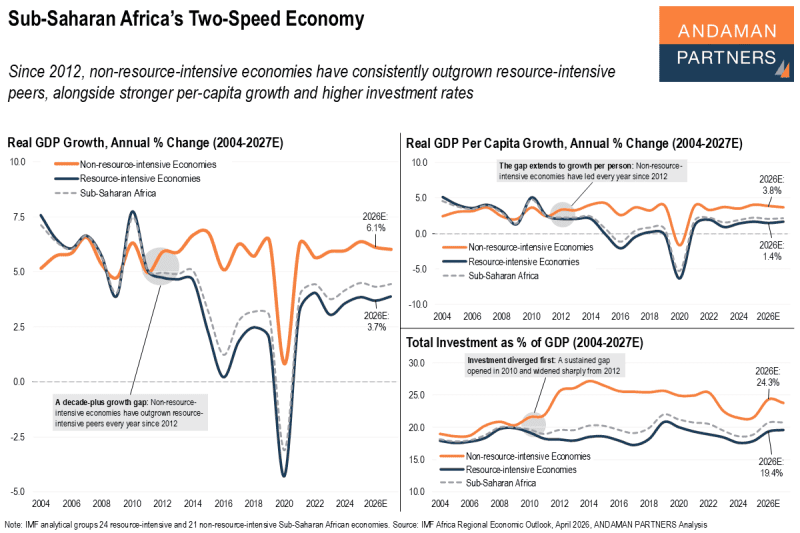
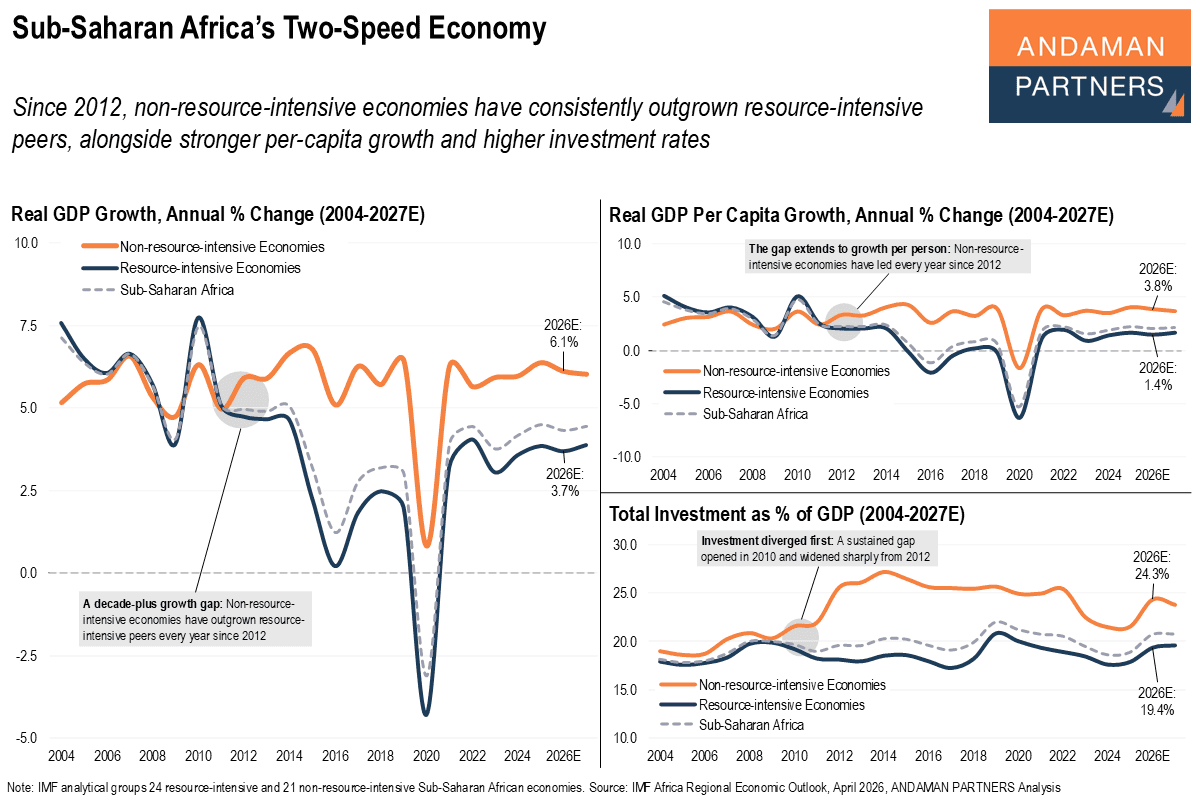
Since 2012, non-resource-intensive economies have consistently outgrown resource-intensive peers, alongside stronger per-capita growth and higher investment rates.

Sub-Saharan Africa is increasingly moving at two speeds. Since 2012, the region’s non-resource-intensive economies have consistently grown faster than their resource-intensive peers, with forecasted growth of 6.1% versus 3.7% in 2026. The divide also holds on a per-capita basis, and the non-resource group has had higher investment rates for more than a decade, suggesting the divergence is deeper than a single commodity cycle.

These groups represent very different parts of the continent. The resource-intensive side includes major economies and commodity producers such as South Africa, Nigeria, Angola, the DRC, Ghana and Zambia. The non-resource-intensive side includes economies such as Côte d’Ivoire, Ethiopia, Kenya, Rwanda, Senegal and Uganda. The IMF classifies countries as resource-intensive when oil or other non-renewable resources account for a sufficiently large share of exports; the non-resource group comprises economies that do not meet those thresholds.

The implications reach beyond the growth numbers. Africa’s natural resources remain a major economic advantage, but they are not automatically translating into faster economy-wide growth. Increasingly, some of the continent’s strongest momentum is coming from economies with broader growth engines and higher investment rates. For businesses and investors, that means Africa’s future opportunities cannot be understood through commodities alone; for resource-rich countries, the challenge is to convert mineral and energy wealth into investment, productivity and growth across the wider economy. The continent’s next phase of growth may therefore depend as much on what economies build around their resources as on the resources themselves.

Also by ANDAMAN PARTNERS:

ANDAMAN PARTNERS supports international business ventures and growth. We help launch global initiatives and accelerate successful expansion across borders. If your business, operations or project requires cross-border support, contact connect@andamanpartners.com.

Media
News & Events
Knowledge