
You are currently viewing ASEAN’s Expanding Export Base, Driven by Electronics and Resources

ASEAN’s Expanding Export Base, Driven by Electronics and Resources

Exports have doubled over the past decade as electronics manufacturing hubs and resource-exporting economies drive ASEAN’s trade expansion.

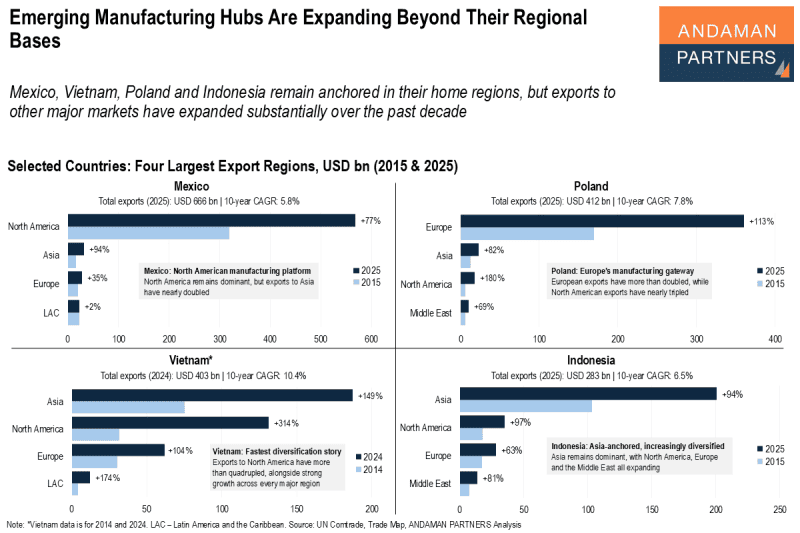
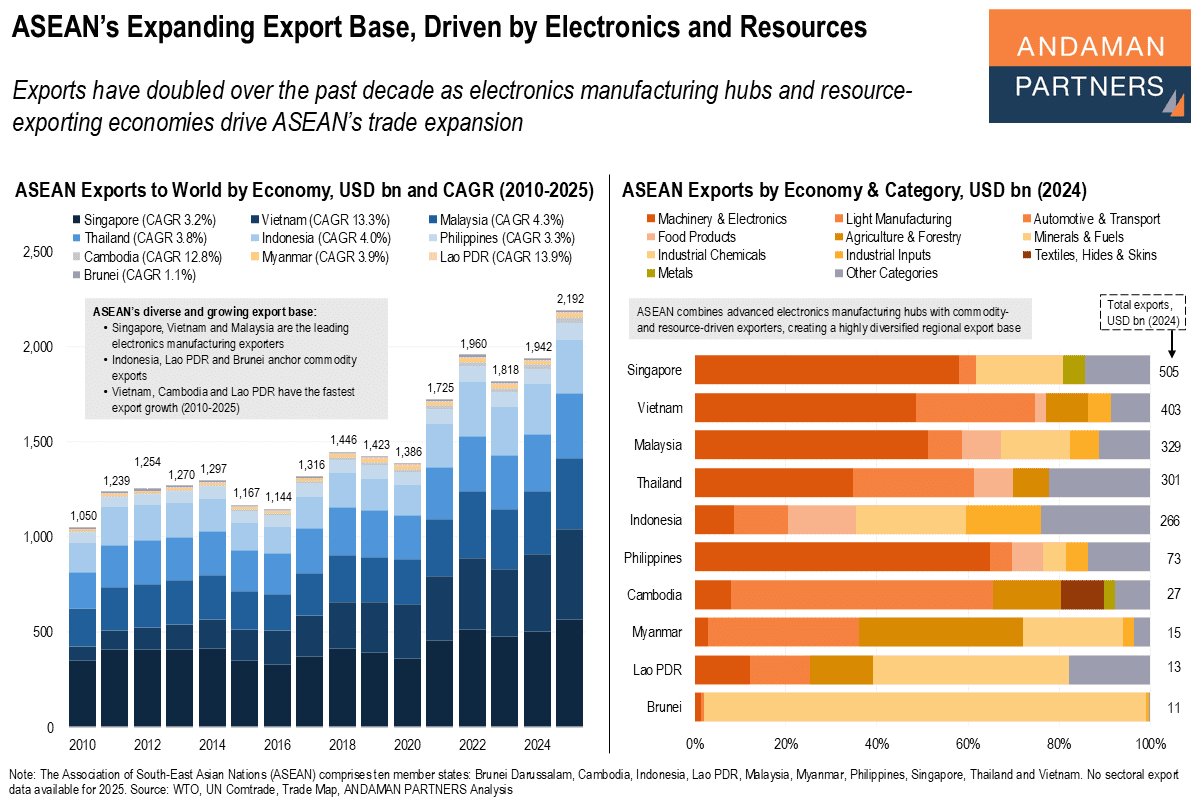
ASEAN’s exports reached a record USD 2.2 trillion in 2025, doubling from USD 1.1 trillion in 2010 as the region continued to strengthen its role in global manufacturing and commodity trade. Singapore remained ASEAN’s largest exporter at USD 567 billion, followed by Vietnam at USD 473 billion and Malaysia at USD 376 billion. Thailand and Indonesia also remained major export economies, with exports of USD 340 billion and USD 283 billion, respectively.

Vietnam continued to stand out among large exporters, recording a CAGR of 13.3% between 2010 and 2025, while Cambodia and Lao PDR posted similarly rapid export growth rates of 12.8% and 13.9% respectively, albeit from much smaller export bases.

The structure of ASEAN exports increasingly reflects two dominant pillars: electronics manufacturing and resource-based trade. Singapore, Vietnam and Malaysia have emerged as major exporters of electronics and machinery, deeply integrated into global semiconductor, computing and industrial supply chains. Thailand also maintains a diversified manufacturing base spanning electronics, automotive and industrial products.

By contrast, Indonesia and Brunei remain far more concentrated in mineral, fuel and commodity exports, while the Lao PDR retains a strong resource and energy orientation. Cambodia and Myanmar sit somewhat outside this dual structure, with exports still heavily concentrated in textiles, apparel and lower-value manufacturing activities.

From a global trade perspective, ASEAN is becoming increasingly important as both a manufacturing platform and a resource supplier. The region combines large-scale industrial capacity, competitive labour markets, commodity reserves and deep integration into Asian supply chains.

As companies continue to diversify production networks across Asia, ASEAN is likely to attract further investment in electronics, industrial manufacturing and resource processing. At the same time, the growing divergence between advanced manufacturing economies and lower-income frontier exporters suggests ASEAN will become more specialised internally, rather than converging toward a single export model.

Also by ANDAMAN PARTNERS:

ANDAMAN PARTNERS supports international business ventures and growth. We help launch global initiatives and accelerate successful expansion across borders. If your business, operations or project requires cross-border support, contact connect@andamanpartners.com.

Media
News & Events
Knowledge