
China Q1 2026 Trade Profile
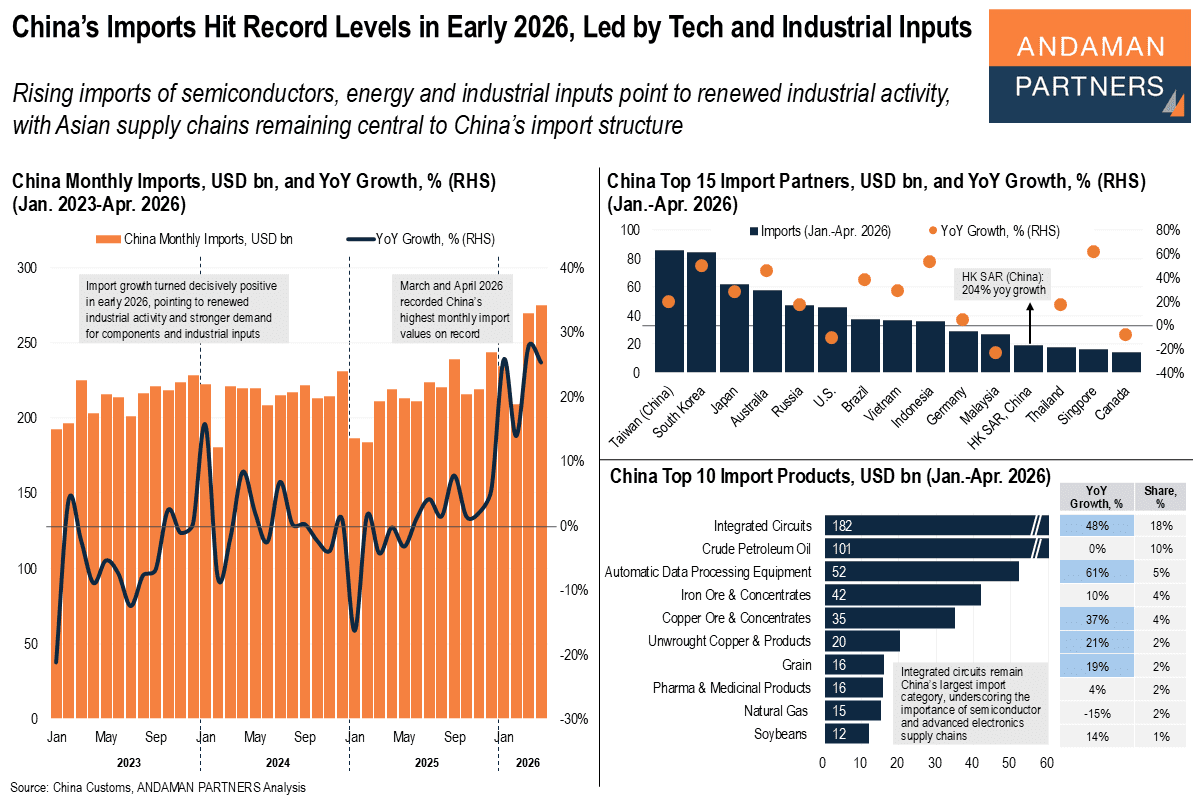
Rising imports of semiconductors, energy and industrial inputs point to renewed industrial activity, with Asian supply chains remaining central to China’s import structure.
China’s imports entered record territory in early 2026, with both March and April registering the highest monthly import values on record. The rebound follows a more uneven 2024-2025 period and points to renewed industrial activity, stronger manufacturing demand and continued integration within Asian supply chains. Import growth has accelerated sharply in recent months, with China’s import structure continuing to be dominated by technology, energy and industrial inputs rather than consumer goods.
The composition of imports highlights where demand is strongest. Integrated circuits remained China’s largest import category at USD 182 billion in the first four months of 2026, underscoring the continued importance of semiconductor and advanced electronics supply chains to China’s industrial economy. Crude oil imports reached USD 101 billion, while automatic data processing equipment, iron ore, copper ore and refined copper also recorded substantial import volumes. Together, the top 10 import products accounted for more than half of China’s total imports during the period.
The geography of imports also reinforces Asia’s central role in China’s external trade structure. Taiwan (China), South Korea and Japan remained among China’s largest suppliers, reflecting deep regional integration in semiconductors, electronics and industrial manufacturing. Commodity exporters such as Australia, Brazil and Russia also maintained large positions, supplying critical energy and raw material inputs to China’s industrial base. The U.S. remained China’s sixth-largest supplier overall, although imports from the U.S. continue to decline, falling by 11% year-on-year.
Rising Chinese imports matter globally because they support manufacturing activity, commodity demand and export growth across major supplier economies, reinforcing China’s central role in global trade and industrial supply chains.
Also by ANDAMAN PARTNERS:
ANDAMAN PARTNERS supports international business ventures and growth. We help launch global initiatives and accelerate successful expansion across borders. If your business, operations or project requires cross-border support, contact connect@andamanpartners.com.

ANDAMAN PARTNERS Attended the Australia Governance Summit 2026 in Sydney
ANDAMAN PARTNERS Co-Founder Kobus van der Wath attended the Australia Governance Summit (AGS26) in Sydney, Australia.
ANDAMAN PARTNERS Wishes You a Happy and Prosperous Year of the Horse!
Compliments of the Chinese Lunar New Year to all our clients, customers, suppliers and partners.

ANDAMAN PARTNERS to Attend Investing in African Mining Indaba 2026 in Cape Town
ANDAMAN PARTNERS Co-Founders Kobus van der Wath and Rachel Wu will attend Investing in African Mining Indaba 2026 in Cape Town, South Africa.

China’s PMI Indicators Point to Uneven Momentum and Rising Cost Pressures in 2026
Manufacturing activity remained close to expansion in early 2026, while weaker export orders and raw material prices pressure the economy

Africa’s Industrial Leaders and Rising Manufacturing Economies
Morocco, South Africa and Egypt remain Africa’s leading industrial economies; DRC, Djibouti and Gabon recorded the largest gains in competitiveness

Africa’s Trade Is Shifting Increasingly Toward China
China’s share of Africa’s trade has expanded sharply since 2001, with imports from China now matching Europe’s share