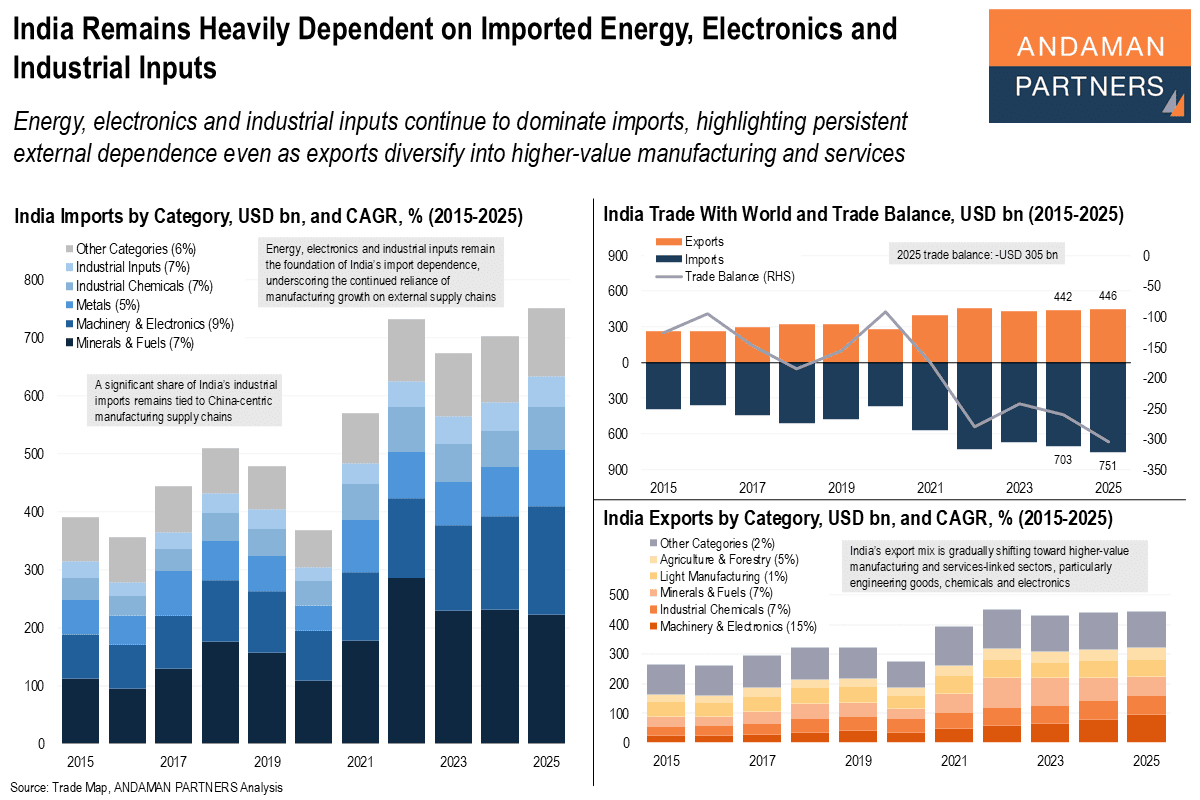

Energy, electronics and industrial inputs continue to dominate imports, highlighting persistent external dependence even as exports diversify into higher-value manufacturing and services.
India’s trade structure continues to reflect a core reality of its economic rise: the country is expanding as a manufacturing and consumption market while remaining heavily dependent on imported energy, electronics and industrial inputs.
India’s goods imports increased from roughly USD 390 billion in 2015 to approximately USD 750 billion in 2025, with Minerals & Fuels and Machinery & Electronics consistently accounting for the largest share of the import bill. Crude oil alone remains a major structural dependency, while a significant portion of India’s industrial imports remains tied to China-centric manufacturing supply chains, particularly in electronics, machinery and intermediate industrial products.
At the same time, India’s export base has continued to expand and gradually diversify. Goods exports rose from approximately USD 265 billion in 2015 to around USD 446 billion in 2025, supported by growth in engineering goods, industrial chemicals, light manufacturing and electronics. This reflects India’s broader push into higher-value manufacturing and export-oriented industrialisation, alongside its globally competitive services sector.
Despite export growth, the gap between imports and exports remains substantial. India’s merchandise trade deficit widened from roughly USD 125 billion in 2015 to around USD 305 billion in 2025 as imports continued to outpace export expansion. The deficit highlights the extent of India’s external dependence in critical industrial and energy supply chains, even as domestic manufacturing capacity expands.
India remains one of the world’s most important long-term growth and manufacturing markets, but the country’s industrial expansion continues to depend heavily on external suppliers, imported energy and globally integrated supply chains. This creates both opportunity and exposure across sourcing, manufacturing localisation, infrastructure, logistics and industrial investment strategies.
Also by ANDAMAN PARTNERS:
ANDAMAN PARTNERS supports international business ventures and growth. We help launch global initiatives and accelerate successful expansion across borders. If your business, operations or project requires cross-border support, contact connect@andamanpartners.com.

ANDAMAN PARTNERS Attended the Australia Governance Summit 2026 in Sydney
ANDAMAN PARTNERS Co-Founder Kobus van der Wath attended the Australia Governance Summit (AGS26) in Sydney, Australia.
ANDAMAN PARTNERS Wishes You a Happy and Prosperous Year of the Horse!
Compliments of the Chinese Lunar New Year to all our clients, customers, suppliers and partners.

ANDAMAN PARTNERS to Attend Investing in African Mining Indaba 2026 in Cape Town
ANDAMAN PARTNERS Co-Founders Kobus van der Wath and Rachel Wu will attend Investing in African Mining Indaba 2026 in Cape Town, South Africa.

China’s Imports Hit Record Levels in Early 2026, Led by Tech and Industrial Inputs
Rising imports of semiconductors, energy and industrial inputs point to renewed industrial activity.

GCC Trade Expansion Is Increasingly Supported by Diversified Regional Demand
Strong export performance, sustained import growth and diversified demand across the GCC have raised the region’s strategic importance.

India Remains Heavily Dependent on Imported Energy, Electronics and Industrial Inputs
Energy, electronics and industrial inputs continue to dominate India’s imports, highlighting persistent external dependence.