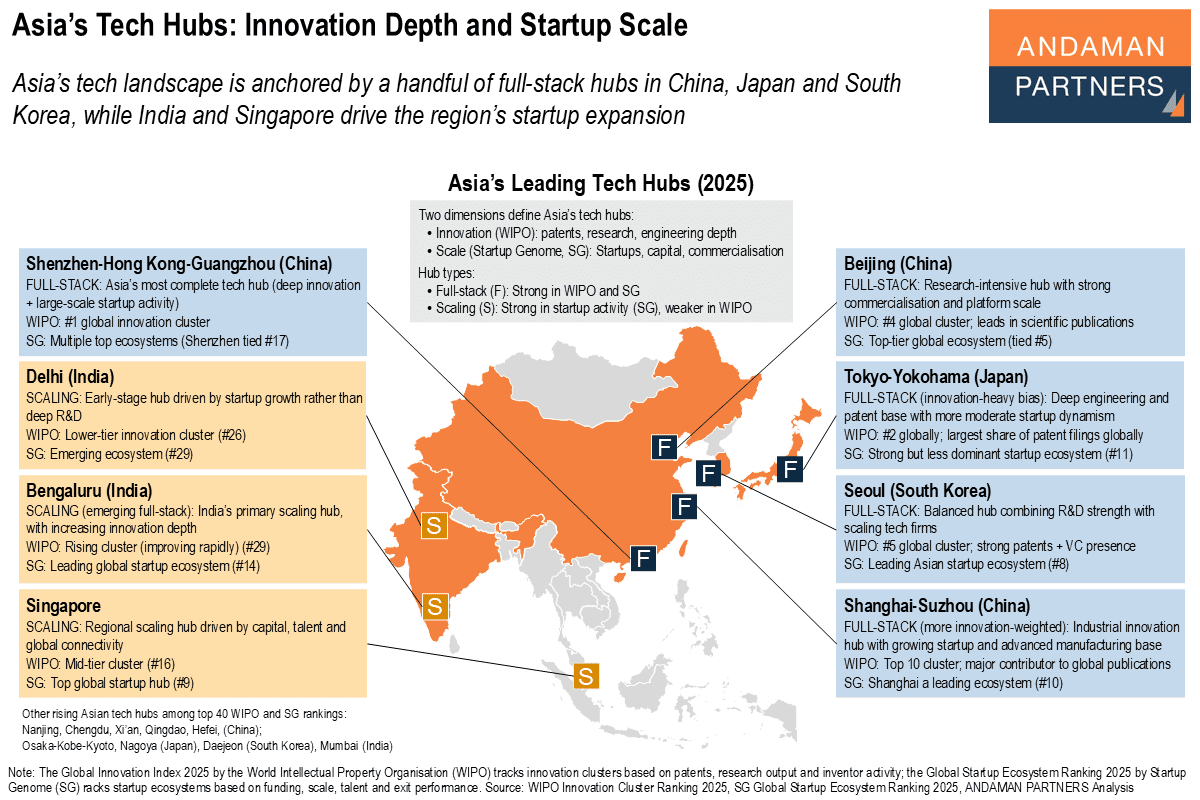
Asia’s tech landscape is anchored by a handful of full-stack hubs in China, Japan and South Korea, while India and Singapore drive the region’s startup expansion.
Asia’s tech hubs are no longer following global innovation; in 2026, they are helping define it, with China, Japan and South Korea anchoring depth while India and Singapore drive startup scale.
Asia’s leading tech hubs in 2026 are defined by a two-speed model: a small set of deep innovation clusters in China, Japan and South Korea, and a second wave of scaling ecosystems led by India and Singapore. WIPO’s 2025 cluster rankings show the region’s strongest research and patent density concentrated in a few metropolitan belts, while Startup Genome’s 2025 report highlights how capital formation, exits and startup velocity are increasingly shifting toward rising Indian and Chinese growth hubs.
- Shenzhen-Hong Kong-Guangzhou remains Asia’s most complete tech cluster, combining research depth with strong commercialisation.
- Beijing is a research-heavy hub with exceptional scientific output and rising startup scale.
- Shanghai-Suzhou stands out for industrial innovation, advanced manufacturing and an increasingly robust startup base.
- Tokyo-Yokohama remains one of Asia’s deepest engineering hubs, with unmatched patent intensity but a slower startup tempo.
- Seoul combines strong R&D with a highly competitive startup environment, making it one of the region’s most balanced hubs.
On the scaling side, Bengaluru is the standout Indian hub, with global startup momentum and rising AI and deep-tech activity. Delhi is still early in its journey, but it is becoming an important gateway for startup formation and talent. Singapore remains the region’s most international scaling platform, benefiting from access to capital, talent and connectivity.
Together, these eight hubs show that Asia’s innovation story is no longer just about manufacturing strength or patents; it is increasingly about how research, startups and capital are converging into globally competitive ecosystems.
Also by ANDAMAN PARTNERS:
ANDAMAN PARTNERS supports international business ventures and growth. We help launch global initiatives and accelerate successful expansion across borders. If your business, operations or project requires cross-border support, contact connect@andamanpartners.com.

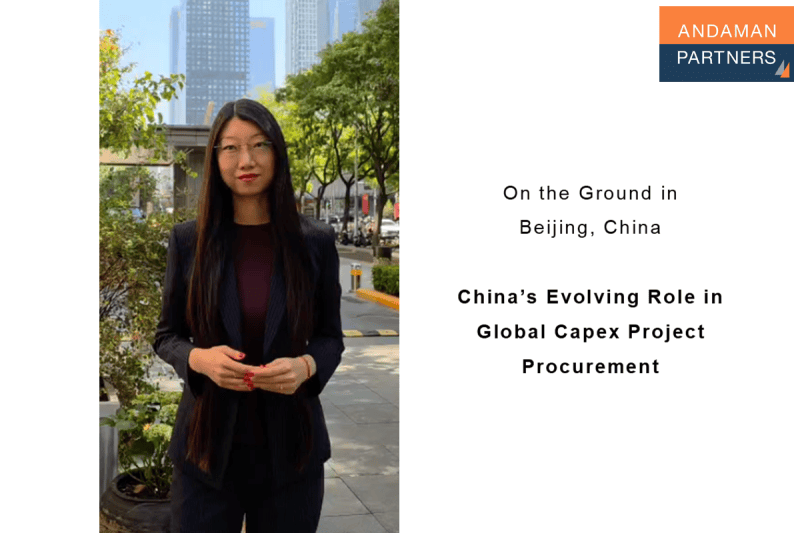
China’s Role in Global Capex Project Procurement by ANDAMAN PARTNERS Co-Founder Rachel Wu
Analysis by ANDAMAN PARTNERS Co-Founder Rachel Wu on how China’s role has evolved in global capex project procurement

ANDAMAN PARTNERS Co-Founder Rachel Wu to Deliver Talk at SEP Global Reunion 2026 in Shanghai, China
Rachel will deliver a talk at the event entitled ‘Two SEPers in the Family – Building in China for 20+ Years’

ANDAMAN PARTNERS to Attend Stanford Executive Programme Global Reunion 2026 in Shanghai, China
ANDAMAN PARTNERS will attend the SEP Global Reunion 2026 in Shanghai, China, from 28 October to 1 November 2026
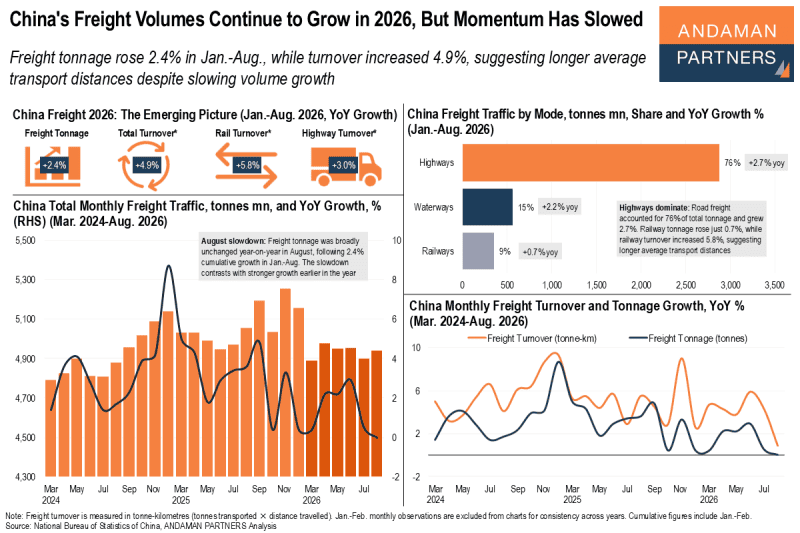
China’s Freight Volumes Continue to Grow in 2026, But Momentum Has Slowed
Freight tonnage rose 2.4% in Jan.-Aug., while turnover increased 4.9%, suggesting longer average transport distances
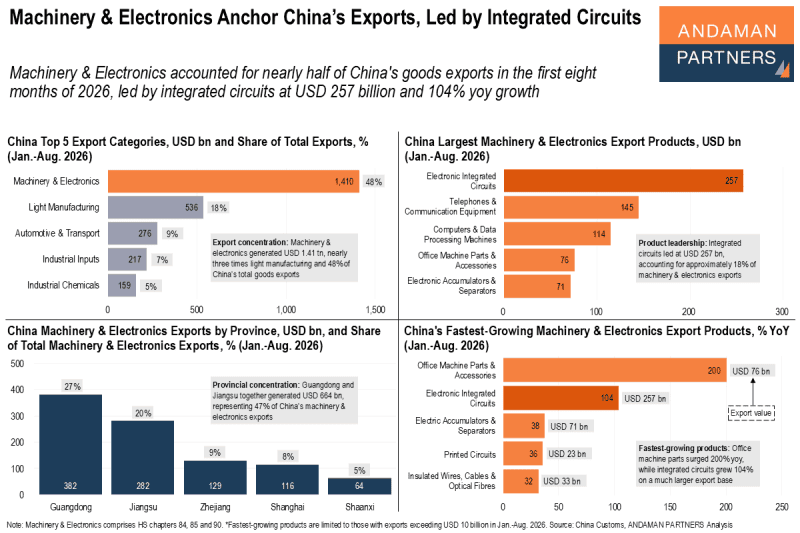
Machinery & Electronics Anchor China’s Exports, Led by Integrated Circuits
Machinery & Electronics accounted for nearly half of China’s goods exports in the first eight months of 2026, led by integrated circuits
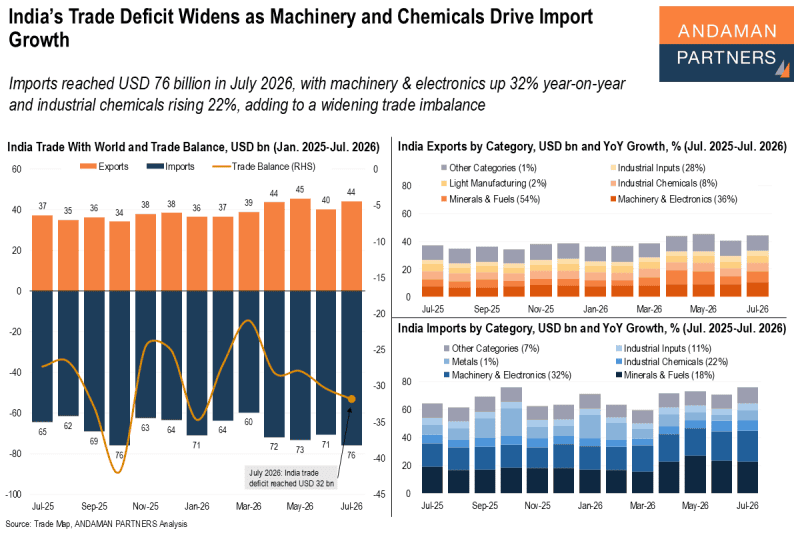
India’s Trade Deficit Widens as Machinery and Chemicals Drive Import Growth
Imports reached USD 76 billion in July 2026, with machinery & electronics up 32%, adding to a widening trade imbalance