
Southeast Asia’s Digital Economy Is Scaling Rapidly
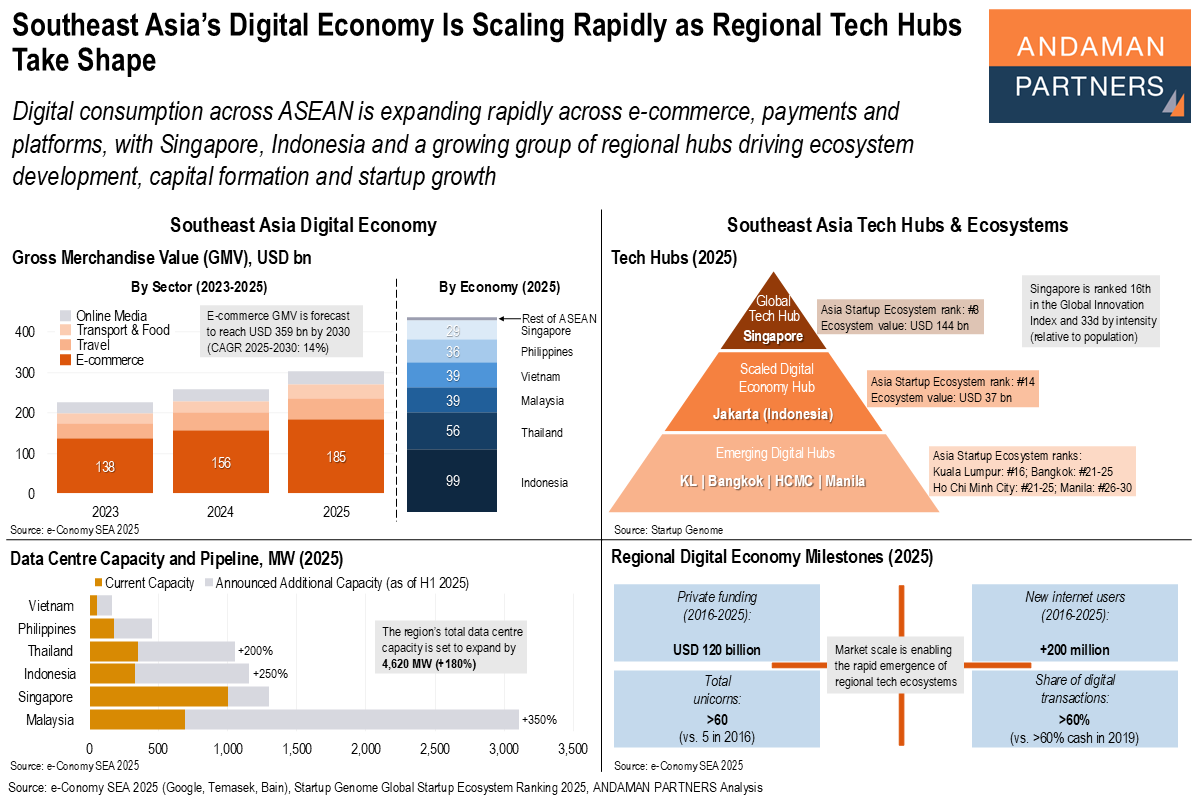
Digital consumption across ASEAN is expanding rapidly across e-commerce, payments and platforms, with Singapore, Indonesia and a growing group of regional hubs driving ecosystem development, capital formation and startup growth.
Southeast Asia’s digital economy is entering a new phase of scale, with the region’s total gross merchandise value (GMV) rising from USD 138 billion in 2023 to USD 185 billion in 2025, led primarily by e-commerce, which remains the dominant driver of regional digital consumption.
Growth is increasingly underpinned by a broader monetisation stack, including digital payments and platform services, while the region’s digital economy is projected to continue expanding toward USD 359 billion by 2030. This demand is highly concentrated, with Indonesia alone accounting for USD 99 billion of GMV in 2025, followed by Thailand (USD 56 billion) and a second tier of markets including Vietnam and Malaysia (USD 39 billion each), highlighting both scale and fragmentation across ASEAN.
At the same time, the enabling infrastructure is scaling rapidly. Data centre capacity across key Southeast Asian markets is set to expand by 4,620 MW, an increase of around 180%, with particularly strong pipeline growth in Malaysia (+350%), Indonesia (+250%) and Thailand (+200%). This reflects rising demand for cloud services, AI workloads and digital platforms, and signals growing investment depth across the region’s digital backbone.
Crucially, this market expansion is now translating into ecosystem development. Southeast Asia has attracted USD 120 billion in private funding between 2016 and 2025, added more than 200 million new internet users, and now counts over 60 unicorns, up from just 5 in 2016. Singapore anchors the region as a global tech hub, with an ecosystem value of USD 144 billion and a top-tier global innovation ranking. At the same time, Indonesia has emerged as the leading scaled digital platform market, with USD 37 billion in ecosystem value and a strong track record of unicorn creation.
A broader group of emerging hubs, including Kuala Lumpur, Bangkok, Ho Chi Minh City and Manila, is now forming a second layer of innovation capacity, indicating that Southeast Asia’s digital economy is not only scaling rapidly but also maturing into a multi-node ecosystem with expanding regional depth.
Also by ANDAMAN PARTNERS:
ANDAMAN PARTNERS supports international business ventures and growth. We help launch global initiatives and accelerate successful expansion across borders. If your business, operations or project requires cross-border support, contact connect@andamanpartners.com.

China’s Role in Global Capex Project Procurement by ANDAMAN PARTNERS Co-Founder Rachel Wu
Analysis by ANDAMAN PARTNERS Co-Founder Rachel Wu on how China’s role has evolved in global capex project procurement

ANDAMAN PARTNERS Co-Founder Rachel Wu to Deliver Talk at SEP Global Reunion 2026 in Shanghai, China
Rachel will deliver a talk at the event entitled ‘Two SEPers in the Family – Building in China for 20+ Years’

ANDAMAN PARTNERS to Attend Stanford Executive Programme Global Reunion 2026 in Shanghai, China
ANDAMAN PARTNERS will attend the SEP Global Reunion 2026 in Shanghai, China, from 28 October to 1 November 2026
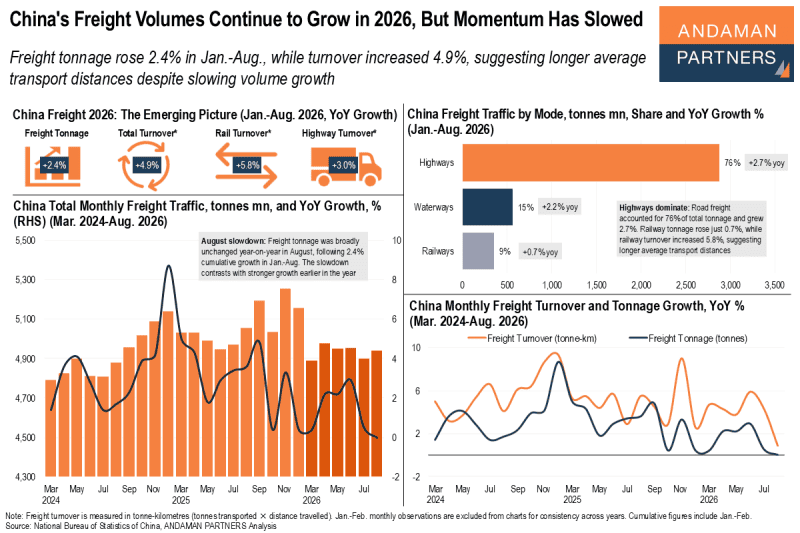
China’s Freight Volumes Continue to Grow in 2026, But Momentum Has Slowed
Freight tonnage rose 2.4% in Jan.-Aug., while turnover increased 4.9%, suggesting longer average transport distances
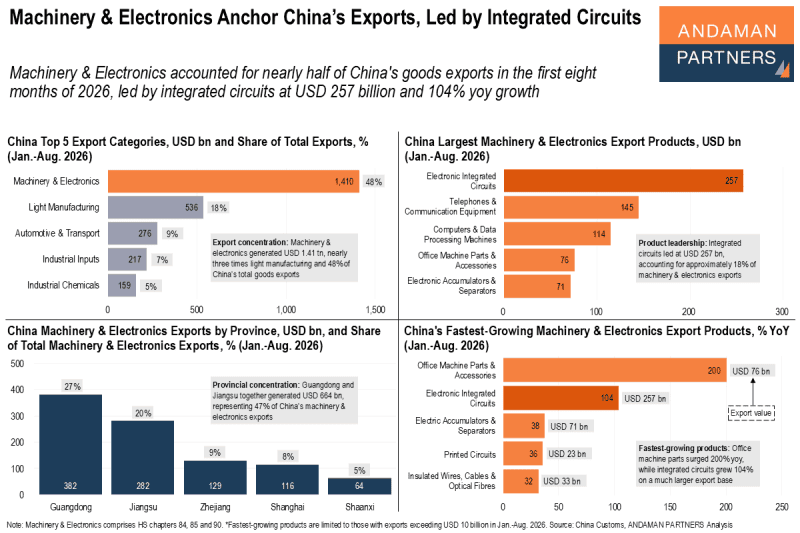
Machinery & Electronics Anchor China’s Exports, Led by Integrated Circuits
Machinery & Electronics accounted for nearly half of China’s goods exports in the first eight months of 2026, led by integrated circuits
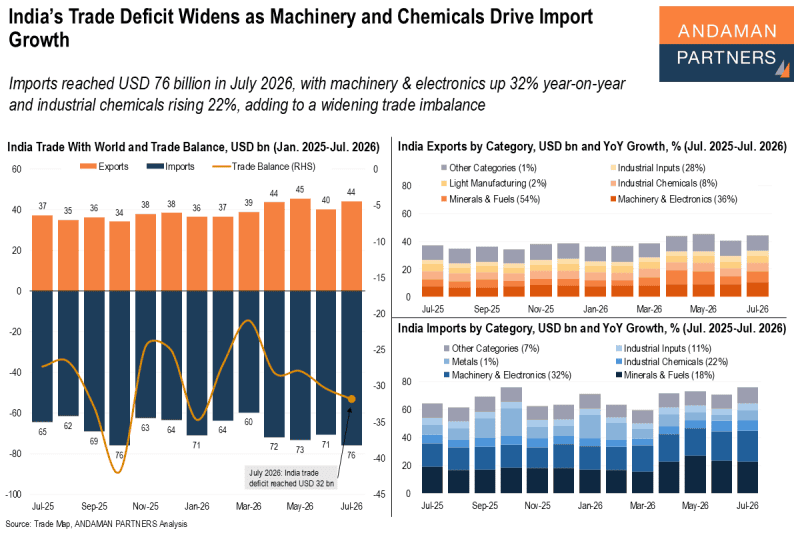
India’s Trade Deficit Widens as Machinery and Chemicals Drive Import Growth
Imports reached USD 76 billion in July 2026, with machinery & electronics up 32%, adding to a widening trade imbalance