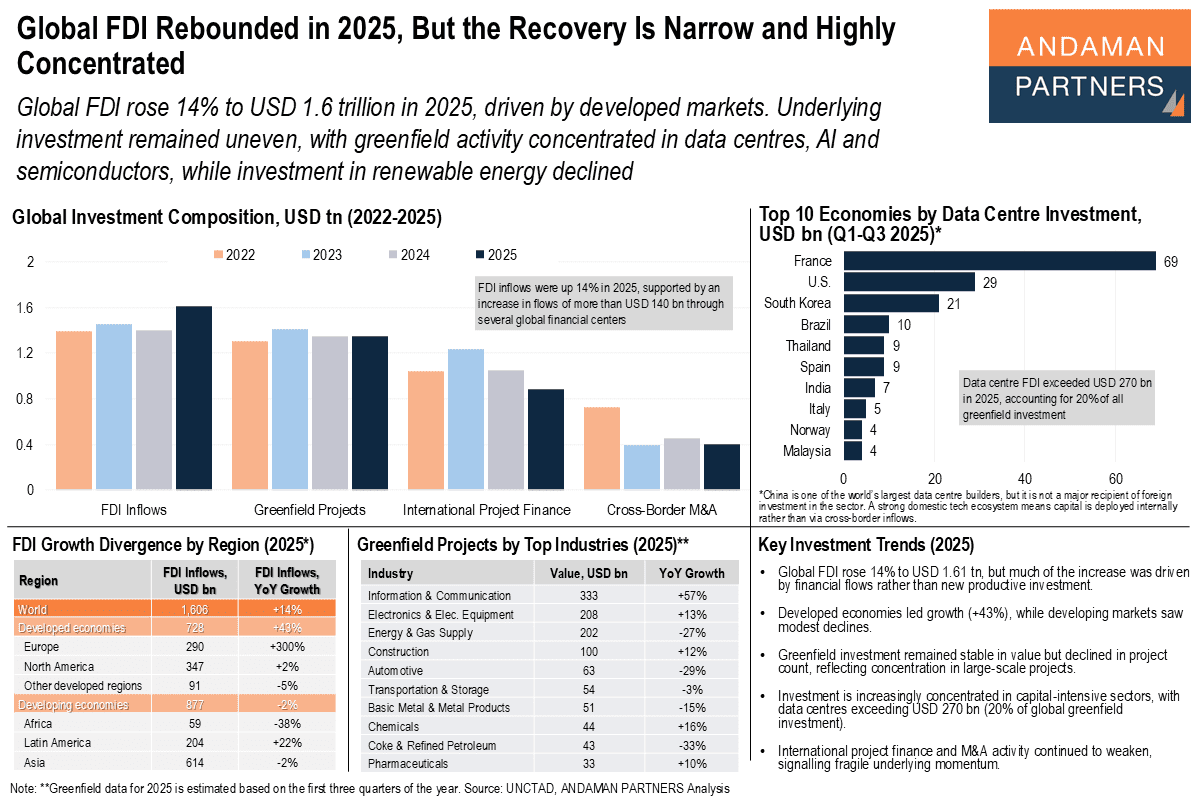
Global FDI rose 14% to USD 1.6 trillion in 2025, driven by developed markets. Underlying investment remained uneven, with greenfield activity concentrated in data centres, AI and semiconductors, while investment in renewable energy declined.
Global investment conditions improved in 2025, but the recovery was narrow, uneven and highly selective. Headline Foreign Direct Investment (FDI) rose by 14% to around USD 1.6 trillion, driven largely by developed markets and a surge in financial flows routed through major investment hubs. Beneath this rebound, however, underlying investment momentum remained fragile. Cross-border M&A and international project finance both declined, pointing to continued caution among corporates and financiers.
Greenfield investment held steady at around USD 1.35 trillion, but the number of projects fell, indicating a shift toward fewer, larger and more capital-intensive investments. This is a critical signal for business: global capital is not retreating, but it is becoming more concentrated and more selective. Investment is increasingly flowing into sectors tied to structural demand and long-term capacity build-out, particularly digital infrastructure, semiconductors and advanced manufacturing.
Data centres alone accounted for over USD 270 billion in investment in 2025, equivalent to more than one-fifth of global greenfield activity. China does not appear among the ten largest recipients of data centre FDI inflows in 2025 because although the country is one of the world’s largest data centre builders, it is not a major recipient of foreign investment in the sector. China’s strong domestic tech ecosystem means capital is deployed internally rather than via cross-border inflows.
Regional divergence in FDI flows widened in 2025. Developed economies led the FDI rebound, with strong growth in Europe, while developing markets saw more mixed outcomes and, in some cases, declining inflows. This suggests that access to capital, policy support and ecosystem depth are becoming more decisive in attracting large-scale investment.
In 2026, opportunities will not be evenly distributed. The most attractive markets will be those that combine scale, policy alignment and sectoral positioning in high-growth industries. For international businesses, success will depend less on broad geographic expansion and more on targeted positioning in specific sectors and locations where capital, technology and demand converge.
Also by ANDAMAN PARTNERS:
ANDAMAN PARTNERS supports international business ventures and growth. We help launch global initiatives and accelerate successful expansion across borders. If your business, operations or project requires cross-border support, contact connect@andamanpartners.com.

ANDAMAN PARTNERS Attended the Australia Governance Summit 2026 in Sydney
ANDAMAN PARTNERS Co-Founder Kobus van der Wath attended the Australia Governance Summit (AGS26) in Sydney, Australia.

ANDAMAN PARTNERS Wishes You a Happy and Prosperous Year of the Horse!
Compliments of the Chinese Lunar New Year to all our clients, customers, suppliers and partners.

ANDAMAN PARTNERS to Attend Investing in African Mining Indaba 2026 in Cape Town
ANDAMAN PARTNERS Co-Founders Kobus van der Wath and Rachel Wu will attend Investing in African Mining Indaba 2026 in Cape Town, South Africa.

China’s Trade Engine Accelerates in 2026 on Industrial Strength and Global Breadth
Broad-based growth across partners and sectors, led by machinery and transport equipment, signals renewed strength in China’s export engine.

Asia’s Growth Engines: Scale, Speed and Opportunity Across Regions
Asia’s scale, speed and integration are no longer concentrated in a single core, but spread across multiple, complementary engines.

China Extends Its Dominance in Global Shipbuilding as Output Surges in 2026
Even as global ship orders declined in 2025, early-2026 data shows a rapid rebound, with China securing the vast majority of new contracts.