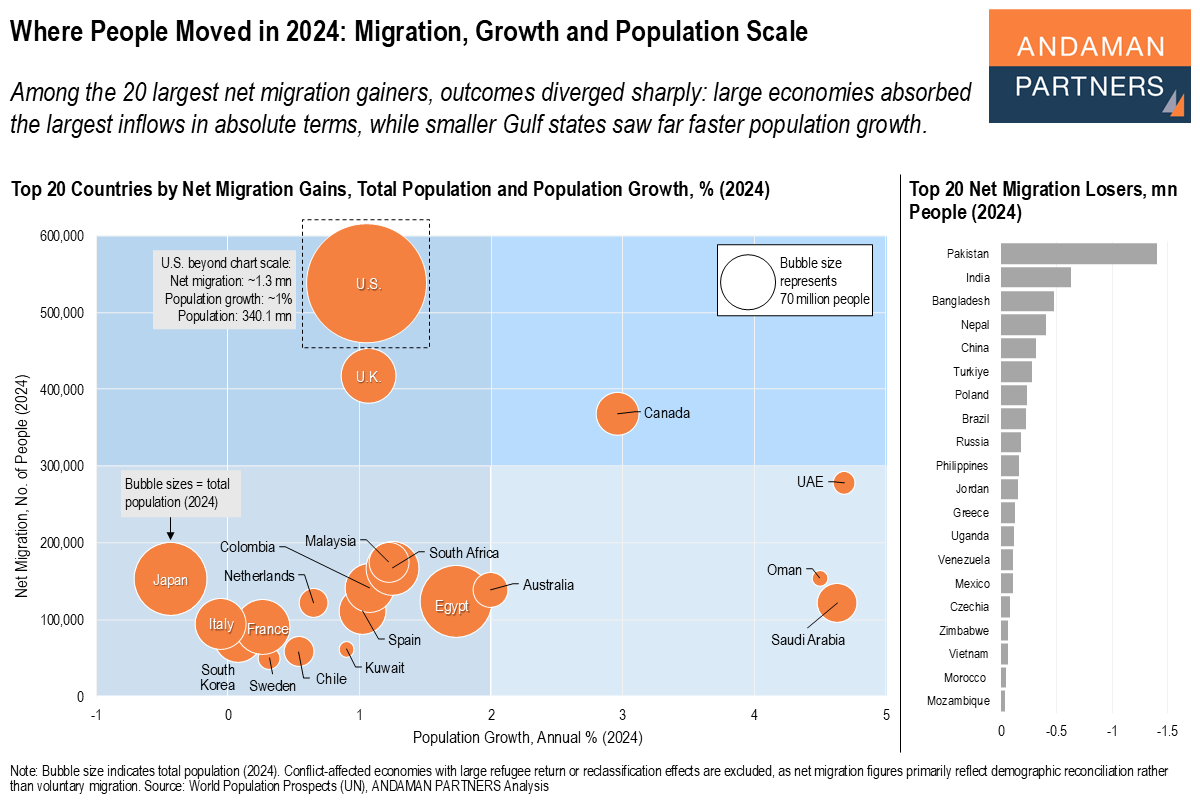
Migration is one of the most politically charged and closely watched issues in the world today, yet it is often discussed without a clear understanding of its demographic consequences. The data from 2024 tells a more nuanced story. Among the world’s 20 largest net migration gainers, migration reshaped population outcomes in markedly different ways depending on population size and underlying growth dynamics. When net migration, population growth rates and population scale are viewed together, they reveal not just where people moved, but how these movements altered national demographics.
At one end of the spectrum are large advanced economies. The U.S., U.K. and Canada absorbed the most significant numbers of migrants in absolute terms, reinforcing their position as major global destinations for labour, talent and opportunity. Yet their population growth rates remained relatively contained. In these countries, migration functioned primarily as a stabilising force, offsetting ageing populations, supporting labour supply and sustaining economic capacity rather than dramatically accelerating population growth.
Scale is decisive: inflows measured in the hundreds of thousands translate into incremental demographic change when spread across populations of tens or hundreds of millions.
A very different picture emerges in smaller, high-mobility economies, particularly in the Gulf. Countries such as the UAE, Saudi Arabia and Oman recorded far higher population growth rates despite receiving fewer migrants in absolute terms than the largest advanced economies. In these settings, migration is not marginal; it is transformative.
Labour inflows rapidly expand the population base, reshaping workforce composition, consumption demand and infrastructure requirements. The same net migration figure that barely registers in a large economy can materially alter demographics in a smaller one.
Between these poles lies a broad group of mid-sized economies across Europe, Asia, Africa and Latin America. Here, migration contributes meaningfully to population growth but operates alongside domestic demographic forces. Migration neither overwhelms natural increase nor disappears into the background; instead, it reflects a combination of economic opportunity, regional mobility and policy choices, producing more balanced demographic outcomes.
The top 20 net migration losers provide an essential counterpoint. The most significant net migration losses in 2024 were concentrated in a distinct set of countries, many of them large and populous economies in South and Southeast Asia, Eastern Europe and parts of Africa and Latin America.
These losses highlight the other side of global migration dynamics: labour-exporting economies where emigration remains a key mechanism for relieving demographic pressure, addressing income gaps or enabling limited job creation. Crucially, these losses are not simple inversions of the gains. Countries losing people occupy a structurally different role within global labour and population flows.
Absolute inflows, population growth rates and population scale each tell a different story. Taken together, they show where migration stabilises ageing societies, where it accelerates population expansion and where population loss remains embedded in economic structure.