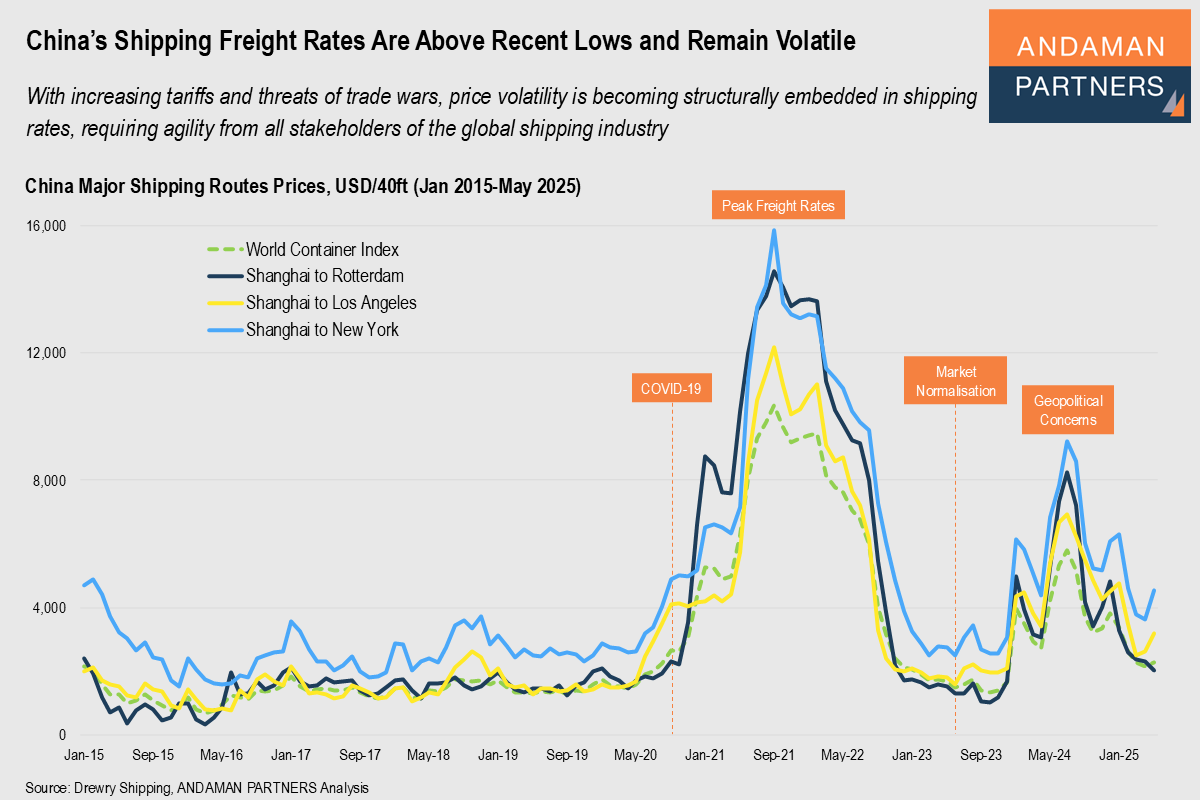
Shipping rates surged amid global disruptions from 2020 to 2021, declined sharply until early 2023, and in 2024-2025 remain volatile, subject to short-term shocks. With increasing tariffs and threats of trade wars, price volatility is becoming structurally embedded in shipping rates, requiring agility from all stakeholders of the global shipping industry.
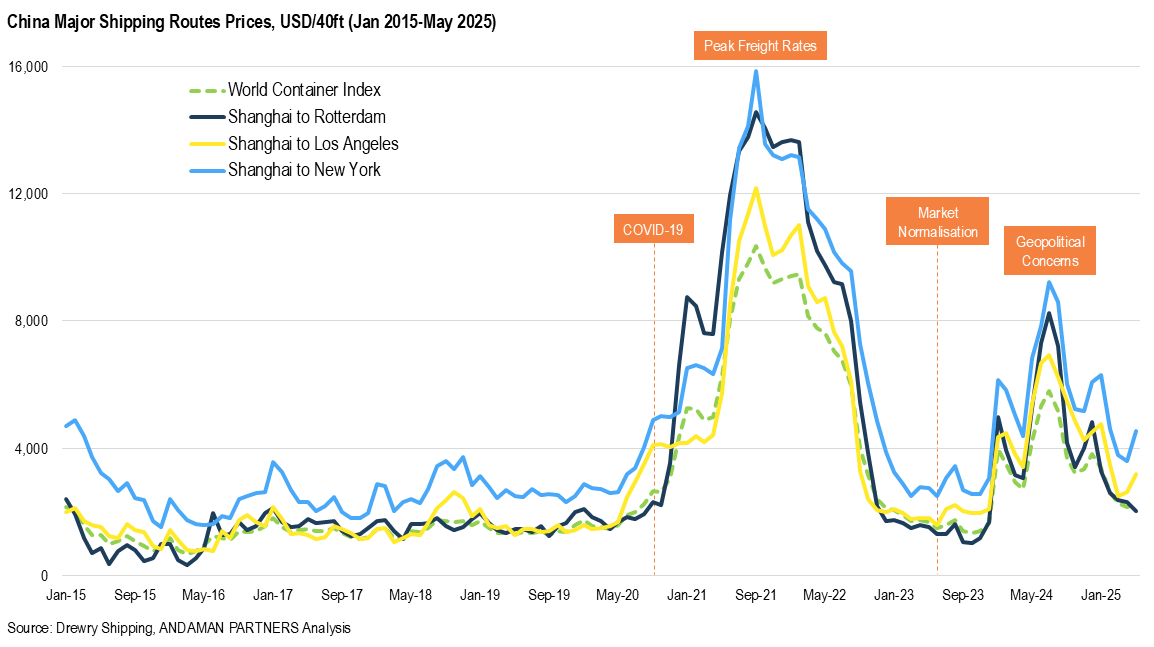
Amid global supply chain disruptions caused by the COVID-19 pandemic in 2020 and 2021, shipping freight rates rose sharply, with the Shanghai to New York route reaching a historical high of USD 16,138 in September 2021. Rates then began to decline as pandemic-related disruptions eased and congestion in logistics networks subsided.
Global trade stabilised in 2023, and shipping prices normalised to pre-pandemic levels.
In 2024, however, volatility returned due to multiple geopolitical concerns, including conflict in the Middle East and disruptions in key maritime routes, particularly the Red Sea.
The World Container Index (WCI) surged from USD 1,660 in December 2023 to a peak of USD 5,805 in July 2024 — an increase of nearly 250% in just seven months — before falling sharply to USD 2,629 by February 2025. The Shanghai-New York route increased from USD 3,074 to USD 9,213 over the same period.
From July 2024, shipping rates contracted again, primarily due to increased shipping capacity and declining demand. From September 2024 to February 2025, the WCI declined by over 50%.
As of May 2025, shipping rates remain above 2023 lows, indicating that underlying cost pressures and route inefficiencies, particularly those associated with longer transit times, have not yet fully eased.
As of May 2025, the WCI stood at USD 2,276, more than USD 600 above the low of USD 1,660 in December 2023, and the Shanghai to New York route stood at USD 4,537, which is more than USD 2,000 above the low of USD 2,494 in March 2023.
The outlook for China’s shipping rates for the remainder of 2025 is for a less volatile price environment than 2021-2023. However, rates are subject to changes amid short-term shocks. With increasing tariffs and threats of trade wars, price volatility is becoming structurally embedded amid ongoing geopolitical risks and evolving logistical strategies.
The current environment demands agility from all stakeholders, underscoring the need for careful long-term recalibration of global shipping capacity.
ANDAMAN PARTNERS supports international business ventures and growth. We help launch global initiatives and accelerate successful expansion across borders. If your business, operations or project requires cross-border support, contact connect@andamanpartners.com.

ANDAMAN PARTNERS Wishes You a Happy and Prosperous Year of the Horse!
Compliments of the Chinese Lunar New Year to all our clients, customers, suppliers and partners.

ANDAMAN PARTNERS to Attend Investing in African Mining Indaba 2026 in Cape Town
ANDAMAN PARTNERS Co-Founders Kobus van der Wath and Rachel Wu will attend Investing in African Mining Indaba 2026 in Cape Town, South Africa.

Join ANDAMAN PARTNERS at Networking Event in Cape Town Ahead of Mining Indaba 2026
ANDAMAN PARTNERS is pleased to support and sponsor this popular Pre-Indaba event in Cape Town.

China and the Global Critical Minerals and Battery Supply Chain Landscape
Upstream mineral supply is globally distributed, but China remains the dominant actor in the midstream and downstream battery ecosystem.

Central Asia’s Emerging Industrial Economy, Driven by Kazakhstan
Kazakhstan accounts for the region’s economic scale, while Uzbekistan and neighbouring economies are expanding manufacturing and trade.

South Asia’s Expanding Industrial Base, Anchored by India
India provides the region’s industrial scale and Bangladesh is driving the fastest export-led expansion.