Europe Still Anchors Global Chemical Trade
Europe Still Anchors Global Chemical Trade, While the U.S. and China Drive Gradual Rebalancing
Europe accounts for half of global chemical exports and more than a third of imports, but over the past two decades, structural change has lifted China on the supply side and the U.S. on the demand side.
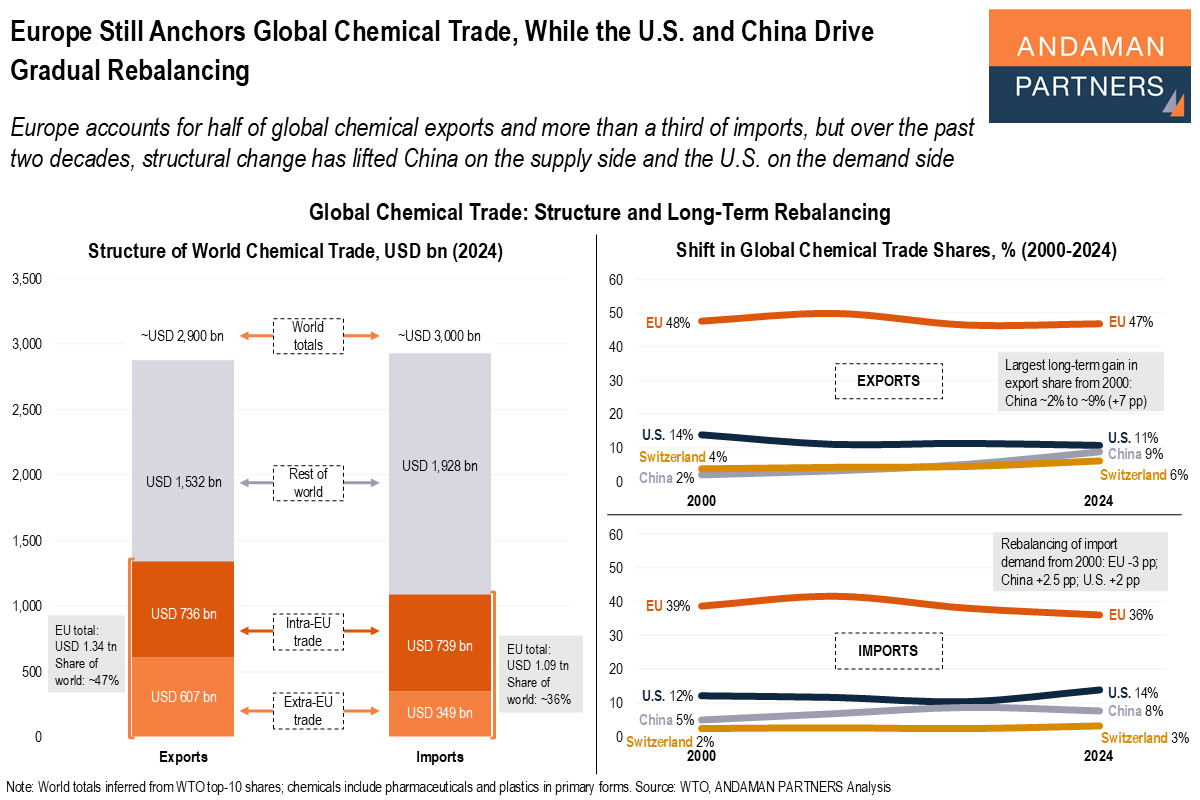
Global chemical trade in 2024 remains a structurally Europe-centred system, anchored by the depth and density of the EU’s internal market. Nearly half of global chemical exports and more than a third of global imports are still accounted for by Europe, and more than half of that activity continues to take place within the single market itself. This makes the EU not just the world’s largest trader, but also the core clearing house for global chemical production, processing and redistribution in a ~USD 3 trillion industry.
Beneath this stable core, however, the long-term rebalancing of the system is increasingly evident. On the supply side, China has delivered by far the most significant structural shift of any major exporter over the past two decades, lifting its global export share from around 2% in 2000 to almost 9% in 2024 as its petrochemical, materials and specialty chemical capacity has scaled rapidly. This reflects a fundamental expansion of China’s role from a marginal supplier to a central pillar of global chemical production.
On the demand side, the rebalancing is being driven primarily by the U.S. While Europe’s share of global imports has edged down gradually, the U.S. has steadily increased its weight as a centre of chemical consumption, reflecting the growing importance of advanced manufacturing, pharmaceuticals and high-value materials in the U.S. economy.
The result is a system that remains anchored in Europe but is quietly being reshaped by a rising Chinese supply base and a strengthening U.S. demand centre. For producers, investors and policymakers, this matters because it signals where future capacity, investment and pricing power are likely to concentrate in the next phase of the global chemical cycle.
Also by ANDAMAN PARTNERS:
ANDAMAN PARTNERS supports international business ventures and growth. We help launch global initiatives and accelerate successful expansion across borders. If your business, operations or project requires cross-border support, contact connect@andamanpartners.com.

How an Inland City Became One of China’s Top 5 Economies by ANDAMAN PARTNERS Co-Founder Rachel Wu
Analysis by ANDAMAN PARTNERS Co-Founder Rachel Wu on how Chongqing became one of China’s top 5 economies
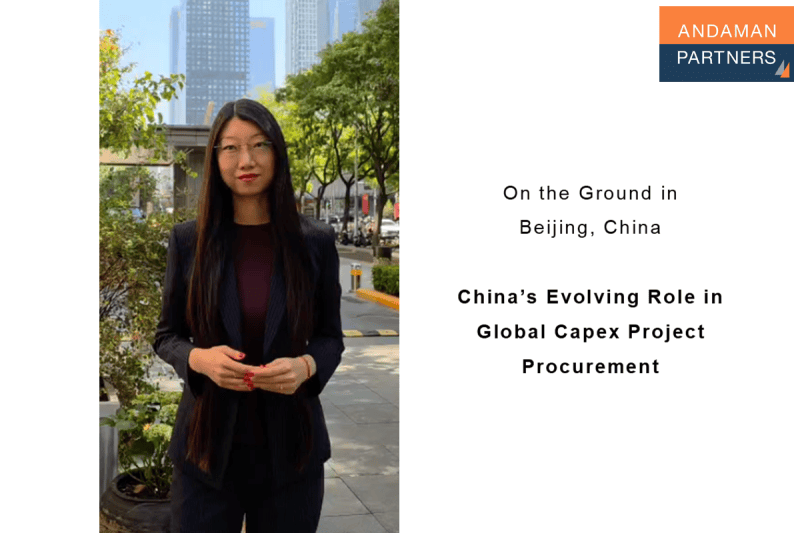
China’s Role in Global Capex Project Procurement by ANDAMAN PARTNERS Co-Founder Rachel Wu
Analysis by ANDAMAN PARTNERS Co-Founder Rachel Wu on how China’s role has evolved in global capex project procurement

ANDAMAN PARTNERS Co-Founder Rachel Wu to Deliver Talk at SEP Global Reunion 2026 in Shanghai, China
Rachel will deliver a talk at the event entitled ‘Two SEPers in the Family – Building in China for 20+ Years’
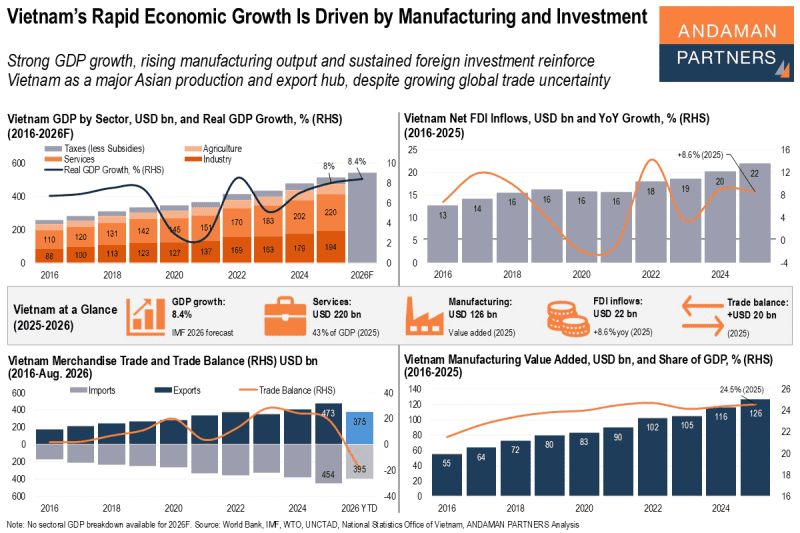
Vietnam’s Rapid Economic Growth Is Driven by Manufacturing and Investment
Strong GDP growth, rising manufacturing output and sustained foreign investment reinforce Vietnam as a major Asian hub
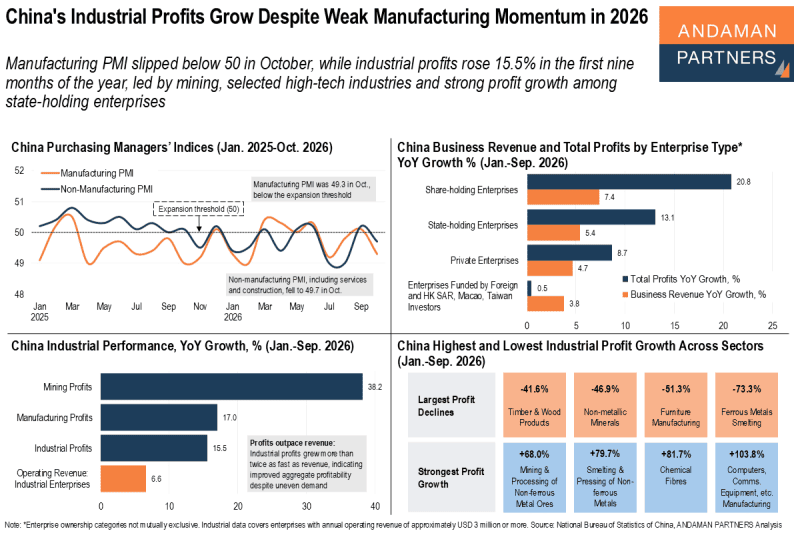
China’s Industrial Profits Grow Despite Weak Manufacturing Momentum in 2026
Manufacturing PMI slipped below 50 in October, while industrial profits rose 15.5% in the first nine months of the year
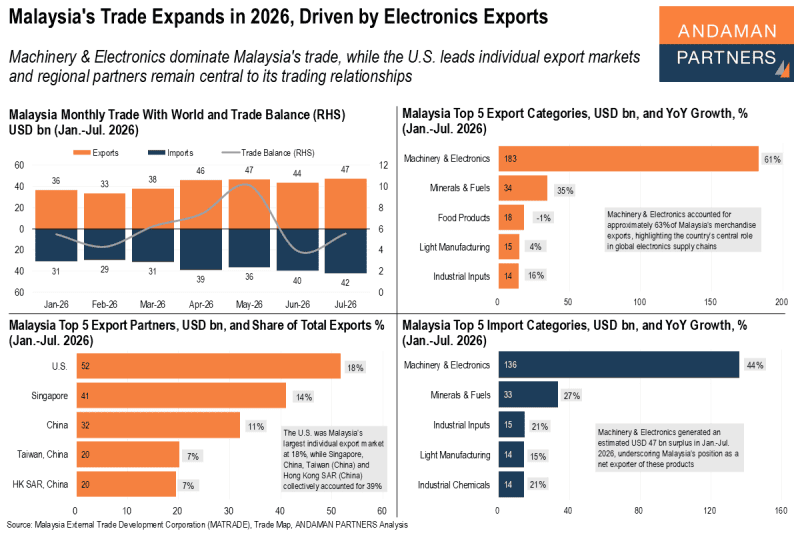
Malaysia’s Trade Expands in 2026, Driven by Electronics Exports
Machinery & Electronics dominate Malaysia’s trade, while the U.S. leads individual export markets