
China’s Import Momentum Moderates as Commodity Suppliers Gain Share
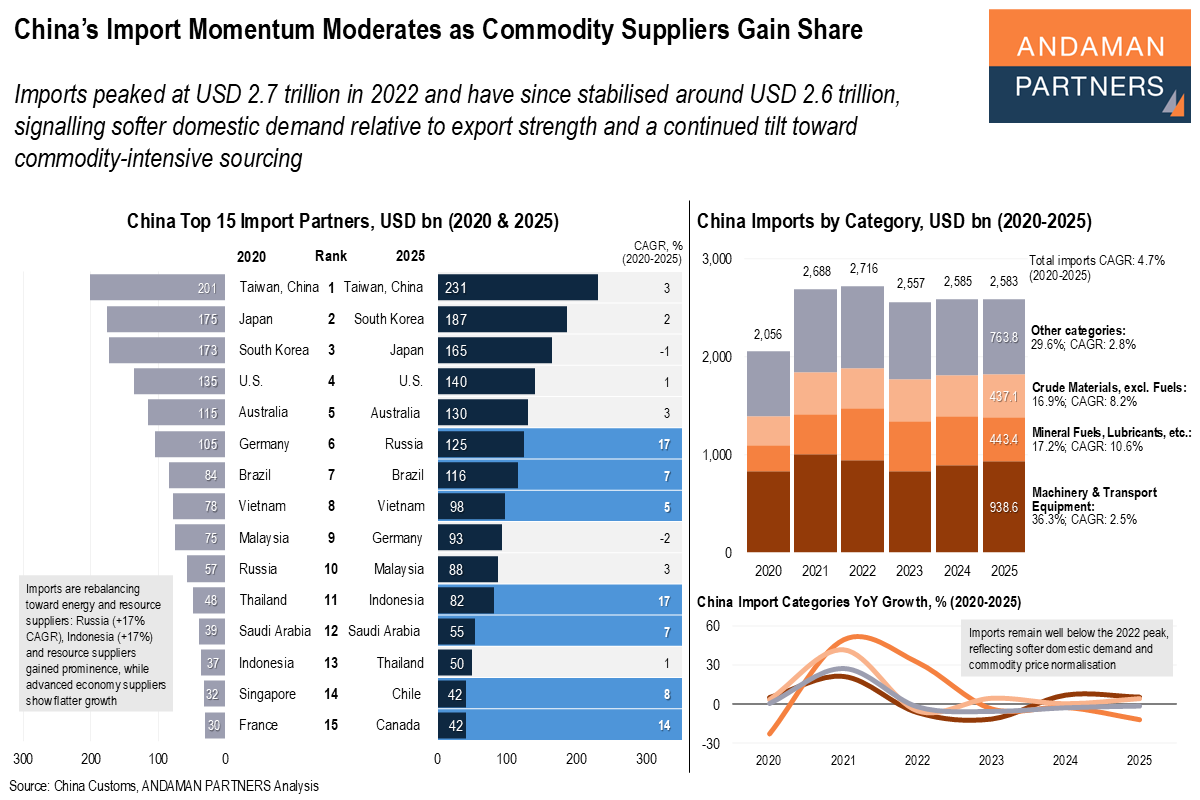
Imports peaked at USD 2.7 trillion in 2022 and have since stabilised around USD 2.6 trillion, signalling softer domestic demand relative to export strength and a continued tilt toward commodity-intensive sourcing.
China’s import cycle has been notably more subdued than its export trajectory. After rising sharply to a peak of USD 2.7 trillion in 2022, total imports have since stabilised around USD 2.6 trillion, ending 2025 at USD 2.58 trillion. The five-year CAGR of 4.7% trails export growth over the same period, underscoring more moderate domestic demand and the normalisation of global commodity prices following the post-pandemic surge. While imports remain structurally large, momentum has clearly softened relative to China’s external sales performance.
The composition of imports highlights a continued reliance on commodity and resource inputs. Mineral fuels and lubricants posted a robust 10.6% CAGR from 2020 to 2025, while crude materials expanded at 8.2%, outpacing machinery and transport equipment (2.5%). This divergence suggests that energy security and raw material supply have remained strategic priorities, even as broader industrial import demand has grown more selectively.
The partner breakdown reinforces this trend. Russia and Indonesia recorded the fastest growth among major suppliers from 2020 to 2025 (both with a +17% CAGR), rising in the rankings as energy and resource trade deepened. Australia and Saudi Arabia remain core commodity providers, while Brazil also strengthened its position. By contrast, imports from advanced manufacturing economies such as Germany and Japan have been comparatively flat or declining. Taiwan (China) and South Korea continue to anchor high-value industrial supply chains, but the incremental shift in sourcing has favoured resource-rich economies.
Taken together, the data point to a stabilised import base shaped by commodity resilience and measured domestic demand; a dynamic that helps explain the widening gap between China’s export momentum and import growth in recent years.
Also by ANDAMAN PARTNERS:
ANDAMAN PARTNERS supports international business ventures and growth. We help launch global initiatives and accelerate successful expansion across borders. If your business, operations or project requires cross-border support, contact connect@andamanpartners.com.

ANDAMAN PARTNERS Attended the Australia Governance Summit 2026 in Sydney
ANDAMAN PARTNERS Co-Founder Kobus van der Wath attended the Australia Governance Summit (AGS26) in Sydney, Australia.

ANDAMAN PARTNERS Wishes You a Happy and Prosperous Year of the Horse!
Compliments of the Chinese Lunar New Year to all our clients, customers, suppliers and partners.

ANDAMAN PARTNERS to Attend Investing in African Mining Indaba 2026 in Cape Town
ANDAMAN PARTNERS Co-Founders Kobus van der Wath and Rachel Wu will attend Investing in African Mining Indaba 2026 in Cape Town, South Africa.

China Navigator – Q3 2026
ANDAMAN PARTNERS outlines and unpacks some of the broad shifts and fine intricacies of China’s economic development and transition.

China Provincial Growth Map H1 2026: East-West Growth Corridor From Tibet to Zhejiang
H1 2026 growth is strongest across a broad central corridor stretching from Tibet in the west to the eastern seaboard

Africa’s Export Growth Accelerates as China’s Role Continues to Expand
Africa’s exports reached a new high in 2025, but the export base remains highly concentrated, and China has become the largest single destination