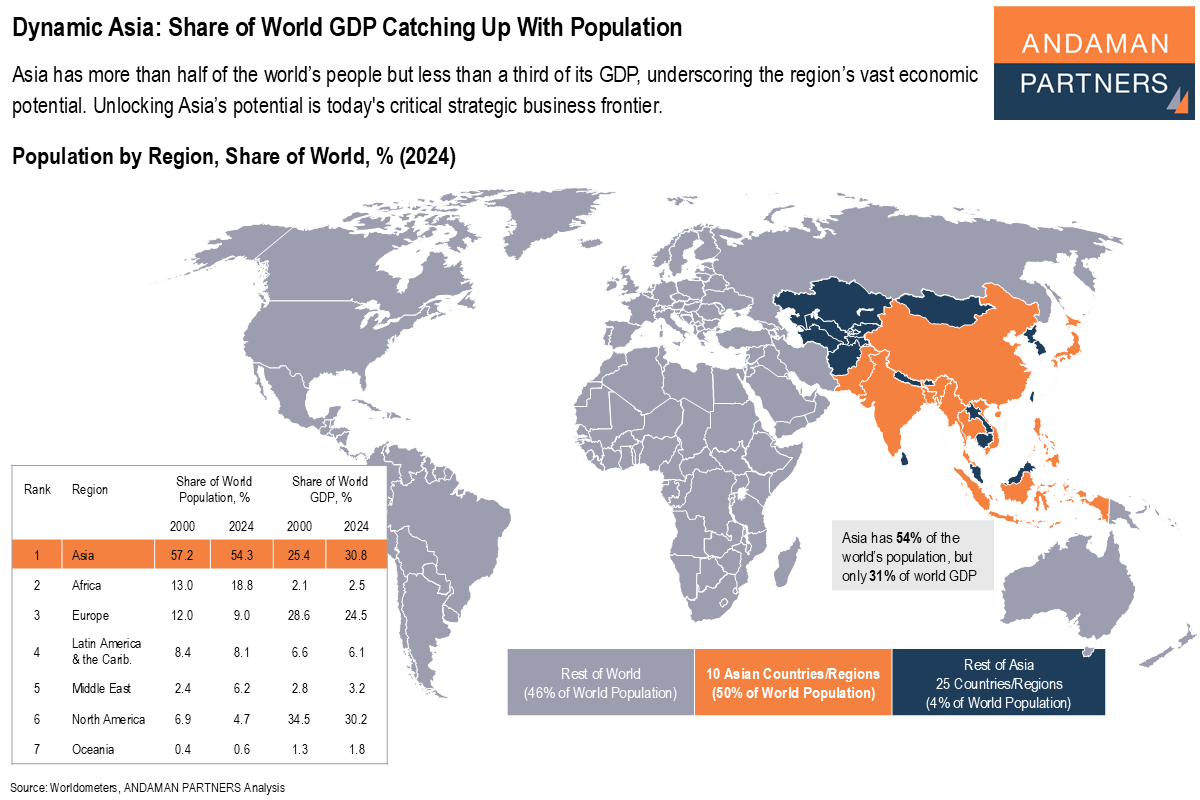

Asia has more than half of the world’s people but less than a third of its GDP, underscoring the region’s vast economic potential. Unlocking Asia’s potential is today’s critical strategic business frontier.
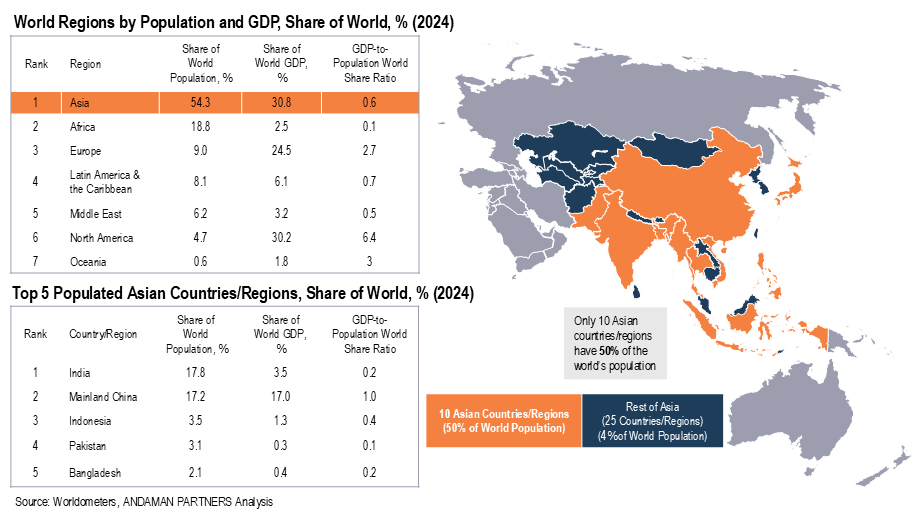
A regional comparison of world population and GDP in 2024 reveals some distinctive features:
- Asia accounts for 54% of the world’s population, yet only 31% of its GDP. Only ten Asian countries/regions account for half the world’s population, but only 29% of the world’s GDP.
- India and Mainland China combined represent more than a third of humanity; in terms of GDP, the two countries account for only 20.5%, with Mainland China contributing 17%.
- Conversely, Europe has 9% of the world’s population and North America has less than 5%, but they account for 24.5% and 30.2% of the world’s GDP, respectively.
By looking back to 2000 and projecting into the future beyond 2024, we can observe some clear historical trends that are of vital importance to companies and investors operating in the world of today:
- From 2000 to 2024, Asia’s share of the world’s population decreased slightly from 57.2% to 54.3%, due primarily to declining population growth in several Asian countries (e.g., China, South Korea, Japan). Africa (13% to 18.8%) and the Middle East (2.4% to 6.2%) were the only regions whose share of the world’s population increased significantly.
- From 2000 to 2024, Asia’s share of the world’s GDP increased from 25.4% to 30.8%, the only region whose share increased significantly. Both Africa and the Middle East’s share of world GDP increased by only 0.4% to 2.5% and 3.2%, respectively, while the share of Europe, North America and Latin America all declined.
- From the current vantage point, if faster-than-global growth persists for the next few decades in large Asian economies (e.g., India, Indonesia, ASEAN) and the region’s population growth continues to decline, Asia’s share of the world’s GDP could catch up with its share of the world’s population by around 2055-2065.
The Asian Century (and Opportunity)
The coming equalisation of Asia’s share of the world population and GDP will be a profound global development with immense implications for the world economy. Over the next few decades, economic power will be massively redistributed to Asia, the world’s most dynamic region, radically transforming trade routes, capital flows, markets and political influence.
Unlocking Asia’s potential is today’s critical strategic business frontier, and it is imperative to shift capital investments to Asia and build deeper trade relationships in the region. Investors and companies worldwide must confront the reality that the global economy is gradually but inexorably shifting towards Asia and take the appropriate actions to turn this reality into a business opportunity.
ANDAMAN PARTNERS supports international business ventures and growth. We help launch global initiatives and accelerate successful expansion across borders. If your business, operations or project requires cross-border support, contact connect@andamanpartners.com.

Join ANDAMAN PARTNERS at Networking Event in Cape Town Ahead of Mining Indaba 2026
ANDAMAN PARTNERS is pleased to support and sponsor this popular Pre-Indaba event in Cape Town.

AAMEG Event in Cape Town Ahead of Mining Indaba 2026
ANDAMAN PARTNERS is pleased to sponsor and support the AAMEG pre-Mining Indaba Cocktails & Canapes event.

AAMEG & ACBSA Event in Johannesburg Ahead of Mining Indaba 2026
ANDAMAN PARTNERS is pleased to sponsor and support the AAMEG & ABCSA pre-Mining Indaba Connections & Canapes event.

The Long Shift in Global Trade Since 1948 and China’s Rise
Since 1948, global merchandise trade has shifted decisively away from the Atlantic economies toward Asia.

Where People Moved in 2024: Migration, Growth and Population Scale
Among the 20 largest net migration gainers, outcomes diverged sharply: large economies absorbed the largest inflows; smaller Gulf states saw far faster growth.

Europe Is a Stable Pillar of China’s Export Demand
Europe’s scale and diversified demand make it a stabilising force in China’s export landscape, with steady export growth over the past decade.