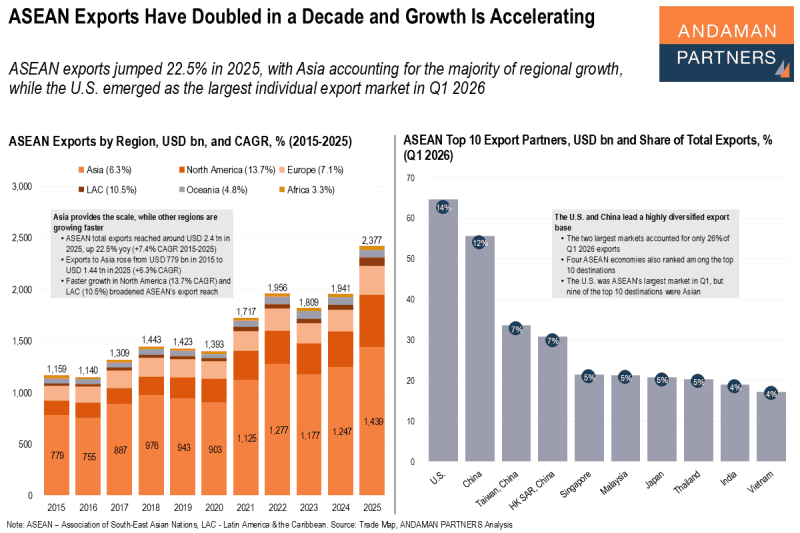
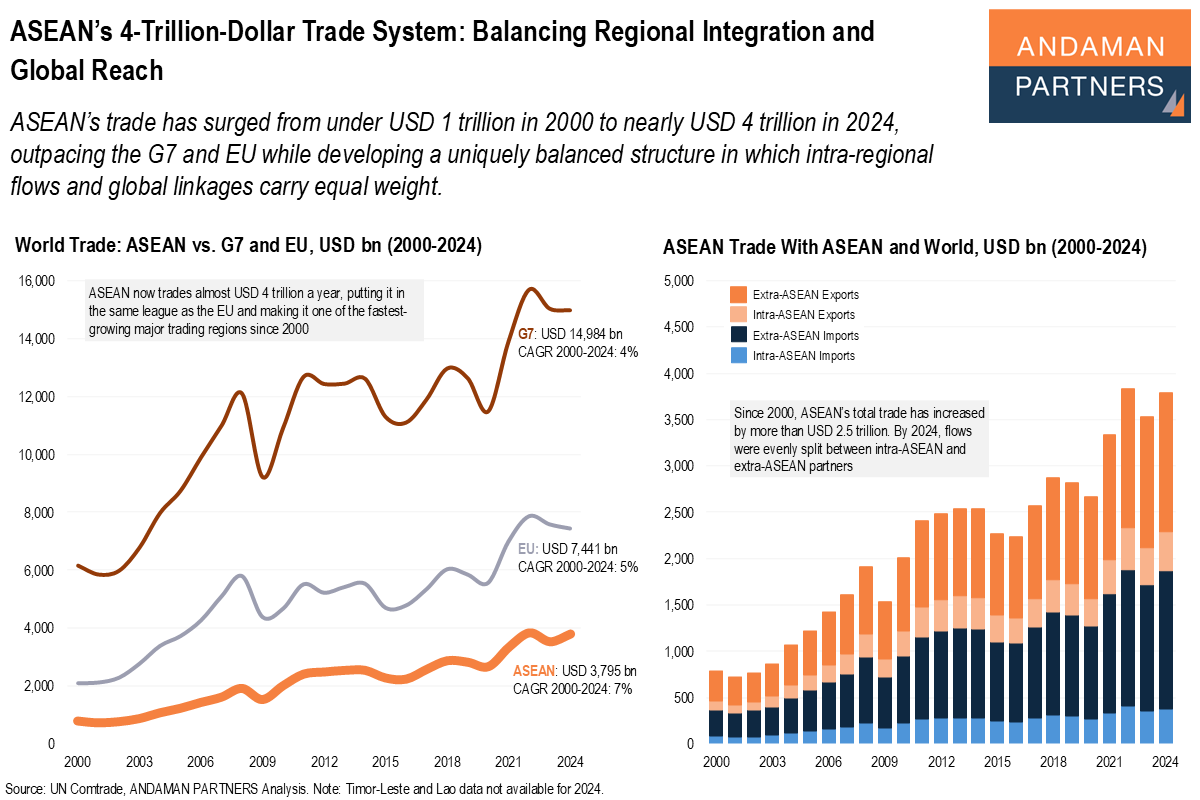
ASEAN’s trade has surged from under USD 1 trillion in 2000 to nearly USD 4 trillion in 2024, outpacing the G7 and EU while developing a uniquely balanced structure in which intra-regional flows and global linkages carry equal weight.
Over the past 24 years, ASEAN has transformed, quietly but decisively, into one of the world’s largest and most dynamic trade systems. With trade expanding from under USD 1 trillion in 2000 to nearly USD 4 trillion in 2024, ASEAN now operates in the same league as major economic blocs such as the EU and the G7 advanced economies. ASEAN’s trade grew at a 7% CAGR over 2000-2024, outpacing the 4-5% growth of the G7 and the EU.
ASEAN is no longer a peripheral growth story; it is a core node in global trade infrastructure. This is not just a matter of size; it is a signal that ASEAN has matured into a comprehensive commercial platform with both regional depth and global reach.
ASEAN’s trade is roughly evenly split between intra-regional flows and extra-ASEAN trade. Since 2000, the bloc has added over USD 2.5 trillion in trade, with internal and external flows rising in tandem. This dual-engine, regional integration plus global linkages, offers both resilience and versatility. Supply-chain disruptions abroad, shifting global demand, or geopolitical turbulence—ASEAN is resilient because it doesn’t depend solely on a single market axis.
ASEAN’s structural evolution is deeply strategic: the bloc is fast cementing its role as a global conduit between East and West, an attractive proposition in an era of fragmented value chains and shifting trade alliances. Robust intraregional flows mean companies can source, assemble and distribute within ASEAN cheaply; strong external flows give access to high-demand markets globally.
For CEOs, investors and strategic planners, this combination of scale, growth and structural balance signifies that ASEAN is no longer just a growing emerging market; it is now a mature, comprehensive trading system. It offers a stable platform for manufacturing, regional distribution and global export.
Also by ANDAMAN PARTNERS:
ANDAMAN PARTNERS supports international business ventures and growth. We help launch global initiatives and accelerate successful expansion across borders. If your business, operations or project requires cross-border support, contact connect@andamanpartners.com.

ANDAMAN PARTNERS Attended the Australia Governance Summit 2026 in Sydney
ANDAMAN PARTNERS Co-Founder Kobus van der Wath attended the Australia Governance Summit (AGS26) in Sydney, Australia.
ANDAMAN PARTNERS Wishes You a Happy and Prosperous Year of the Horse!
Compliments of the Chinese Lunar New Year to all our clients, customers, suppliers and partners.

ANDAMAN PARTNERS to Attend Investing in African Mining Indaba 2026 in Cape Town
ANDAMAN PARTNERS Co-Founders Kobus van der Wath and Rachel Wu will attend Investing in African Mining Indaba 2026 in Cape Town, South Africa.

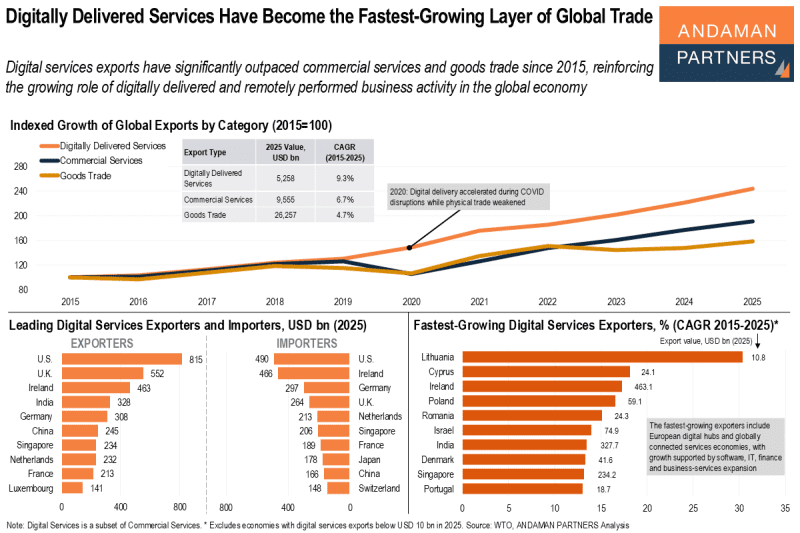
Global Services Trade Is Shifting Decisively Toward Digital Delivery
Digitally delivered services now account for more than half of global services exports, outpacing traditional sectors and reshaping the structure of trade.

China Q1 2026 Trade Profile: Exports At Scale, Imports More Volatile
Machinery dominated exports and imports, reflecting China’s role across the electronics value chain; gold and high-value inputs drove import swings.

Global Data Centre Infrastructure Is Highly Concentrated, With Africa Largely Absent and Asia Uneven
The U.S. and Europe dominate global data centre infrastructure, while Asia’s footprint is concentrated in a few hubs