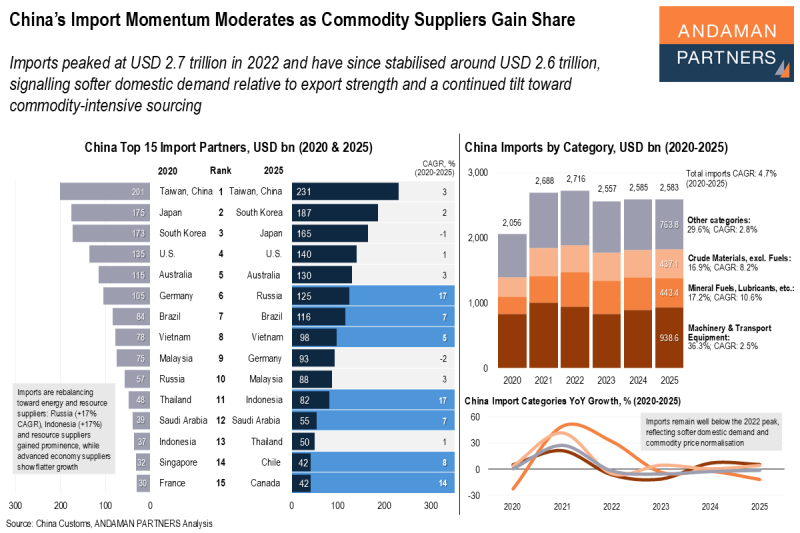
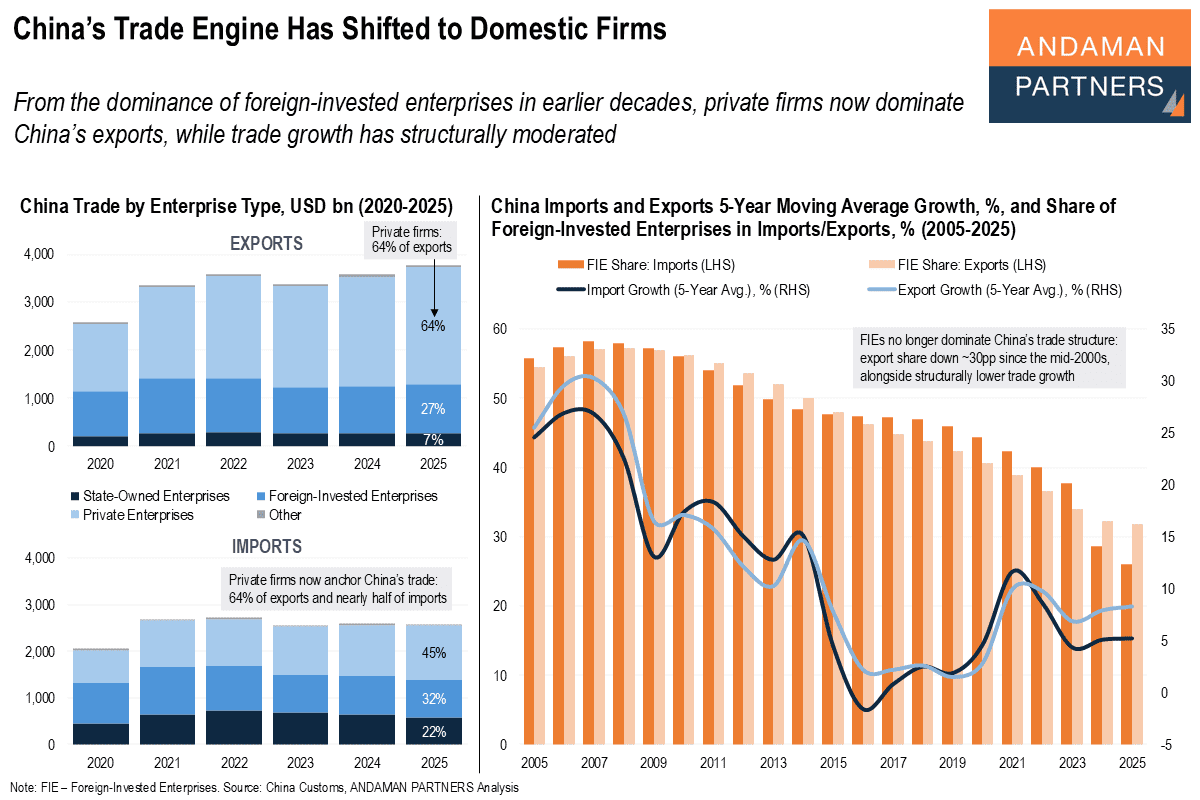
From the dominance of foreign-invested enterprises in earlier decades, private firms now dominate China’s exports, while trade growth has structurally moderated.
China’s trade structure has undergone a fundamental shift over the past two decades. In the mid-2000s, foreign-invested enterprises (FIEs) dominated both exports and imports, accounting for over half of total trade. Today, their role has declined markedly: FIE export share has fallen by roughly 30 percentage points, alongside a clear moderation in trade growth.
In their place, private domestic firms have emerged as the core of China’s export engine. By 2025, they accounted for around 64% of exports and nearly half of imports, far exceeding both FIEs and state-owned enterprises. This marks a structural reorientation from an externally anchored, FIE-led model to a domestically-driven one.
The implication is significant: China’s trade is now less dependent on foreign firms and global production networks, and it is operating in a lower-growth environment, reflecting a more mature and internally anchored economic model.
Also by ANDAMAN PARTNERS:
ANDAMAN PARTNERS supports international business ventures and growth. We help launch global initiatives and accelerate successful expansion across borders. If your business, operations or project requires cross-border support, contact connect@andamanpartners.com.

ANDAMAN PARTNERS Attended the Australia Governance Summit 2026 in Sydney
ANDAMAN PARTNERS Co-Founder Kobus van der Wath attended the Australia Governance Summit (AGS26) in Sydney, Australia.
ANDAMAN PARTNERS Wishes You a Happy and Prosperous Year of the Horse!
Compliments of the Chinese Lunar New Year to all our clients, customers, suppliers and partners.

ANDAMAN PARTNERS to Attend Investing in African Mining Indaba 2026 in Cape Town
ANDAMAN PARTNERS Co-Founders Kobus van der Wath and Rachel Wu will attend Investing in African Mining Indaba 2026 in Cape Town, South Africa.

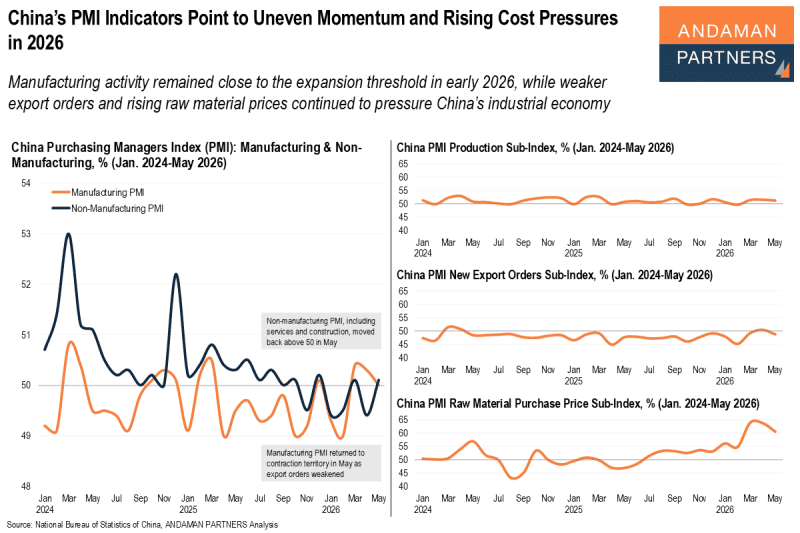
China’s PMI Indicators Point to Uneven Momentum and Rising Cost Pressures in 2026
Manufacturing activity remained close to expansion in early 2026, while weaker export orders and raw material prices pressure the economy

Africa’s Industrial Leaders and Rising Manufacturing Economies
Morocco, South Africa and Egypt remain Africa’s leading industrial economies; DRC, Djibouti and Gabon recorded the largest gains in competitiveness

Africa’s Trade Is Shifting Increasingly Toward China
China’s share of Africa’s trade has expanded sharply since 2001, with imports from China now matching Europe’s share