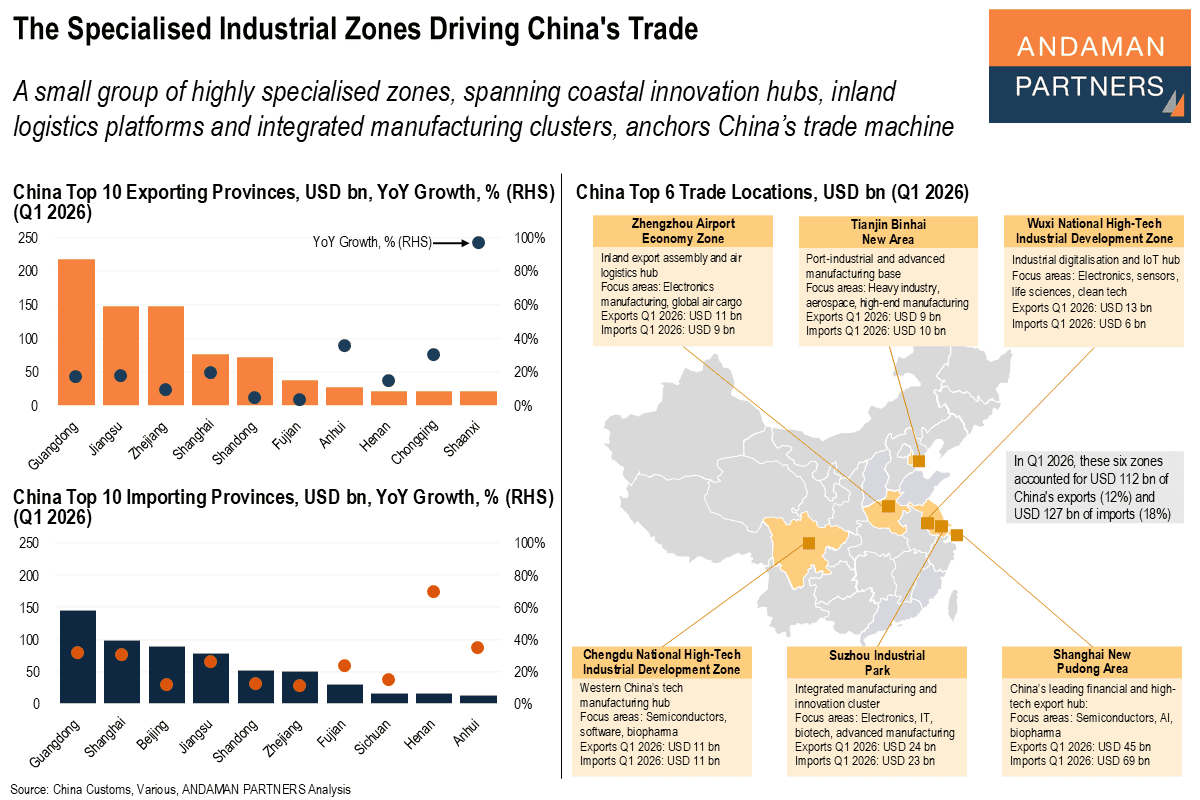
A small group of highly specialised zones, spanning coastal innovation hubs, inland logistics platforms and integrated manufacturing clusters, anchors China’s trade machine.
China’s economic rise has long been anchored in its system of special economic zones (SEZs): controlled environments where policy, infrastructure and global capital are tightly aligned. From the earliest coastal SEZs to today’s advanced industrial platforms, these zones have acted as testing grounds for reform and as engines of export-led growth, concentrating production, logistics and innovation into highly efficient clusters.
This structure is clearly visible in current trade data. In Q1 2026, China’s exports remained heavily concentrated in coastal provinces, led by Guangdong (USD 220 billion), followed by Jiangsu and Zhejiang (both around USD 145 billion), with Shanghai also a major contributor. On the import side, Guangdong again leads (USD 145 billion), alongside Shanghai (USD 100 billion) and Beijing (USD 90 billion), reflecting both industrial demand and the role of major ports and commercial centres. However, provincial data masks a deeper reality: trade is not evenly distributed within regions but is concentrated in specific high-performance zones.
China Customs identifies more than 180 such zones across the country, spanning SEZs, Economic and Technological Development Zones (ETDZs), High and New Technology Industrial Development Zones (HNTIDZs) and integrated experimental areas. Among these, a small group stands out for scale and strategic importance.
- Shanghai Pudong New Area remains China’s leading financial and high-tech export platform, recording USD 45 billion in exports and USD 69 billion in imports.
- Suzhou Industrial Park, a model of integrated manufacturing and innovation, contributed USD 24 billion in exports and USD 23 billion in imports.
- Wuxi National High-Tech Industrial Development Zone, a key industrial digitalisation hub, recorded USD 13 billion in exports and USD 6 billion in imports.
- Zhengzhou Airport Economy Zone, central to electronics assembly and air logistics, exported USD 11 billion and imported USD 9 billion.
- Chengdu’s high-tech zone, anchoring western China’s tech manufacturing, recorded USD 11 billion in both exports and imports.
- Finally, Tianjin Binhai New Area, northern China’s core port-industrial base, exported USD 9 billion and imported USD 10 billion.
Together, these six zones accounted for USD 112 billion of China’s total exports in Q1 2026, a share of 12%, and USD 127 billion of imports (18%). The outsized contribution of these six zones underlines how China’s trade is ultimately organised around a network of specialised, high-performance industrial zoness.
Also by ANDAMAN PARTNERS:
ANDAMAN PARTNERS supports international business ventures and growth. We help launch global initiatives and accelerate successful expansion across borders. If your business, operations or project requires cross-border support, contact connect@andamanpartners.com.

ANDAMAN PARTNERS Attended the Australia Governance Summit 2026 in Sydney
ANDAMAN PARTNERS Co-Founder Kobus van der Wath attended the Australia Governance Summit (AGS26) in Sydney, Australia.

ANDAMAN PARTNERS Wishes You a Happy and Prosperous Year of the Horse!
Compliments of the Chinese Lunar New Year to all our clients, customers, suppliers and partners.

ANDAMAN PARTNERS to Attend Investing in African Mining Indaba 2026 in Cape Town
ANDAMAN PARTNERS Co-Founders Kobus van der Wath and Rachel Wu will attend Investing in African Mining Indaba 2026 in Cape Town, South Africa.

The Specialised Industrial Zones Driving China’s Trade
A small group of highly specialised zones anchors China’s trade machine.

Half of Global E-Commerce Flows Through China
E-commerce growth is global, but scale is overwhelmingly concentrated in China.

Asia’s Tech Hubs: Innovation Depth and Startup Scale
Asia’s tech landscape is anchored by a handful of full-stack hubs in China, Japan and South Korea, while India and Singapore drive startup expansion.