
The Fastest-Growing Layer of Global Trade
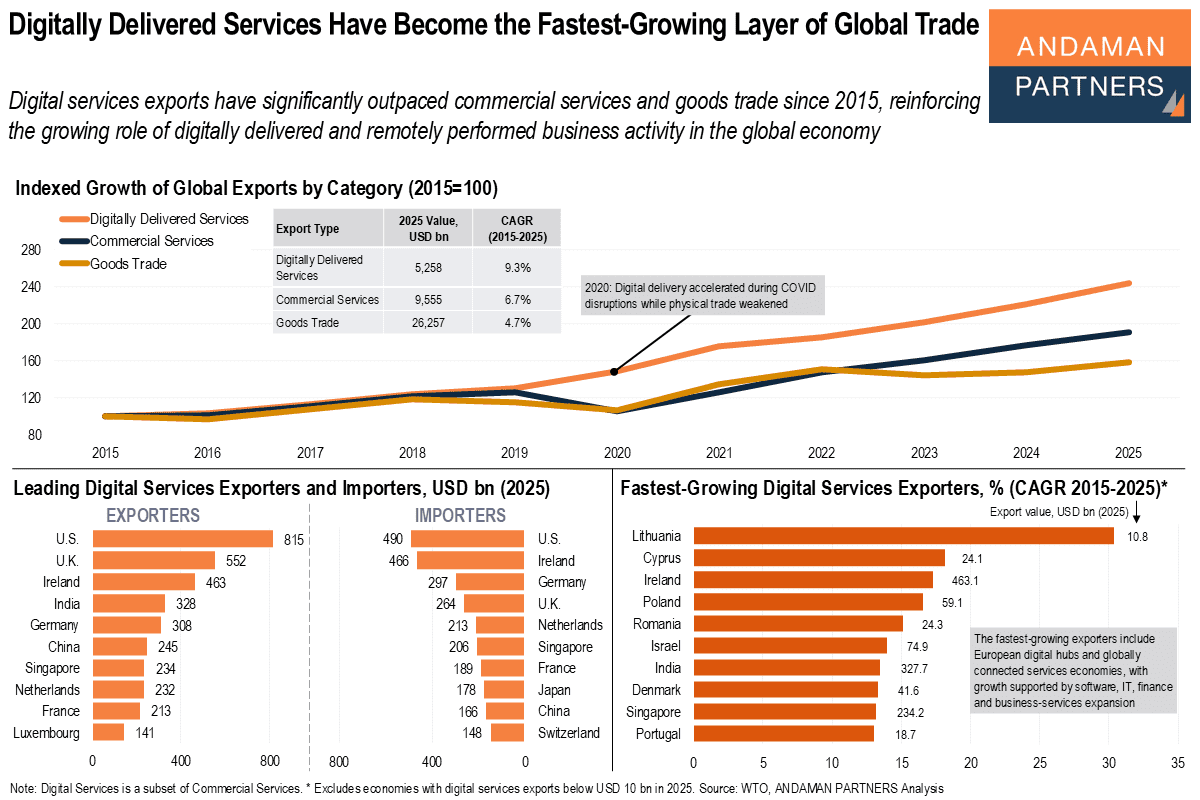
Digital services exports have significantly outpaced commercial services and goods trade since 2015, reinforcing the growing role of digitally delivered and remotely performed business activity in the global economy.
Digitally delivered services are now one of the most important structural shifts in global trade. Unlike physical goods trade, these services, which are a subset of commercial services, can be delivered remotely across borders through digital networks, covering activities such as software, IT services, finance, consulting, engineering, design, media and business-process outsourcing. As economies become more data- and technology-intensive, these services are increasingly central to competitiveness, productivity and value creation.
Global digital services exports reached USD 5.3 trillion in 2025, expanding at a CAGR of 9.3% since 2015, significantly faster than both broader commercial services trade (6.7%) and goods trade (4.7%). The COVID period marked a major acceleration point, reinforcing the resilience and scalability of digitally delivered activity while physical trade faced disruption.
The market remains concentrated among a relatively small group of leading economies. The U.S. dominates both exports and imports, reflecting its position in software, platforms, IP and global technology services. The U.K., Ireland, Germany and India are also major players, though for different reasons: Ireland functions as a major multinational digital and IP hub, while India continues to scale as a globally competitive IT and business-services powerhouse. Singapore and the Netherlands increasingly serve as digitally connected trade and services gateways.
At the same time, a second tier of economies is rapidly emerging. Lithuania, Poland, Portugal, Romania and Cyprus highlight Europe’s growing digital-services footprint, while Israel, India and Singapore continue to deepen globally competitive technology and business-services ecosystems.
Trade growth is increasingly shifting toward digitally deliverable activity, meaning competitiveness is becoming less dependent on physical scale alone and more tied to digital capability, skilled talent, data infrastructure and integration into global technology and services networks.
Also by ANDAMAN PARTNERS:
ANDAMAN PARTNERS supports international business ventures and growth. We help launch global initiatives and accelerate successful expansion across borders. If your business, operations or project requires cross-border support, contact connect@andamanpartners.com.

ANDAMAN PARTNERS Attended the Australia Governance Summit 2026 in Sydney
ANDAMAN PARTNERS Co-Founder Kobus van der Wath attended the Australia Governance Summit (AGS26) in Sydney, Australia.
ANDAMAN PARTNERS Wishes You a Happy and Prosperous Year of the Horse!
Compliments of the Chinese Lunar New Year to all our clients, customers, suppliers and partners.

ANDAMAN PARTNERS to Attend Investing in African Mining Indaba 2026 in Cape Town
ANDAMAN PARTNERS Co-Founders Kobus van der Wath and Rachel Wu will attend Investing in African Mining Indaba 2026 in Cape Town, South Africa.

ASEAN’s Expanding Export Base, Driven by Electronics and Resources
Exports have doubled over the past decade as electronics manufacturing hubs and resource-exporting economies drive ASEAN’s trade expansion.

China Q1 2026 Trade Profile. China’s Imports Hit Record Levels in Early 2026, Led by Tech and Industrial Inputs
Rising imports of semiconductors, energy and industrial inputs point to renewed industrial activity.

GCC Trade Expansion Is Increasingly Supported by Diversified Regional Demand
Strong export performance, sustained import growth and diversified demand across the GCC have raised the region’s strategic importance.