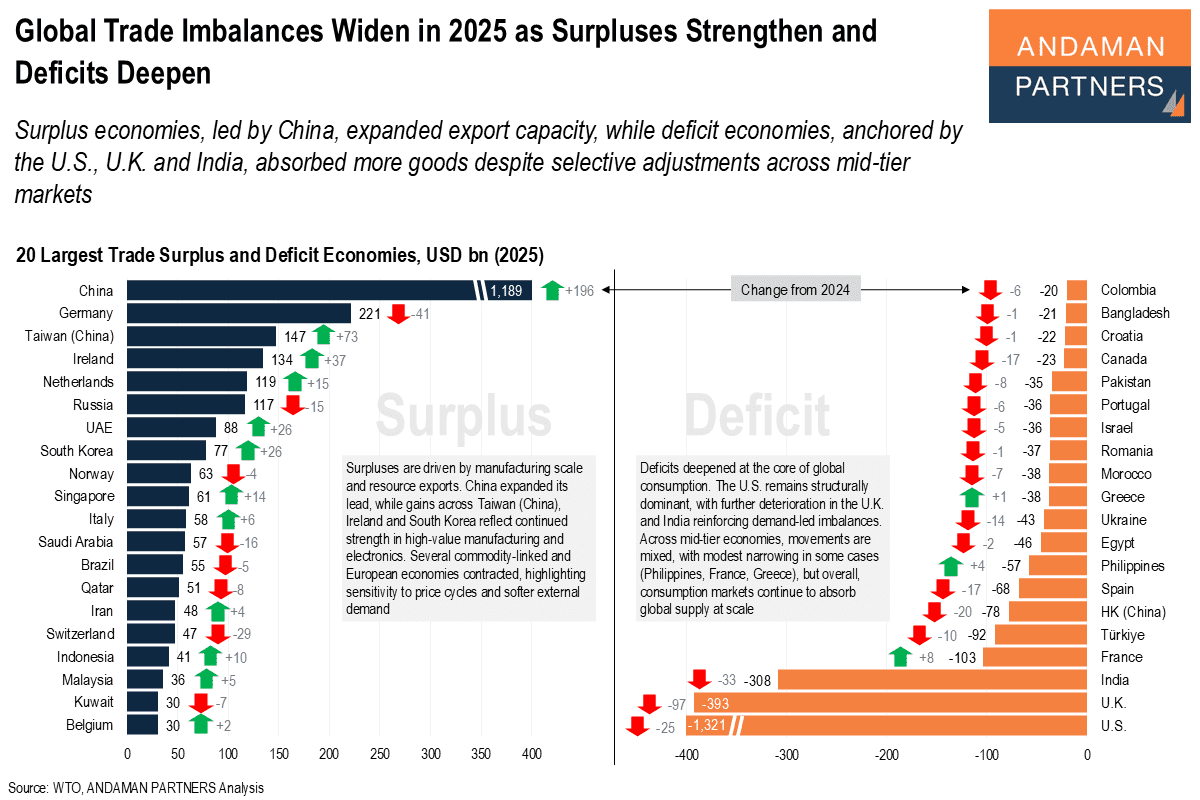

Surplus economies, led by China, expanded export capacity, while deficit economies, anchored by the U.S., U.K. and India, absorbed more goods despite selective adjustments across mid-tier markets.
Global trade imbalances widened further in 2025, reinforcing a system split between export-driven surplus economies and consumption-led deficit markets. China expanded its lead to USD 1.19 trillion (+USD 196 billion vs 2024), with additional gains across Taiwan (China), Ireland and South Korea, underscoring continued strength in high-value manufacturing and electronics.
At the same time, several commodity-linked and European economies, such as Russia, Norway and Brazil, saw surpluses contract, reflecting sensitivity to price cycles and softer external demand.
On the deficit side, the U.S. remains structurally dominant at -USD 1.32 trillion, with further deterioration in the U.K. and India reinforcing demand-led imbalances. While some mid-tier economies recorded modest narrowing, notably France, the Philippines and Greece, these shifts remain incremental. Overall, global consumption markets continue to absorb supply at scale, and the underlying structure of trade imbalances remains firmly in place.
Also by ANDAMAN PARTNERS:
ANDAMAN PARTNERS supports international business ventures and growth. We help launch global initiatives and accelerate successful expansion across borders. If your business, operations or project requires cross-border support, contact connect@andamanpartners.com.

ANDAMAN PARTNERS Attended the Australia Governance Summit 2026 in Sydney
ANDAMAN PARTNERS Co-Founder Kobus van der Wath attended the Australia Governance Summit (AGS26) in Sydney, Australia.
ANDAMAN PARTNERS Wishes You a Happy and Prosperous Year of the Horse!
Compliments of the Chinese Lunar New Year to all our clients, customers, suppliers and partners.

ANDAMAN PARTNERS to Attend Investing in African Mining Indaba 2026 in Cape Town
ANDAMAN PARTNERS Co-Founders Kobus van der Wath and Rachel Wu will attend Investing in African Mining Indaba 2026 in Cape Town, South Africa.

China’s PMI Indicators Point to Uneven Momentum and Rising Cost Pressures in 2026
Manufacturing activity remained close to expansion in early 2026, while weaker export orders and raw material prices pressure the economy

Africa’s Industrial Leaders and Rising Manufacturing Economies
Morocco, South Africa and Egypt remain Africa’s leading industrial economies; DRC, Djibouti and Gabon recorded the largest gains in competitiveness

Africa’s Trade Is Shifting Increasingly Toward China
China’s share of Africa’s trade has expanded sharply since 2001, with imports from China now matching Europe’s share