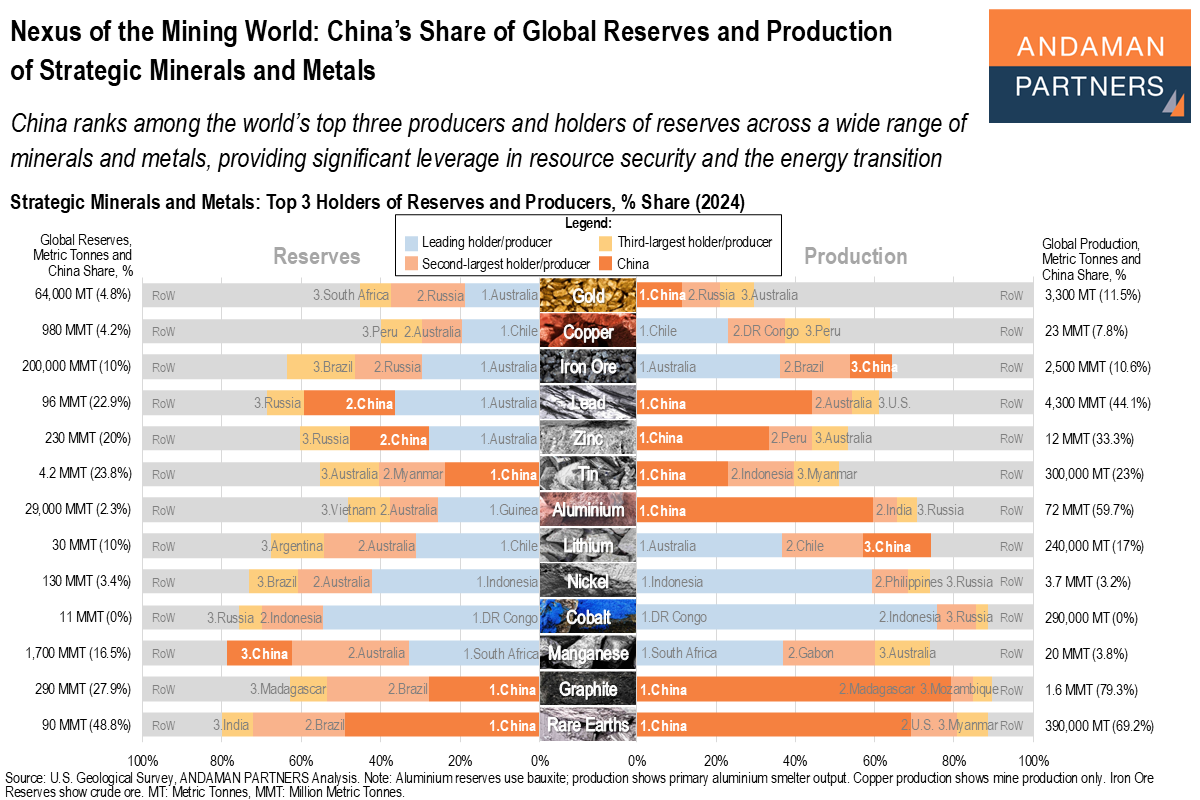
China ranks among the world’s top three producers and holders of reserves across a wide range of minerals and metals, providing significant leverage in resource security and the energy transition.
China holds the world’s largest reserves of tin, graphite and rare earths, as well as the second-largest reserves of lead and zinc and the third-largest reserves of manganese. By contrast, China’s reserves of gold, copper, bauxite, nickel and cobalt are relatively modest.
China is the leading global producer of gold, lead, zinc, tin, aluminium, graphite and rare earths, and ranks third in iron ore and lithium production. China accounts for nearly 80% of world graphite output, 70% of rare earths, 60% of aluminium, 44% of lead, 33% of zinc and 23% of tin.
China’s dominance in both reserves and production across various key strategic minerals provides the country with significant geopolitical leverage, supply-chain security and industrial capacity. However, in a few critical cases—notably cobalt, copper and nickel—China remains reliant on strategic imports.
Also by ANDAMAN PARTNERS:
ANDAMAN PARTNERS supports international business ventures and growth. We help launch global initiatives and accelerate successful expansion across borders. If your business, operations or project requires cross-border support, contact connect@andamanpartners.com.

ANDAMAN PARTNERS Attended the Australia Governance Summit 2026 in Sydney
ANDAMAN PARTNERS Co-Founder Kobus van der Wath attended the Australia Governance Summit (AGS26) in Sydney, Australia.
ANDAMAN PARTNERS Wishes You a Happy and Prosperous Year of the Horse!
Compliments of the Chinese Lunar New Year to all our clients, customers, suppliers and partners.

ANDAMAN PARTNERS to Attend Investing in African Mining Indaba 2026 in Cape Town
ANDAMAN PARTNERS Co-Founders Kobus van der Wath and Rachel Wu will attend Investing in African Mining Indaba 2026 in Cape Town, South Africa.

The World’s Most Strategic Supply Chain Is Highly Concentrated and Interdependent
Integrated circuits exceed USD 1 trillion in global trade, with supply concentrated in Asia and demand in China, reinforcing structural dependencies.

China’s Long-Term Impact on Global Trade and the Reconfiguration of the World Economy
China’s rise from a minor exporter to the centre of global manufacturing redefined trade flows, reshaped supply chains and forced the global economy to evolve.

Global Trade Has Recovered To Scale, With Export Power Still Concentrated
Merchandise trade reaches USD 26 trillion in 2025, while the top 20 exporters account for 70% of global exports.