
High-Tech Exports
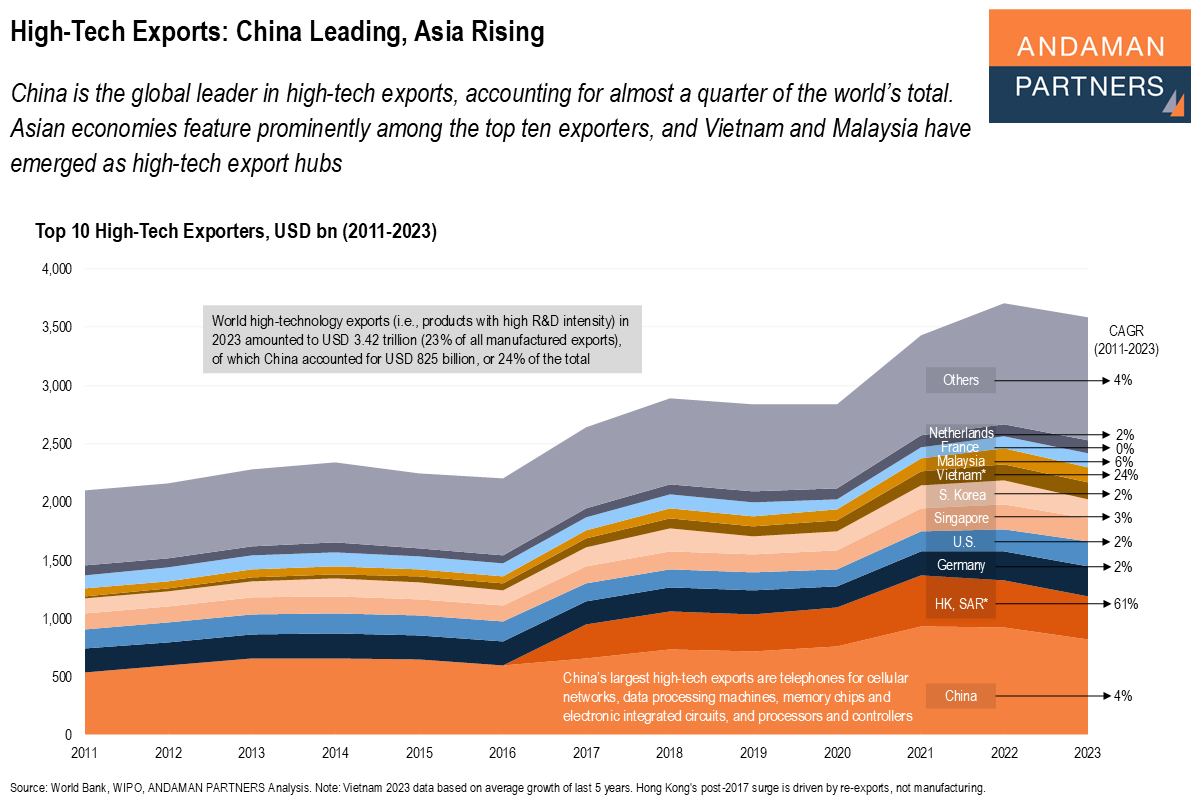
China is the global leader in high-tech exports, accounting for almost a quarter of the world’s total. Asian economies feature prominently among the top ten exporters, and Vietnam and Malaysia have emerged as high-tech export hubs.
High-technology exports include products with high R&D intensity, such as those used in artificial intelligence (AI), biotechnology, aerospace, vehicles, microchips, computers, scientific instruments and electrical machinery. As such, they are a key indicator of global competitiveness and the effectiveness of industrial policy, reflecting a country’s competency in advanced manufacturing, R&D and innovation.
China, the world’s largest exporter overall, is also the clear leader in high-tech exports. Following a peak of USD 936 billion in 2021, China’s high-tech exports in 2023 (complete datasets for 2024 are not yet available) stood at USD 825 billion, accounting for 24% of the world total of USD 3.42 trillion, which was a slight decrease from the all-time high of USD 3.72 trillion in 2022.
In 2023, China’s most significant high-tech exports were telephones for cellular networks (USD 139 billion), data processing machines (USD 99 billion), memory chips and electronic integrated circuits (USD 56 billion), and processors and controllers (USD 50 billion).
In 2024, world high-tech exports grew at an estimated annual growth rate of 8.6%, driven by booming trade in microchips, electric vehicles (EVs), aeroplanes, spacecraft, energy equipment and equipment for nuclear reactors.
Asia Rising
China’s high-tech exports in 2023 were more than three times larger than those of Germany (USD 255 billion) and the U.S. (USD 208 billion). The value for the EU in 2023 was USD 523 billion.
Six of the top ten largest high-tech exporters in 2023 were Asian economies. Following a post-2017 surge in high-tech re-exports, Hong Kong was in second place with USD 369 billion, followed by Germany and the U.S., whose high-tech exports both increased significantly from 2020. In 2024, U.S. exports (led by processors, controllers and electronic integrated circuits) reached USD 233 billion, an increase of USD 92 billion from 2020.
The high-tech exports of Singapore, in fifth place, and South Korea, in sixth, both declined year-on-year in 2023, but are estimated to have recovered well in 2024.
In 2023, Vietnam had the seventh-largest high-tech exports at an estimated USD 153 billion, and Malaysia had the eighth-largest at USD 127 billion. These two Southeast Asian economies represent a rapidly rising force in global high-tech exports. From 2011 to 2023, Malaysia’s high-tech exports increased by 6% and those of Vietnam by an incredible 24%.
Both these Asian economies have become critical nodes in electronics and semiconductor value chains. Vietnam is now a centre for consumer electronics and smartphone assembly, and Malaysia has consolidated its role in high-value exports of semiconductors and electrical and electronic products.
Driven by investment inflows, supply-chain diversification from China and strong global demand for microchips and electronics, Vietnam and Malaysia are now long-term pillars of the global high-tech supply chain, not just short-term beneficiaries.
ANDAMAN PARTNERS supports international business ventures and growth. We help launch global initiatives and accelerate successful expansion across borders. If your business, operations or project requires cross-border support, contact connect@andamanpartners.com.

Hong Kong: From a Gateway to a Springboard Out of Mainland China by ANDAMAN PARTNERS Co-Founder Rachel Wu
Analysis by ANDAMAN PARTNERS Co-Founder Rachel Wu on Hong Kong’s changing role

A Glance at China’s Consumer Market from Nanjing West Road by ANDAMAN PARTNERS Co-Founder Rachel Wu
Analysis by ANDAMAN PARTNERS Co-Founder Rachel Wu on China’s consumer economy

China Keeps Shopping for Services. Are You Selling? By ANDAMAN PARTNERS Co-Founder Rachel Wu
Analysis by ANDAMAN PARTNERS Co-Founder Rachel Wu on Shanghai’s services economy
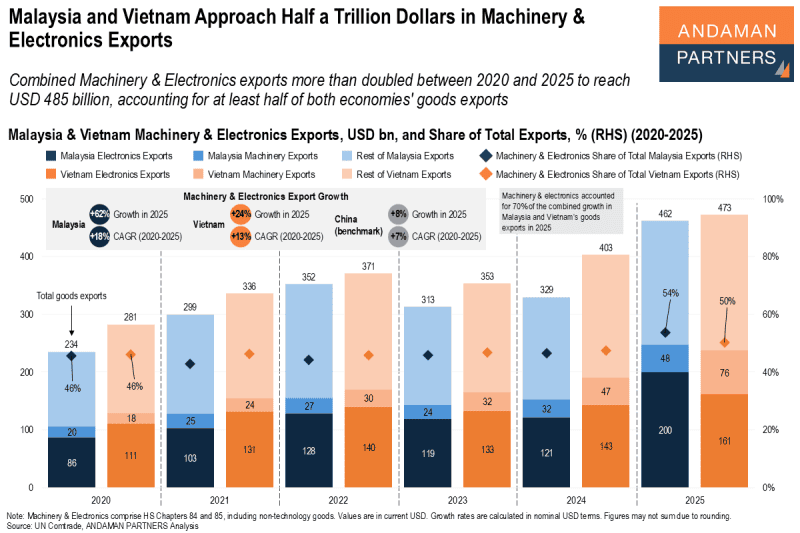
Malaysia and Vietnam Approach Half a Trillion Dollars in Machinery & Electronics Exports
Combined Machinery & Electronics exports more than doubled between 2020 and 2025 to reach USD 485 billion
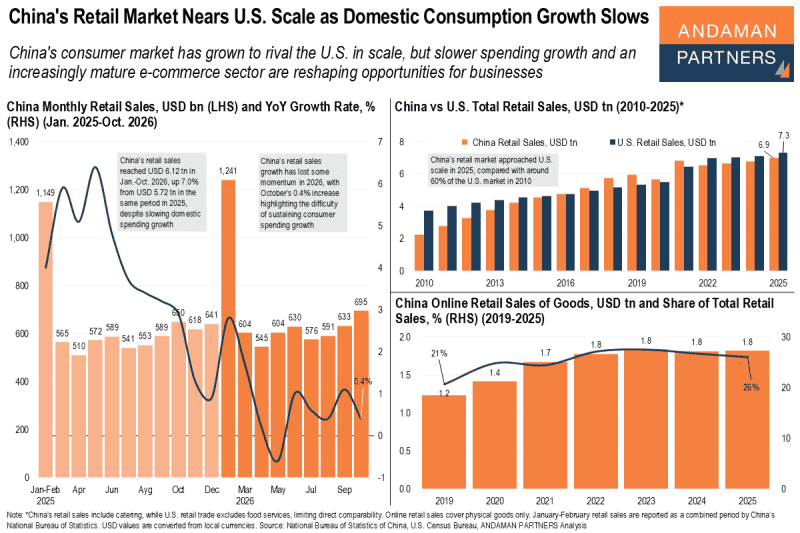
China’s Retail Market Nears U.S. Scale as Domestic Consumption Growth Slows
China’s consumer market has grown to rival the U.S. in scale, but slower spending growth is reshaping opportunities for businesses
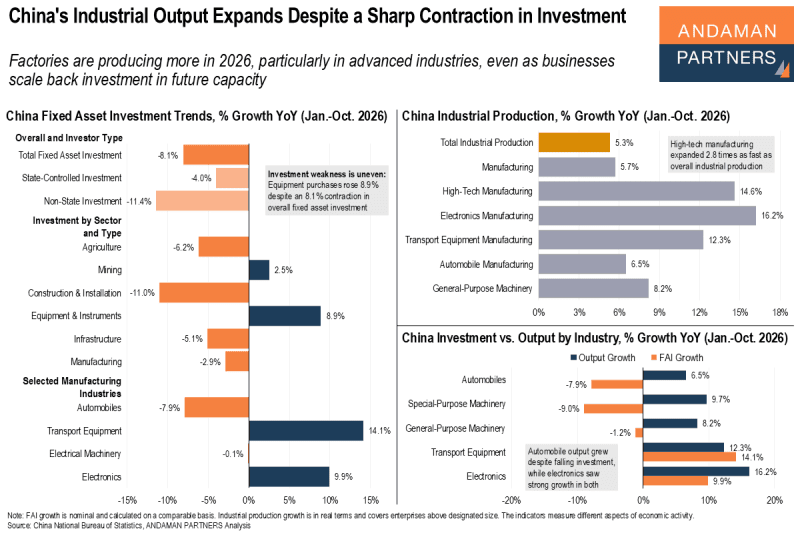
China’s Industrial Output Expands Despite a Sharp Contraction in Investment
Factories are producing more in 2026, particularly in advanced industries, even as businesses scale back investment in future capacity
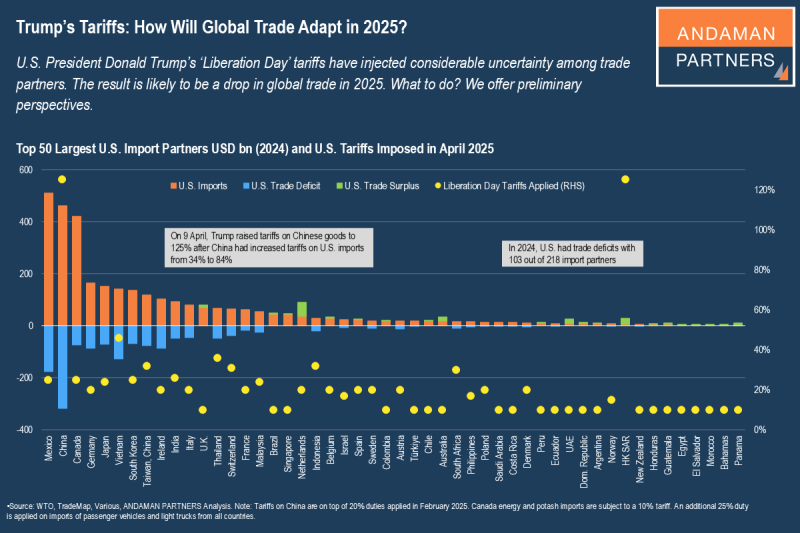
Pingback: The World’s Most Dynamic Export Economies | ANDAMAN PARTNERS
Pingback: Emerging Market Exporters Beyond China to Watch in 2026 | ANDAMAN PARTNERS
Pingback: AI Is Reshaping the Global Jobs and Skills Landscape | ANDAMAN PARTNERS
Pingback: AI in Procurement 2026: Adoption Is Widespread, But Scaling Remains Constrained | ANDAMAN PARTNERS
Pingback: The Rise of Next-Tier Manufacturing Economies Beyond China | ANDAMAN PARTNERS
Pingback: A Small Set of Emerging Markets Is Driving Machinery & Electronics Export Scale to the World’s Largest Markets | ANDAMAN PARTNERS
Pingback: World’s Most Dynamic Export Economies | ANDAMAN PARTNERS
Pingback: China’s Exports: Africa Surging | ANDAMAN PARTNERS