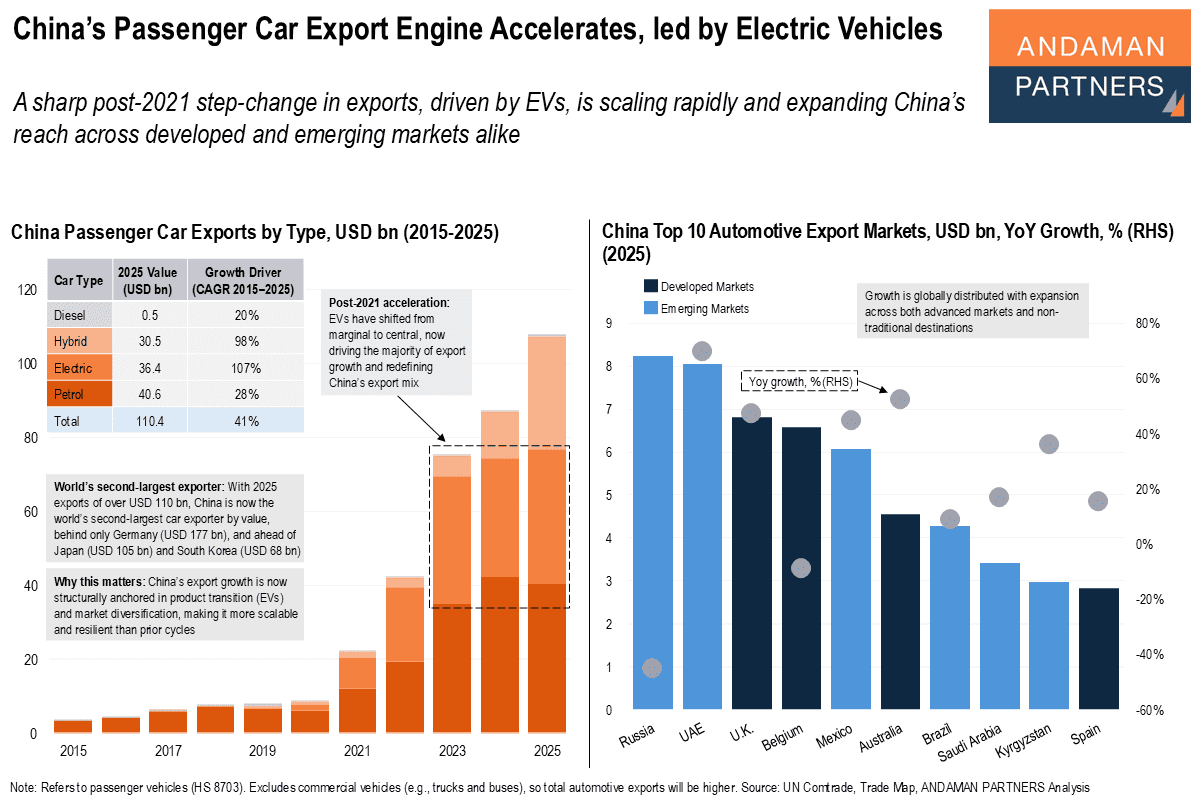

A sharp post-2021 step-change in exports, driven by EVs, is scaling rapidly and expanding China’s reach across developed and emerging markets alike.
China’s passenger car export story has shifted from steady expansion to structural acceleration. Exports have increased roughly tenfold since 2015, but the decisive change comes post-2021, where growth steepens sharply. This is not cyclical; it reflects a product transition: electric vehicles have moved from the margins to the centre, now driving the majority of incremental export growth. Hybrid exports have also surged, while petrol vehicles continue to provide scale. The result is a more balanced and resilient export mix, anchored in both legacy and next-generation powertrains.
Equally important is where this growth is landing. China’s export expansion is not concentrated in a narrow set of core markets; it is broadly distributed across diverse geographies. In 2025, large volumes continue to flow into established trading hubs such as the UAE and the U.K., while markets like Belgium and Australia serve as key entry points for advanced economies. At the same time, emerging and non-traditional destinations are playing an increasing role. Russia remains a major outlet, reflecting the ongoing realignment of automotive trade flows, while Brazil and Saudi Arabia indicate deeper penetration into large, structurally growing-demand markets.
Further down the list, countries such as Kyrgyzstan highlight China’s ability to scale into smaller, less conventional markets, often acting as regional gateways. Mexico and Spain reflect more competitive environments, where growth is positive but more measured. The overall pattern is clear: China is building a globally distributed export footprint, combining volume markets, strategic hubs and new growth frontiers.
The combination of EV-led product transformation and broad-based market expansion signals a more scalable and durable export model. China is not only exporting more cars; it is reshaping how and where it competes in the global automotive market.
Also by ANDAMAN PARTNERS:
ANDAMAN PARTNERS supports international business ventures and growth. We help launch global initiatives and accelerate successful expansion across borders. If your business, operations or project requires cross-border support, contact connect@andamanpartners.com.

ANDAMAN PARTNERS Attended the Australia Governance Summit 2026 in Sydney
ANDAMAN PARTNERS Co-Founder Kobus van der Wath attended the Australia Governance Summit (AGS26) in Sydney, Australia.
ANDAMAN PARTNERS Wishes You a Happy and Prosperous Year of the Horse!
Compliments of the Chinese Lunar New Year to all our clients, customers, suppliers and partners.

ANDAMAN PARTNERS to Attend Investing in African Mining Indaba 2026 in Cape Town
ANDAMAN PARTNERS Co-Founders Kobus van der Wath and Rachel Wu will attend Investing in African Mining Indaba 2026 in Cape Town, South Africa.

China’s Passenger Car Export Engine Accelerates, led by Electric Vehicles
A sharp post-2021 step-change in car exports is scaling rapidly and expanding China’s reach across developed and emerging markets.

Global Trade Imbalances Widen in 2025 as Surpluses Strengthen and Deficits Deepen
Surplus economies expanded export capacity, while deficit economies absorbed more goods despite selective adjustments across mid-tier markets.

The World Mines With Chinese Equipment: Scale in Core Inputs, Growth in High-Value Segments
China is no longer just a low-cost supplier; it now leads in high-growth segments while maintaining scale in consumables and components.