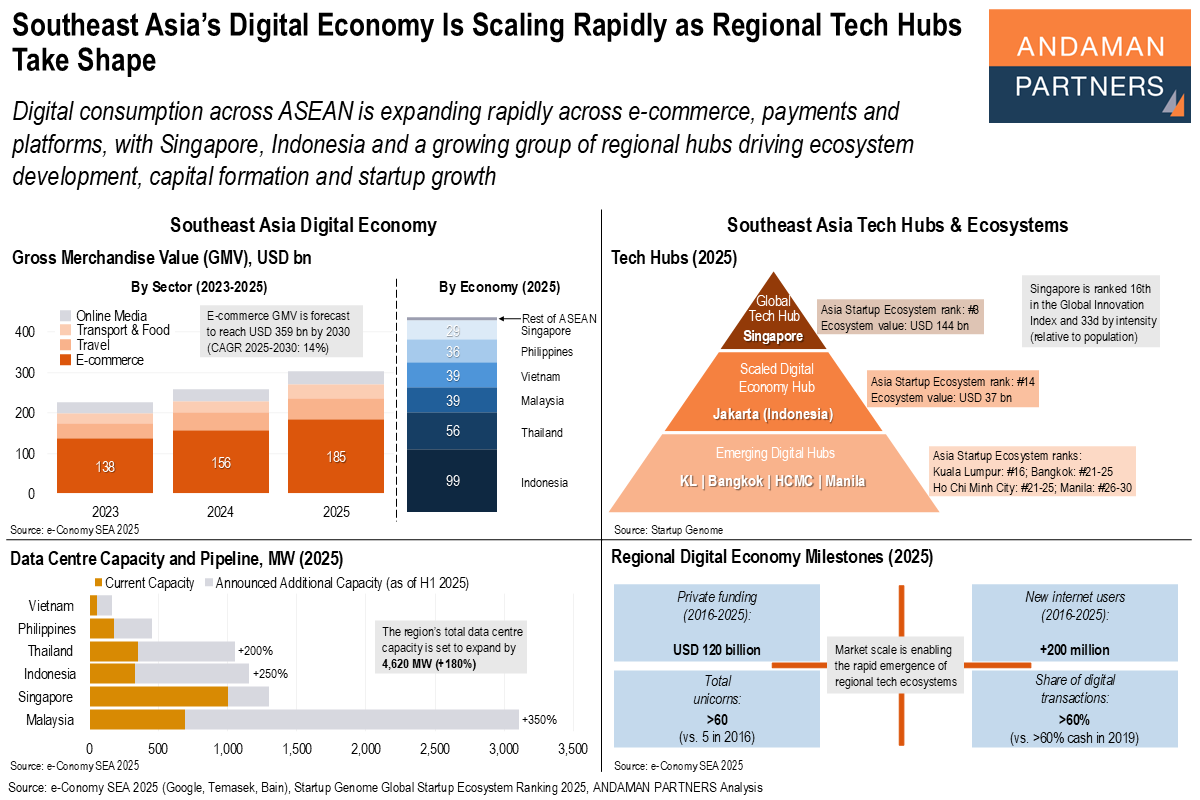

Digital consumption across ASEAN is expanding rapidly across e-commerce, payments and platforms, with Singapore, Indonesia and a growing group of regional hubs driving ecosystem development, capital formation and startup growth.
Southeast Asia’s digital economy is entering a new phase of scale, with the region’s total gross merchandise value (GMV) rising from USD 138 billion in 2023 to USD 185 billion in 2025, led primarily by e-commerce, which remains the dominant driver of regional digital consumption.
Growth is increasingly underpinned by a broader monetisation stack, including digital payments and platform services, while the region’s digital economy is projected to continue expanding toward USD 359 billion by 2030. This demand is highly concentrated, with Indonesia alone accounting for USD 99 billion of GMV in 2025, followed by Thailand (USD 56 billion) and a second tier of markets including Vietnam and Malaysia (USD 39 billion each), highlighting both scale and fragmentation across ASEAN.
At the same time, the enabling infrastructure is scaling rapidly. Data centre capacity across key Southeast Asian markets is set to expand by 4,620 MW, an increase of around 180%, with particularly strong pipeline growth in Malaysia (+350%), Indonesia (+250%) and Thailand (+200%). This reflects rising demand for cloud services, AI workloads and digital platforms, and signals growing investment depth across the region’s digital backbone.
Crucially, this market expansion is now translating into ecosystem development. Southeast Asia has attracted USD 120 billion in private funding between 2016 and 2025, added more than 200 million new internet users, and now counts over 60 unicorns, up from just 5 in 2016. Singapore anchors the region as a global tech hub, with an ecosystem value of USD 144 billion and a top-tier global innovation ranking. At the same time, Indonesia has emerged as the leading scaled digital platform market, with USD 37 billion in ecosystem value and a strong track record of unicorn creation.
A broader group of emerging hubs, including Kuala Lumpur, Bangkok, Ho Chi Minh City and Manila, is now forming a second layer of innovation capacity, indicating that Southeast Asia’s digital economy is not only scaling rapidly but also maturing into a multi-node ecosystem with expanding regional depth.
Also by ANDAMAN PARTNERS:
ANDAMAN PARTNERS supports international business ventures and growth. We help launch global initiatives and accelerate successful expansion across borders. If your business, operations or project requires cross-border support, contact connect@andamanpartners.com.

ANDAMAN PARTNERS Attended the Australia Governance Summit 2026 in Sydney
ANDAMAN PARTNERS Co-Founder Kobus van der Wath attended the Australia Governance Summit (AGS26) in Sydney, Australia.

ANDAMAN PARTNERS Wishes You a Happy and Prosperous Year of the Horse!
Compliments of the Chinese Lunar New Year to all our clients, customers, suppliers and partners.

ANDAMAN PARTNERS to Attend Investing in African Mining Indaba 2026 in Cape Town
ANDAMAN PARTNERS Co-Founders Kobus van der Wath and Rachel Wu will attend Investing in African Mining Indaba 2026 in Cape Town, South Africa.

China’s Trade Engine Accelerates in 2026 on Industrial Strength and Global Breadth
Broad-based growth across partners and sectors, led by machinery and transport equipment, signals renewed strength in China’s export engine.

Asia’s Growth Engines: Scale, Speed and Opportunity Across Regions
Asia’s scale, speed and integration are no longer concentrated in a single core, but spread across multiple, complementary engines.

China Extends Its Dominance in Global Shipbuilding as Output Surges in 2026
Even as global ship orders declined in 2025, early-2026 data shows a rapid rebound, with China securing the vast majority of new contracts.