Global Investment Patterns in 2025
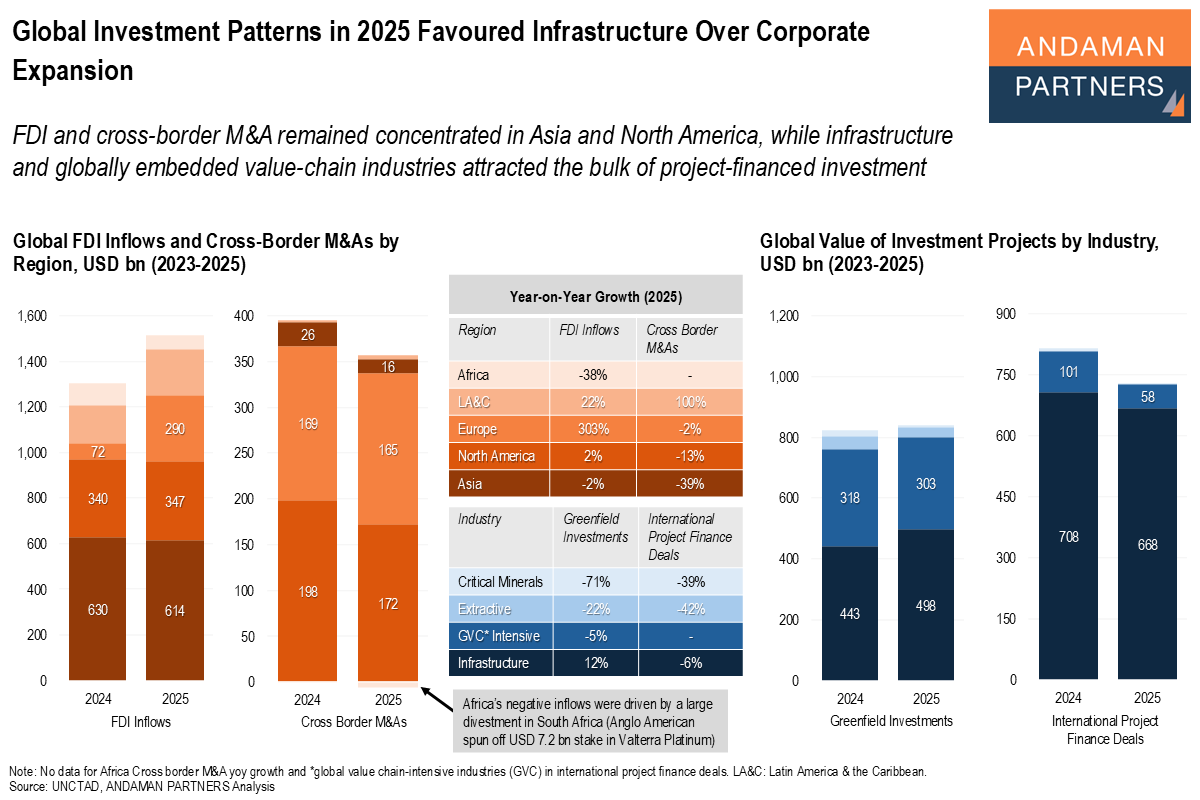
Global Investment Patterns in 2025 Favoured Infrastructure Over Corporate Expansion
FDI and cross-border M&A remained concentrated in Asia and North America, while infrastructure and globally embedded value-chain industries attracted the bulk of project-financed investment.
Global investment patterns in 2025 reflected a clear divergence between corporate expansion and project-financed investment. On the corporate side, global FDI inflows and cross-border M&A remained sizable in absolute terms but were uneven across regions and softer in momentum. Asia and North America continued to account for the largest share of FDI, while Europe recorded a sharp year-on-year rebound from a low base. Cross-border M&A activity weakened across several major regions in 2025, most notably in Asia and North America, underscoring continued caution around large discretionary corporate transactions.
By contrast, project-financed investment displayed greater stability, particularly in infrastructure and globally embedded value-chain industries. While overall greenfield investment levels were broadly stable between 2024 and 2025, infrastructure was the only major category to show positive year-on-year growth.
International project finance volumes declined modestly in 2025 but remained concentrated in long-lived assets with relatively predictable cash flows. This contrasts with a sharp pullback in critical minerals and extractive projects, highlighting a selective rather than broad-based preference within asset-linked investment.
The year-on-year growth breakdown reinforces this picture. Corporate investment flows showed significant regional dispersion, with weak outcomes in Africa and Asia offset by strong growth in Europe and Latin America. Within project finance, infrastructure proved comparatively resilient, while commodity-exposed sectors experienced pronounced retrenchment.
Taken together, the data suggest that in 2025, global capital allocation was shaped less by a generalised expansionary cycle and more by caution and selectivity. Corporate investment remained concentrated in established regions, while project finance favoured infrastructure and essential value-chain assets over more cyclical or price-sensitive opportunities. This pattern highlights how risk considerations and cash-flow visibility continued to play a crucial role in shaping global investment decisions during the year.
Also by ANDAMAN PARTNERS:
ANDAMAN PARTNERS supports international business ventures and growth. We help launch global initiatives and accelerate successful expansion across borders. If your business, operations or project requires cross-border support, contact connect@andamanpartners.com.

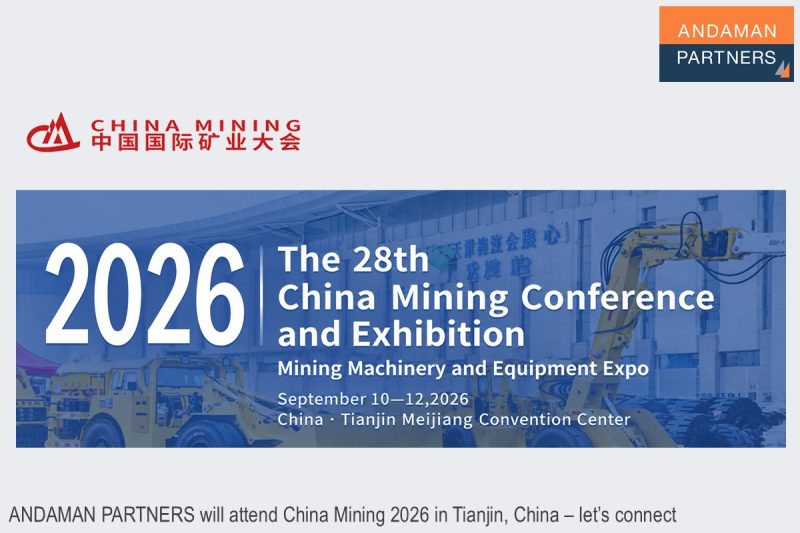
ANDAMAN PARTNERS to Attend China Mining 2026 in Tianjin, China
ANDAMAN PARTNERS will attend the China Mining Conference and Exhibition in Tianjin, China, on 10-12 September 2026

ANDAMAN PARTNERS at the Singapore Institute of Directors Annual Conference 2026
ANDAMAN PARTNERS at the Singapore Institute of Directors Conference 2026 in Singapore on 28 August 2026

ANDAMAN PARTNERS Attended the Australia Governance Summit 2026 in Sydney
ANDAMAN PARTNERS Co-Founder Kobus van der Wath attended the Australia Governance Summit (AGS26) in Sydney, Australia.
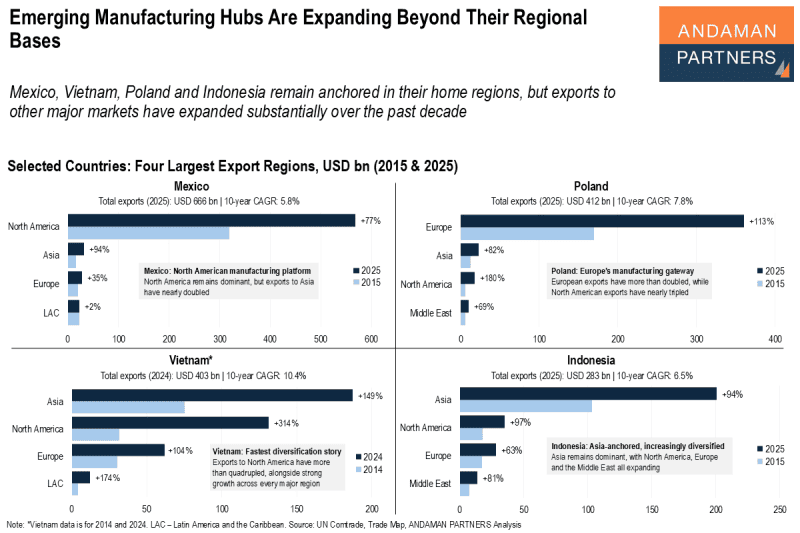
Emerging Manufacturing Hubs Are Expanding Beyond Their Regional Bases
Mexico, Vietnam, Poland and Indonesia remain anchored in their home regions, but exports to other major markets have expanded substantially
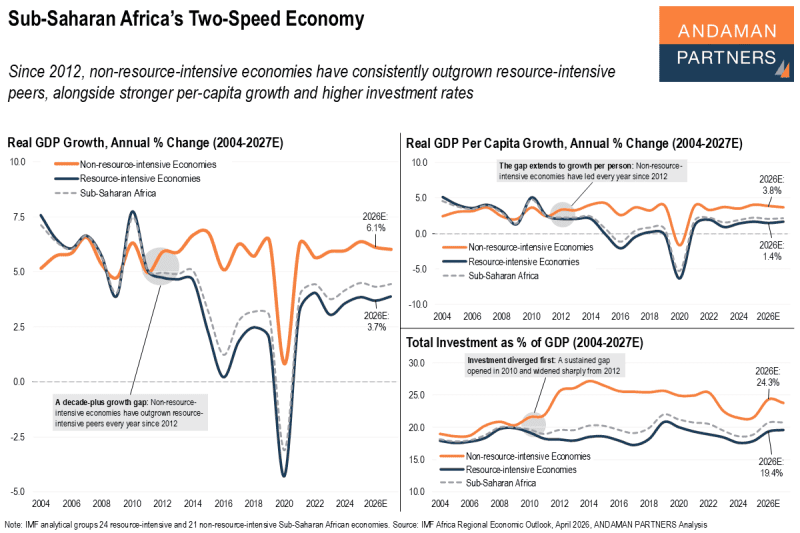
Sub-Saharan Africa’s Two-Speed Economy
Since 2012, non-resource-intensive economies have consistently outgrown resource-intensive peers
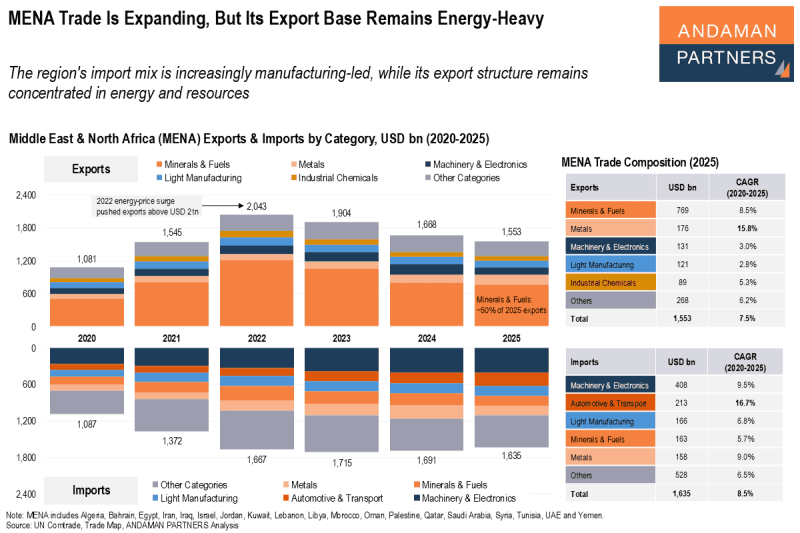
MENA Trade Is Expanding, But Its Export Base Remains Energy-Heavy
The region’s import mix is increasingly manufacturing-led, while its export structure remains concentrated in energy and resources.