
You are currently viewing Reserves & Import Dependence: Which Major Economies Can Absorb Trade Shocks?

Reserves & Import Dependence: Which Major Economies Can Absorb Trade Shocks?

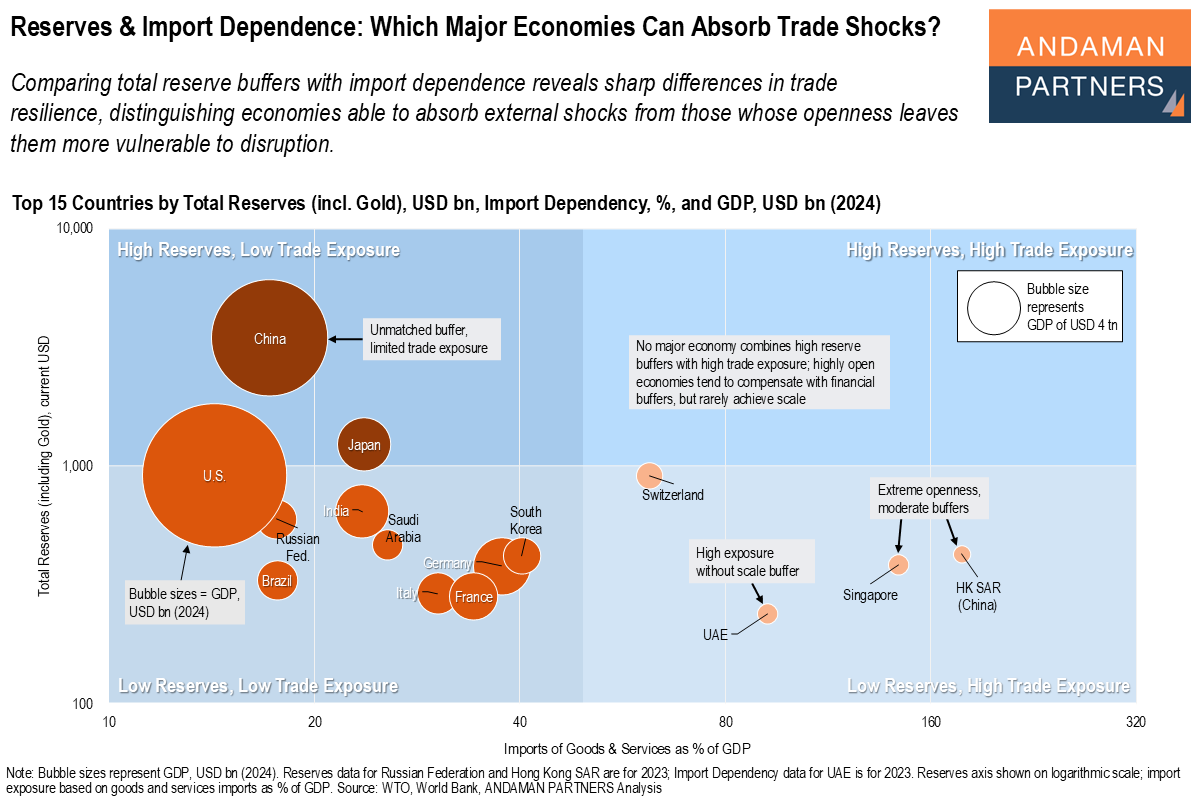
Comparing total reserve buffers with import dependence reveals sharp differences in trade resilience, distinguishing economies able to absorb external shocks from those whose openness leaves them more vulnerable to disruption.

Total reserve buffers and import dependence offer a powerful lens through which to assess which major economies are structurally positioned to absorb external trade shocks, and which remain vulnerable if global trade conditions deteriorate.

Economies combining large financial buffers with limited trade exposure are best placed to withstand disruption. China stands apart, with unmatched reserves and relatively low import dependence, giving it exceptional capacity to absorb external shocks without excessive adjustment. Japan also sits in this resilient category, pairing substantial buffers with moderate exposure and strong policy flexibility. Switzerland combines very high trade exposure with strong reserve buffers, placing it closer to true resilience than most open economies.

A second group includes economies with lower trade exposure but more limited reserve buffers, notably the U.S., India, Brazil, Saudi Arabia and Russia. Their relative insulation from trade shocks reduces immediate exposure, but their ability to absorb stress relies more on policy responses, domestic demand and institutional strength than on reserve firepower alone.

Several economies combine higher trade exposure with comparatively limited buffers, increasing vulnerability to external shocks. Germany, France, Italy and South Korea all rely heavily on global trade while holding smaller reserve cushions, leaving them more exposed if disruptions persist.

A third group consists of economies that maintain buffers of comparative size to the second group but are highly trade-exposed. The UAE stands out for its high exposure, with more limited reserve buffers, making it particularly sensitive to shifts in global trade conditions. Ultra-open hubs such as Singapore and Hong Kong SAR exhibit extreme openness combined with moderate reserve protection. These economies are resilient to routine volatility but remain sensitive to prolonged or systemic trade disruptions.

Overall, actual shock-absorbing capacity remains rare. While many open economies attempt to offset vulnerability through financial buffers, only a small number combine sufficient scale, structure and insulation to withstand a major global trade shock without significant adjustment.

Also by ANDAMAN PARTNERS:

ANDAMAN PARTNERS supports international business ventures and growth. We help launch global initiatives and accelerate successful expansion across borders. If your business, operations or project requires cross-border support, contact connect@andamanpartners.com.

Media
News & Events
Knowledge