Asian Real GDP Growth vs Population Growth
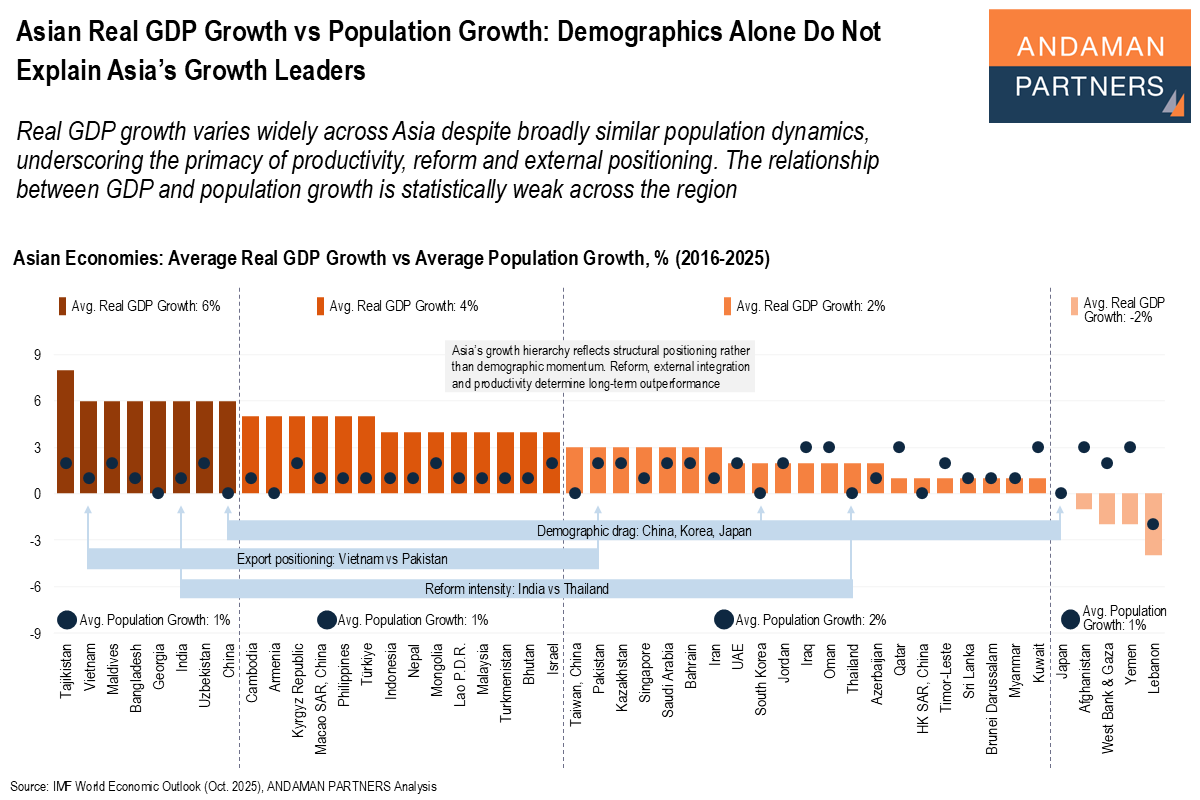
Asian Real GDP Growth vs Population Growth: Demographics Alone Do Not Explain Asia’s Growth Leaders
Real GDP growth varies widely across Asia despite broadly similar population dynamics, underscoring the primacy of productivity, reform and external positioning. The relationship between GDP and population growth is statistically weak across the region.
Real GDP growth across Asia has diverged markedly over 2016-2025, even as population growth has remained broadly clustered within a narrow 0-2% range. High-growth economies such as Tajikistan, Vietnam, Bangladesh and India have sustained 4-6% expansion despite modest demographic momentum. In contrast, several lower-growth economies have experienced similar population dynamics but have recorded materially weaker output performance. The statistical relationship between GDP and population growth is therefore weak across the region.
The divergence instead reflects structural positioning. Export integration is a decisive differentiator: Vietnam’s deep integration into global electronics and manufacturing supply chains contrasts sharply with Pakistan’s more limited export diversification, helping explain their growth gap despite comparable demographic trends. Reform intensity also matters. India’s sustained structural reform agenda spanning infrastructure, digitisation and industrial policy has supported stronger medium-term expansion relative to Thailand, where reform momentum has been more uneven.
At the other end of the spectrum, demographic drag is visible in China, South Korea and Japan, where ageing populations weigh on labour-force growth and potential output. Commodity exposure has amplified outcomes in economies such as Mongolia and Kazakhstan during favourable external cycles.
Asia’s growth hierarchy reflects productivity, reform depth and external integration more than demographic expansion alone. For investors and operators, long-term outperformance depends less on population scale and more on structural competitiveness within regional and global value chains.
Also by ANDAMAN PARTNERS:
ANDAMAN PARTNERS supports international business ventures and growth. We help launch global initiatives and accelerate successful expansion across borders. If your business, operations or project requires cross-border support, contact connect@andamanpartners.com.

ANDAMAN PARTNERS Attended the Australia Governance Summit 2026 in Sydney
ANDAMAN PARTNERS Co-Founder Kobus van der Wath attended the Australia Governance Summit (AGS26) in Sydney, Australia.

ANDAMAN PARTNERS Wishes You a Happy and Prosperous Year of the Horse!
Compliments of the Chinese Lunar New Year to all our clients, customers, suppliers and partners.

ANDAMAN PARTNERS to Attend Investing in African Mining Indaba 2026 in Cape Town
ANDAMAN PARTNERS Co-Founders Kobus van der Wath and Rachel Wu will attend Investing in African Mining Indaba 2026 in Cape Town, South Africa.

China’s PMI Indicators Point to Uneven Momentum and Rising Cost Pressures in 2026
Manufacturing activity remained close to expansion in early 2026, while weaker export orders and raw material prices pressure the economy

Africa’s Industrial Leaders and Rising Manufacturing Economies
Morocco, South Africa and Egypt remain Africa’s leading industrial economies; DRC, Djibouti and Gabon recorded the largest gains in competitiveness

Africa’s Trade Is Shifting Increasingly Toward China
China’s share of Africa’s trade has expanded sharply since 2001, with imports from China now matching Europe’s share