Understanding global exports requires examining performance across two tiers of economies: those already operating at scale, and those climbing from a smaller base. Reviewing the largest exporters reveals the engines driving global trade in absolute terms, while including fast-growing smaller economies highlights where the next wave of export growth may emerge.
Together, these two tiers reveal both absolute bulk and outright speed, scaling today and accelerating for tomorrow, thus offering a fuller strategic picture of how global trade leadership is evolving.
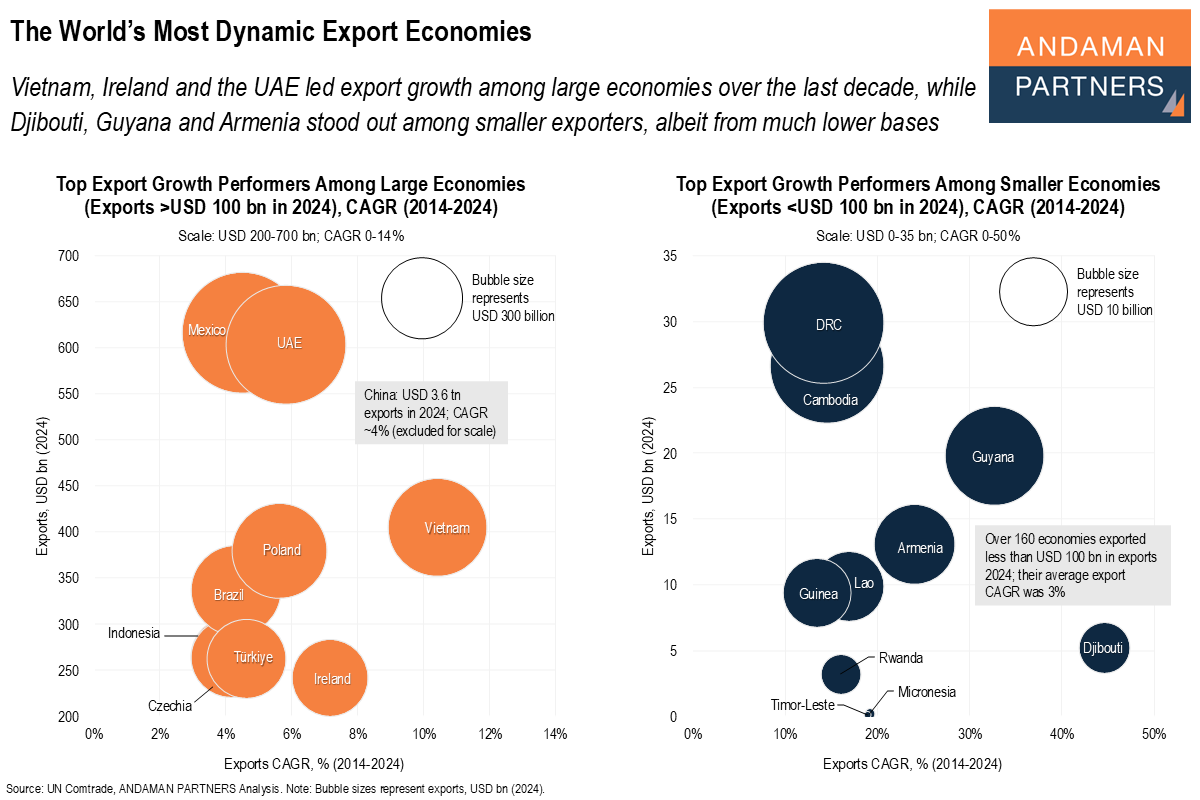
Over the past decade, a new cohort of export economies has emerged, reshaping global trade dynamics beyond traditional manufacturing hubs. Vietnam and Ireland led all major economies in export growth from 2014 to 2024, posting double-digit and high-single-digit CAGRs while scaling exports to USD 405 billion and USD 242 billion, respectively.
The UAE and Mexico also accelerated meaningfully, combining rising competitiveness, trade facilitation reform and integration into shifting supply chains. China remains the world’s largest exporter by a wide margin, but its growth rate expanded at a steadier 4% CAGR as its export engine transitions from hyper-growth to high-scale maturity.
At the next tier, Poland, Türkiye, Brazil, the Czech Republic and Indonesia posted solid mid-single-digit export growth while strengthening their position in global value chains. These economies benefited from industrial upgrading, near-shoring and friend-shoring trends, as well as greater participation in diversified trade corridors.
The performances of these major exporting economies underscore a broader structural trend: export leadership is no longer concentrated in one region, but is increasingly distributed across competitive mid-sized economies with improving manufacturing ecosystems, logistics infrastructure, and trade agreements.
Alongside these large and mid-sized performers, a group of frontier economies is experiencing rapid export growth, albeit from a significantly lower base. Djibouti, Guyana, Armenia and several small Asian and African economies achieved double-digit to high double-digit export CAGRs over the last decade, supported by resource developments, port and logistics investment, and niche industrial capabilities.
While the absolute export values of these smaller economies remain modest, their trajectories indicate emerging export hubs in various sectors, ranging from energy to tourism and services.




Pingback: The Four Export Clusters Producing 80% of China’s Exports | ANDAMAN PARTNERS
Pingback: Reserves & Import Dependence: Which Major Economies Can Absorb Trade Shocks? | ANDAMAN PARTNERS
Pingback: The Rise of Next-Tier Manufacturing Economies Beyond China | ANDAMAN PARTNERS
Pingback: High-Tech Manufacturing Export Growth | ANDAMAN PARTNERS
Pingback: The Long Shift in Global Trade Since 1948 | ANDAMAN PARTNERS
Pingback: High-Tech Export Intensity Since 2007 | ANDAMAN PARTNERS
Pingback: Global Trade’s Competitive Field | ANDAMAN PARTNERS
Pingback: Shifting Architecture of Global Trade (1987-2025) | ANDAMAN PARTNERS