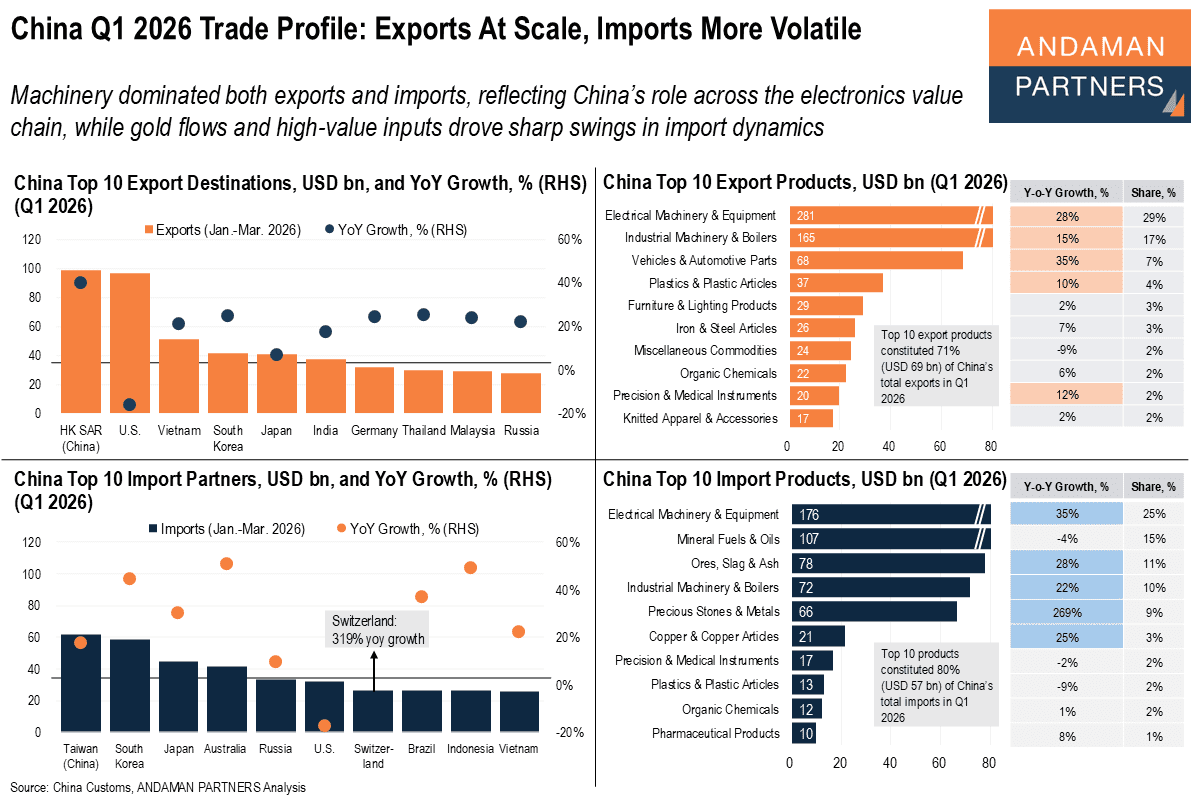

Machinery dominated both exports and imports, reflecting China’s role across the electronics value chain, while gold flows and high-value inputs drove sharp swings in import dynamics.
China’s trade in Q1 2026 showed a stabilising but uneven recovery, defined by strong electronics flows, concentrated product structures and volatile import dynamics.
Exports remained anchored in a handful of major markets: Hong Kong (USD 100 billion) and the U.S. (USD 97 billion) led by wide margins, followed by Vietnam (USD 52 billion) and South Korea (USD 43 billion). Growth was broadly positive across partners, with export yoy expansion typically in the 20-30% range, signalling steady external demand despite a more moderate overall trade environment.
The U.S. still ranks among China’s largest trade partners but has shown continued softness, with around -20% growth in both China’s exports and imports in Q1.
On the product side, exports are highly concentrated. Electrical machinery and equipment alone reached USD 281 billion, accounting for 29% of total exports, followed by industrial machinery (USD 165 billion, 17%) and vehicles (USD 68 billion, 7%). The top ten export products accounted for 71% of total exports, underscoring the centrality of industrial and technology goods.
Imports followed a more volatile pattern. China’s largest import partners: Taiwan, China (USD 62 billion), South Korea (USD 59 billion) and Japan (USD 44 billion) reflect China’s dependence on regional supply chains. However, Switzerland (USD 27 billion) stands out with a 319% yoy surge, driven primarily by gold (over 70% of imports) and high-value pharmaceuticals, with base effects and shipment patterns amplifying growth.
By product, imports are equally concentrated: electrical machinery led at USD 176 billion (25%), followed by mineral fuels (USD 107 billion) and ores (USD 78 billion). Electrical machinery dominated both imports and exports because it spans the full electronics value chain. China imports high-end components such as semiconductors while exporting finished goods like smartphones and telecom equipment.
Overall, Q1 2026 reflects a trade system that is large, concentrated and structurally anchored in electronics, but with increasingly uneven import dynamics.
Also by ANDAMAN PARTNERS:
ANDAMAN PARTNERS supports international business ventures and growth. We help launch global initiatives and accelerate successful expansion across borders. If your business, operations or project requires cross-border support, contact connect@andamanpartners.com.

ANDAMAN PARTNERS Attended the Australia Governance Summit 2026 in Sydney
ANDAMAN PARTNERS Co-Founder Kobus van der Wath attended the Australia Governance Summit (AGS26) in Sydney, Australia.
ANDAMAN PARTNERS Wishes You a Happy and Prosperous Year of the Horse!
Compliments of the Chinese Lunar New Year to all our clients, customers, suppliers and partners.

ANDAMAN PARTNERS to Attend Investing in African Mining Indaba 2026 in Cape Town
ANDAMAN PARTNERS Co-Founders Kobus van der Wath and Rachel Wu will attend Investing in African Mining Indaba 2026 in Cape Town, South Africa.

China’s PMI Indicators Point to Uneven Momentum and Rising Cost Pressures in 2026
Manufacturing activity remained close to expansion in early 2026, while weaker export orders and raw material prices pressure the economy

Africa’s Industrial Leaders and Rising Manufacturing Economies
Morocco, South Africa and Egypt remain Africa’s leading industrial economies; DRC, Djibouti and Gabon recorded the largest gains in competitiveness

Africa’s Trade Is Shifting Increasingly Toward China
China’s share of Africa’s trade has expanded sharply since 2001, with imports from China now matching Europe’s share