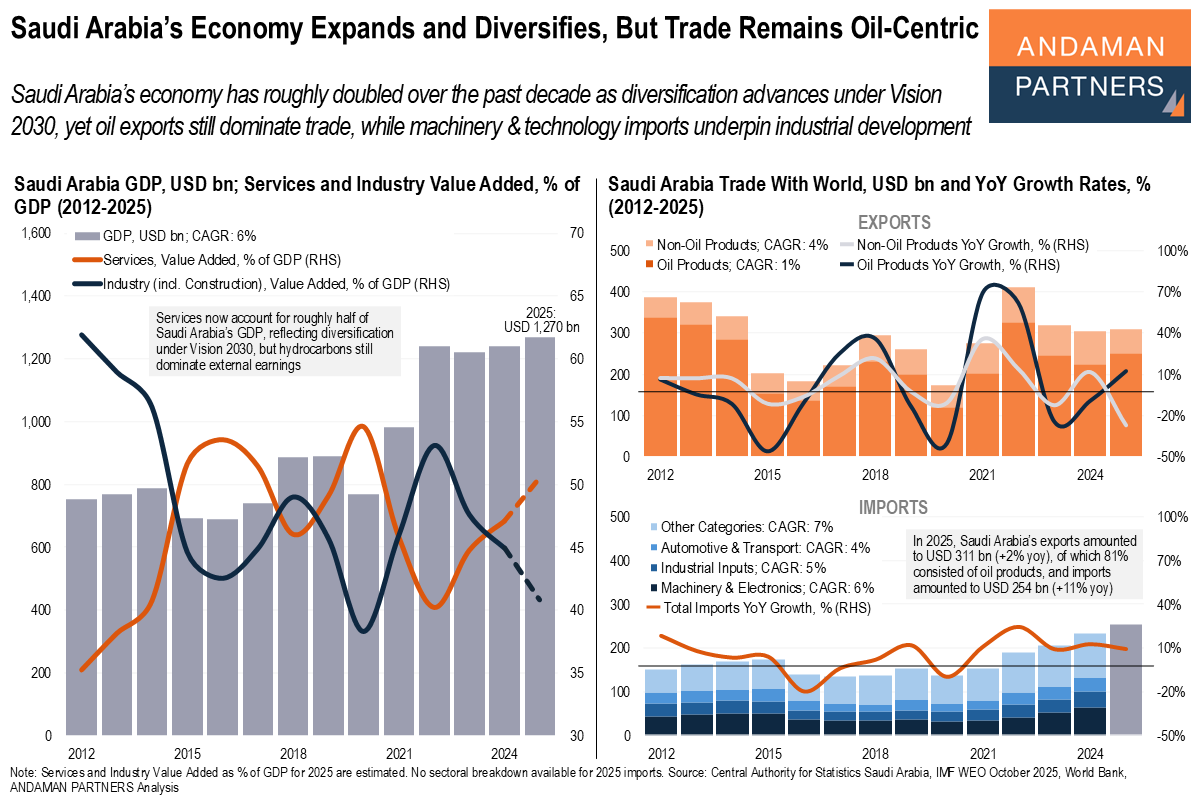
Saudi Arabia’s economy has roughly doubled over the past decade as diversification advances under Vision 2030, yet oil exports still dominate trade, while machinery & technology imports underpin industrial development.
Saudi Arabia is undergoing a major economic transformation that is reshaping the country’s business landscape and creating new opportunities for global companies. Over the past decade, the kingdom’s economy has expanded significantly, with GDP rising from USD 752 billion in 2012 to USD 1.27 trillion in 2025. This expansion reflects both the continued importance of hydrocarbons and the growing momentum behind economic diversification under the government’s Vision 2030 strategy.
One of the most notable structural changes is the rising role of services in the domestic economy. Services now account for roughly half of Saudi Arabia’s GDP, reflecting rapid growth in sectors such as logistics, tourism, finance, digital services and professional business services. Large-scale public investment programmes and sovereign wealth fund initiatives are driving infrastructure development, urban projects and new industrial ecosystems across the country. For international companies, this creates opportunities across construction, engineering, technology, transport, consumer services and advanced manufacturing.
At the same time, Saudi Arabia’s external trade profile remains closely tied to hydrocarbons. Oil exports continue to dominate the country’s export earnings, meaning overall trade performance still tracks global energy markets. However, non-oil exports are gradually expanding, supported by industrial policies aimed at developing the petrochemicals, metals and downstream manufacturing sectors.
Imports also highlight where business opportunities lie. Saudi Arabia remains a major buyer of machinery, electronics, industrial inputs and transport equipment; goods essential to building its new industrial and infrastructure base. For global firms, Saudi Arabia represents a large consumer market where one of the world’s most ambitious state-led economic transformation programmes is currently underway.
Also by ANDAMAN PARTNERS:
ANDAMAN PARTNERS supports international business ventures and growth. We help launch global initiatives and accelerate successful expansion across borders. If your business, operations or project requires cross-border support, contact connect@andamanpartners.com.

ANDAMAN PARTNERS Attended the Australia Governance Summit 2026 in Sydney
ANDAMAN PARTNERS Co-Founder Kobus van der Wath attended the Australia Governance Summit (AGS26) in Sydney, Australia.
ANDAMAN PARTNERS Wishes You a Happy and Prosperous Year of the Horse!
Compliments of the Chinese Lunar New Year to all our clients, customers, suppliers and partners.

ANDAMAN PARTNERS to Attend Investing in African Mining Indaba 2026 in Cape Town
ANDAMAN PARTNERS Co-Founders Kobus van der Wath and Rachel Wu will attend Investing in African Mining Indaba 2026 in Cape Town, South Africa.

China’s PMI Indicators Point to Uneven Momentum and Rising Cost Pressures in 2026
Manufacturing activity remained close to expansion in early 2026, while weaker export orders and raw material prices pressure the economy

Africa’s Industrial Leaders and Rising Manufacturing Economies
Morocco, South Africa and Egypt remain Africa’s leading industrial economies; DRC, Djibouti and Gabon recorded the largest gains in competitiveness

Africa’s Trade Is Shifting Increasingly Toward China
China’s share of Africa’s trade has expanded sharply since 2001, with imports from China now matching Europe’s share