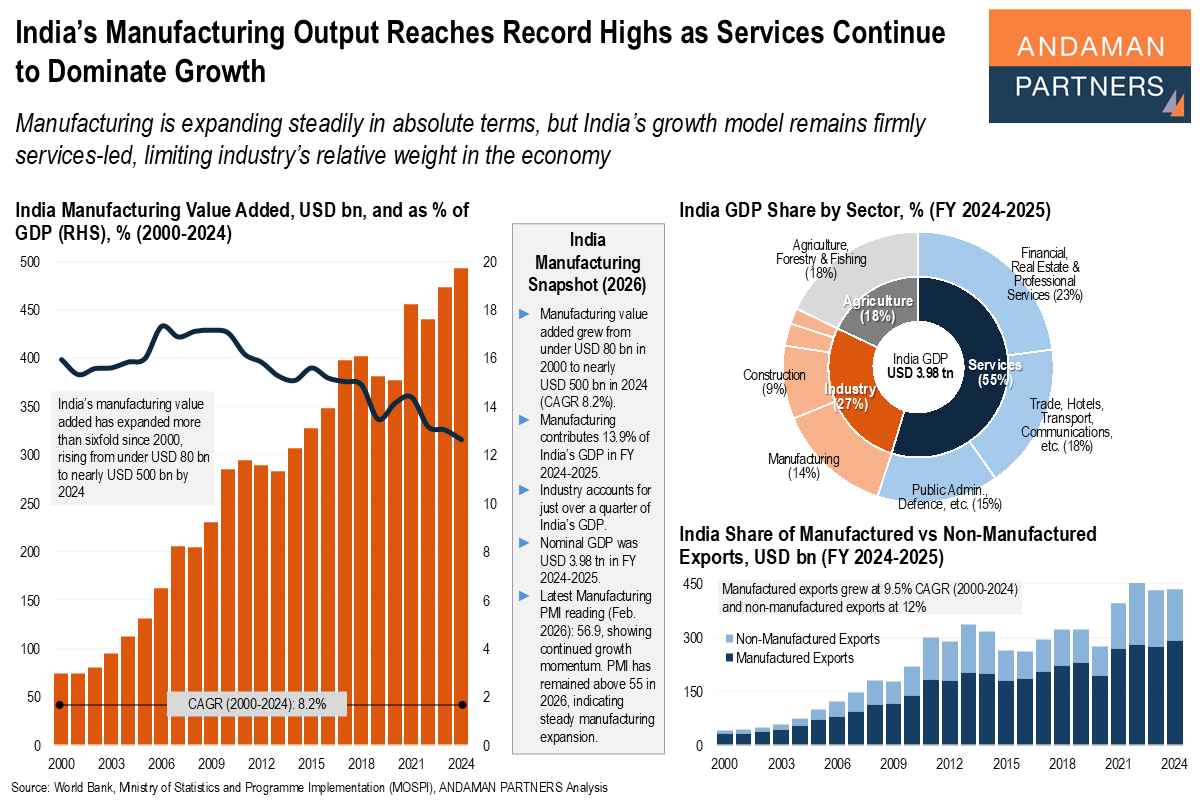
Manufacturing is expanding steadily in absolute terms, but India’s growth model remains firmly services-led, limiting industry’s relative weight in the economy.
India’s manufacturing sector has expanded dramatically over the past two decades, even as services have consolidated their position as the dominant engine of the economy. Manufacturing value added has risen more than sixfold since 2000, increasing from under USD 80 billion to nearly USD 500 billion by 2024. This steady expansion reflects the gradual deepening of India’s industrial base, supported by rising domestic demand, expanding production capacity and policy initiatives aimed at strengthening local manufacturing capabilities.
The data highlights a defining feature of India’s development model: services have grown even faster than industry. As a result, manufacturing’s share of GDP has gradually declined from its mid-2000s peak to around 13-14% in recent years. The broader industrial sector accounts for just over a quarter of the economy, while services represent roughly 55% of GDP, underscoring India’s distinctive services-led growth trajectory compared with the manufacturing-heavy development paths seen in East Asia.
Trade patterns reinforce this structural dynamic. India’s manufactured exports have expanded steadily at 9.5% CAGR over the past two decades, but non-manufactured exports (including commodities and other goods) have grown even faster at 12%. While manufacturing is gaining scale, the country has yet to develop the large export-oriented industrial base that characterizes major global manufacturing hubs.
For businesses and supply chain planners, India’s manufacturing sector is expanding and will continue to offer growing opportunities as domestic demand rises. However, the country’s economic structure remains fundamentally services-led, meaning industrial growth is likely to be gradual rather than transformational in the near term, with domestic market expansion remaining the primary driver of manufacturing activity.
Also by ANDAMAN PARTNERS:
ANDAMAN PARTNERS supports international business ventures and growth. We help launch global initiatives and accelerate successful expansion across borders. If your business, operations or project requires cross-border support, contact connect@andamanpartners.com.

China’s Role in Global Capex Project Procurement by ANDAMAN PARTNERS Co-Founder Rachel Wu
Analysis by ANDAMAN PARTNERS Co-Founder Rachel Wu on how China’s role has evolved in global capex project procurement

ANDAMAN PARTNERS Co-Founder Rachel Wu to Deliver Talk at SEP Global Reunion 2026 in Shanghai, China
Rachel will deliver a talk at the event entitled ‘Two SEPers in the Family – Building in China for 20+ Years’

ANDAMAN PARTNERS to Attend Stanford Executive Programme Global Reunion 2026 in Shanghai, China
ANDAMAN PARTNERS will attend the SEP Global Reunion 2026 in Shanghai, China, from 28 October to 1 November 2026
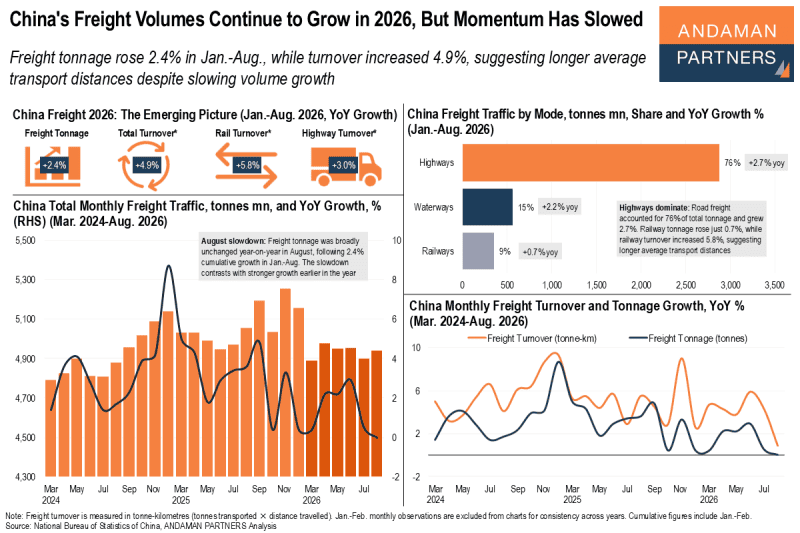
China’s Freight Volumes Continue to Grow in 2026, But Momentum Has Slowed
Freight tonnage rose 2.4% in Jan.-Aug., while turnover increased 4.9%, suggesting longer average transport distances
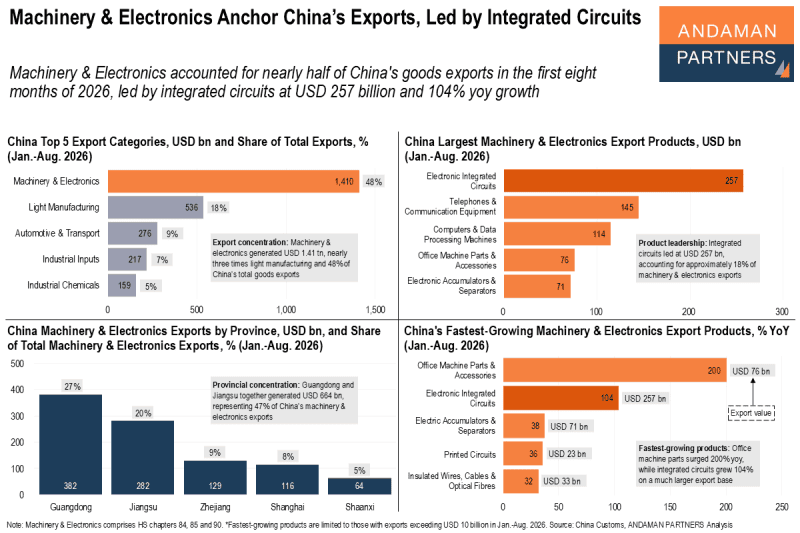
Machinery & Electronics Anchor China’s Exports, Led by Integrated Circuits
Machinery & Electronics accounted for nearly half of China’s goods exports in the first eight months of 2026, led by integrated circuits
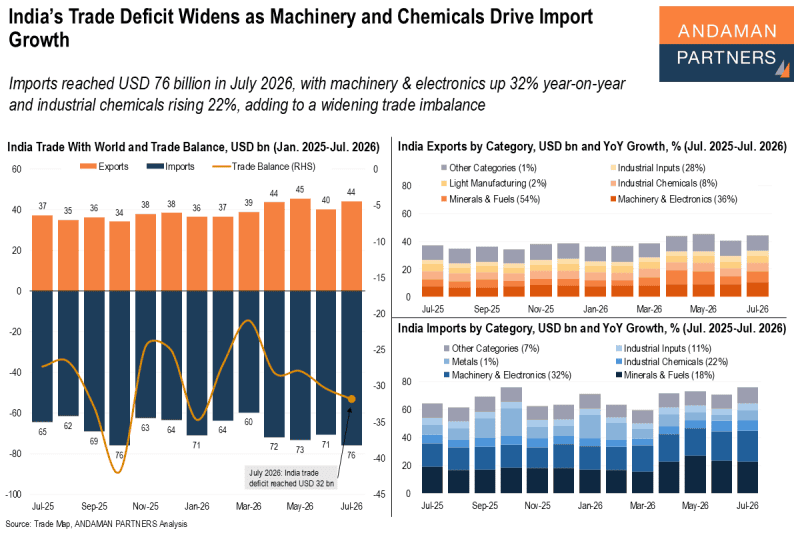
India’s Trade Deficit Widens as Machinery and Chemicals Drive Import Growth
Imports reached USD 76 billion in July 2026, with machinery & electronics up 32%, adding to a widening trade imbalance
Pingback: India’s Trade Deficit Widens | ANDAMAN PARTNERS