
EV Battery Value Chain
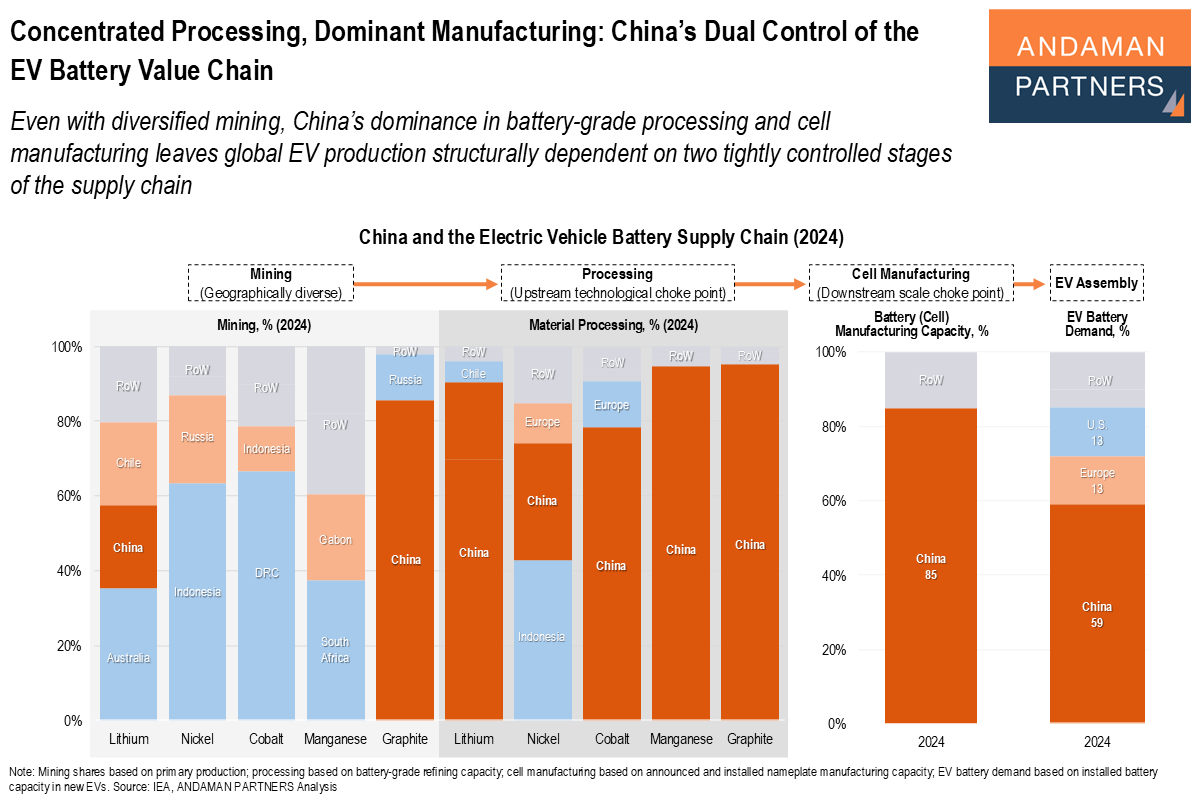
Concentrated Processing, Dominant Manufacturing: China’s Dual Control of the EV Battery Value Chain
Even with diversified mining, China’s dominance in battery-grade processing and cell manufacturing leaves global EV production structurally dependent on two tightly controlled stages of the supply chain.
Even as critical mineral supply becomes more geographically diversified, the global electric vehicle (EV) battery value chain remains structurally anchored in China because control is exercised not at the mine but at two decisive stages: processing and cell manufacturing.
Upstream, mining is distributed across Australia, Indonesia, the DRC, Chile and a range of other producers, with no single country dominating primary extraction across the major battery materials. This diversification has led many policymakers to believe that upstream dependence can be gradually reduced through new projects and investment partnerships. But this view overlooks where actual bottlenecks now exist. The binding constraint is no longer access to raw ore, but the ability to convert those materials into battery-grade inputs at scale.
In the materials processing industry, China has built overwhelming dominance across all five critical materials. In graphite, lithium, cobalt, manganese and large parts of nickel refining, China controls the vast majority of global battery-grade processing capacity. This stage focuses on technical know-how, environmental permitting, chemical engineering expertise and supply-chain integration, in a way that is extremely difficult to replicate elsewhere. Even diversified mining flows are therefore still routed back through Chinese processing networks.
Downstream, this concentration is reinforced by the scale of manufacturing. China accounts for around 85% of global cell manufacturing capacity but absorbs only about 59% of global EV battery demand. This surplus capacity positions China as the systemic supplier of last resort for the rest of the world. Western gigafactory build-outs can reduce exposure at the margin, but they remain dependent on Chinese-processed inputs and lag far behind in accumulated manufacturing experience, yields and ramp-up speed.
The result is a two-layer dependency. Mining diversification weakens upstream concentration, but it does not break the system’s core constraint. Control has migrated downstream to processing and scale manufacturing, where substitution is slow, capital-intensive and technologically complex. Until those two stages are meaningfully diversified, global EV production will remain structurally dependent on China, regardless of how widely mineral supply is distributed.
Also by ANDAMAN PARTNERS:
ANDAMAN PARTNERS supports international business ventures and growth. We help launch global initiatives and accelerate successful expansion across borders. If your business, operations or project requires cross-border support, contact connect@andamanpartners.com.

ANDAMAN PARTNERS Co-Founder Rachel Wu to Deliver Talk at SEP Global Reunion 2026 in Shanghai, China
Rachel will deliver a talk at the event entitled ‘Two SEPers in the Family – Building in China for 20+ Years’

ANDAMAN PARTNERS to Attend Stanford Executive Programme Global Reunion 2026 in Shanghai, China
ANDAMAN PARTNERS will attend the SEP Global Reunion 2026 in Shanghai, China, from 28 October to 1 November 2026

ANDAMAN PARTNERS to Attend 2026 IMF & World Bank Annual Meetings in Bangkok, Thailand
ANDAMAN PARTNERS will attend the IMF & World Bank Annual Meetings in Bangkok on 12-18 October 2026
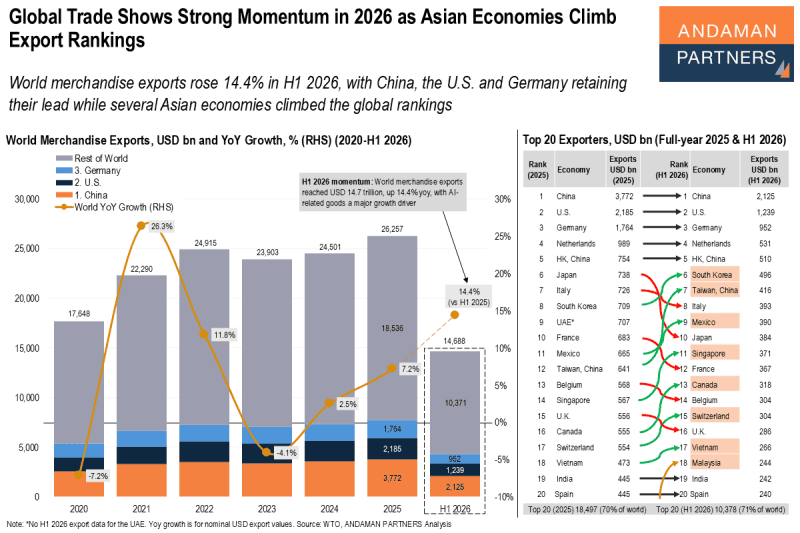
Global Trade Shows Strong Momentum in 2026 as Asian Economies Climb Export Rankings
World merchandise exports rose 14.4% in H1 2026, with several Asian economies climbing the global rankings
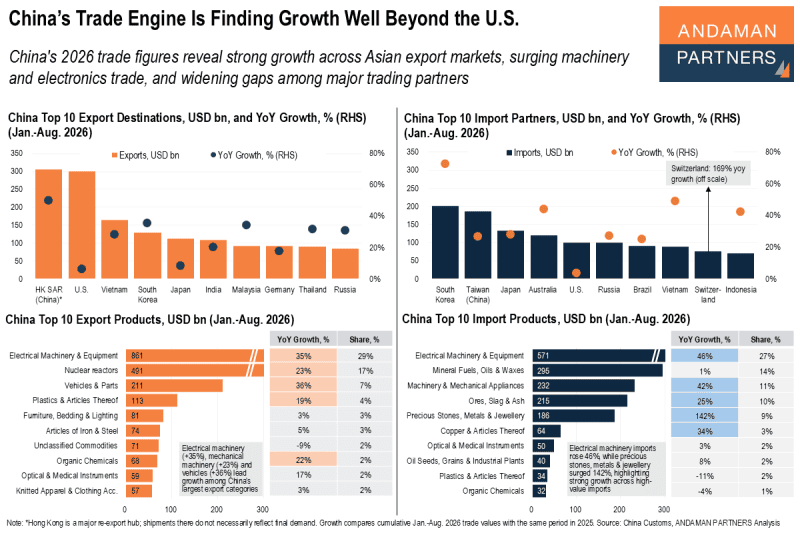
China’s Trade Engine Is Finding Growth Well Beyond the U.S.
China’s 2026 trade figures reveal strong growth across Asian export markets and surging machinery and electronics trade
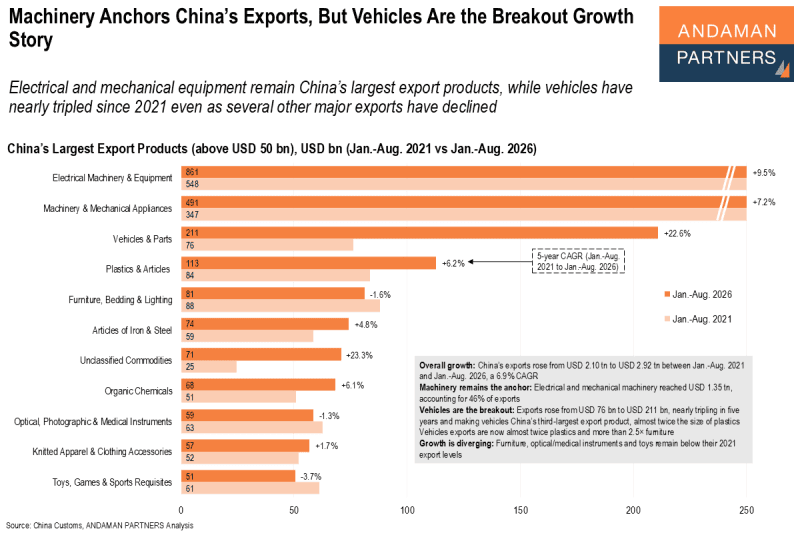
Machinery Anchors China’s Exports, But Vehicles Are the Breakout Growth Story
Electrical and mechanical equipment remain China’s largest export products, while vehicles have nearly tripled since 2021