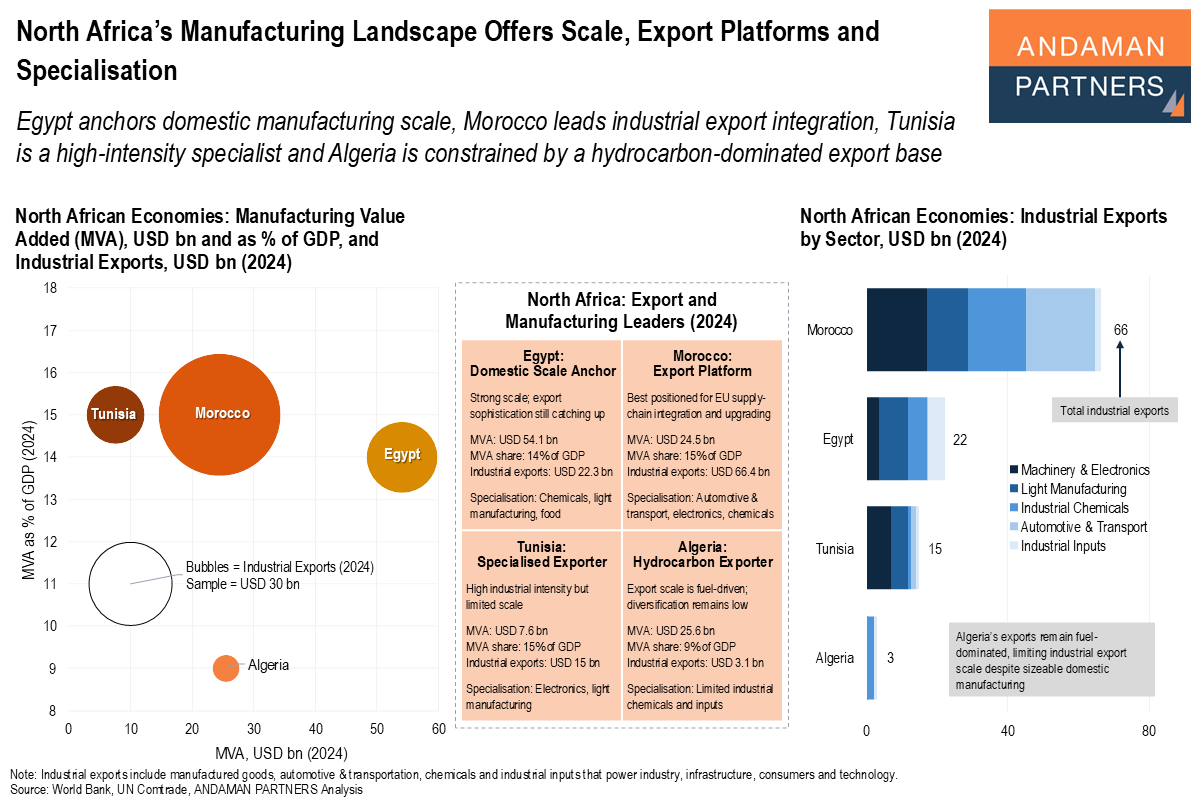

Egypt anchors domestic manufacturing scale, Morocco leads industrial export integration, Tunisia is a high-intensity specialist and Algeria is constrained by a hydrocarbon-dominated export base.
North Africa offers a compelling manufacturing proposition for global firms seeking nearshore capacity, cost-competitive production and proximity to European and Middle Eastern demand. The region’s industrial opportunity is concentrated in four economies—Egypt, Morocco, Tunisia and Algeria—which collectively account for the overwhelming majority of North Africa’s manufacturing value added (MVA) and export scale, and represent four distinct models for industrial growth.
Egypt is the region’s clear domestic scale anchor, with USD 54.1 billion in manufacturing value added in 2024 and an MVA share of 14% of GDP. Industrial exports total USD 22.3 billion, reflecting a broad base across chemicals, light manufacturing, and food-linked industries, but export sophistication still lags behind the scale of domestic production.
Morocco is North Africa’s standout export platform. While its MVA is smaller at USD 24.5 billion, its industrial export engine is the region’s largest at USD 66.4 billion, underpinned by strong integration into European supply chains. Export strength is concentrated in automotive and transport, machinery and electronics and industrial chemicals, all of which are aligned with higher-value-added manufacturing.
Tunisia is a smaller but highly industrialised specialist, with MVA of USD 7.6 billion but a high MVA share of 15% of GDP. Its USD 15 billion in industrial exports highlights deep integration into export-oriented light manufacturing and electronics supply chains, though limited domestic scale constrains overall volume.
Algeria, by contrast, combines meaningful manufacturing value (USD 25.6 billion) with the lowest industrial export scale (USD 3.1 billion) and the lowest MVA intensity (9% of GDP), reflecting an export economy still dominated by hydrocarbons and limited diversification into tradable industrial sectors.
North Africa offers clear strategic options: scale in Egypt, export-led platforms in Morocco, specialised production in Tunisia and selective downstream potential in Algeria.
Also by ANDAMAN PARTNERS:
ANDAMAN PARTNERS supports international business ventures and growth. We help launch global initiatives and accelerate successful expansion across borders. If your business, operations or project requires cross-border support, contact connect@andamanpartners.com.

ANDAMAN PARTNERS Attended the Australia Governance Summit 2026 in Sydney
ANDAMAN PARTNERS Co-Founder Kobus van der Wath attended the Australia Governance Summit (AGS26) in Sydney, Australia.

ANDAMAN PARTNERS Wishes You a Happy and Prosperous Year of the Horse!
Compliments of the Chinese Lunar New Year to all our clients, customers, suppliers and partners.

ANDAMAN PARTNERS to Attend Investing in African Mining Indaba 2026 in Cape Town
ANDAMAN PARTNERS Co-Founders Kobus van der Wath and Rachel Wu will attend Investing in African Mining Indaba 2026 in Cape Town, South Africa.

Africa’s Export Growth Remains Commodity-Led, with Scale Concentrated in a Handful of Economies
Exports have grown steadily since 2015, but minerals, fuels and metals still dominate, while five countries account for half of the total

Asia Moved From Demographic Scale in the 1990s to Global Economic and Trade Centrality in the 2020s
Asia’s share of global GDP and exports expanded sharply to 2025, bringing the region’s influence closer to its demographic scale.

Asia Is Driving the World’s Largest Expansion of Power Generation Capacity
Demand across Asia is driving simultaneous expansion in renewable generation, fossil fuel capacity and electricity grids