
You are currently viewing China’s Capital Goods Exports Are Shifting To New Industrial Markets

China’s Capital Goods Exports Are Shifting To New Industrial Markets

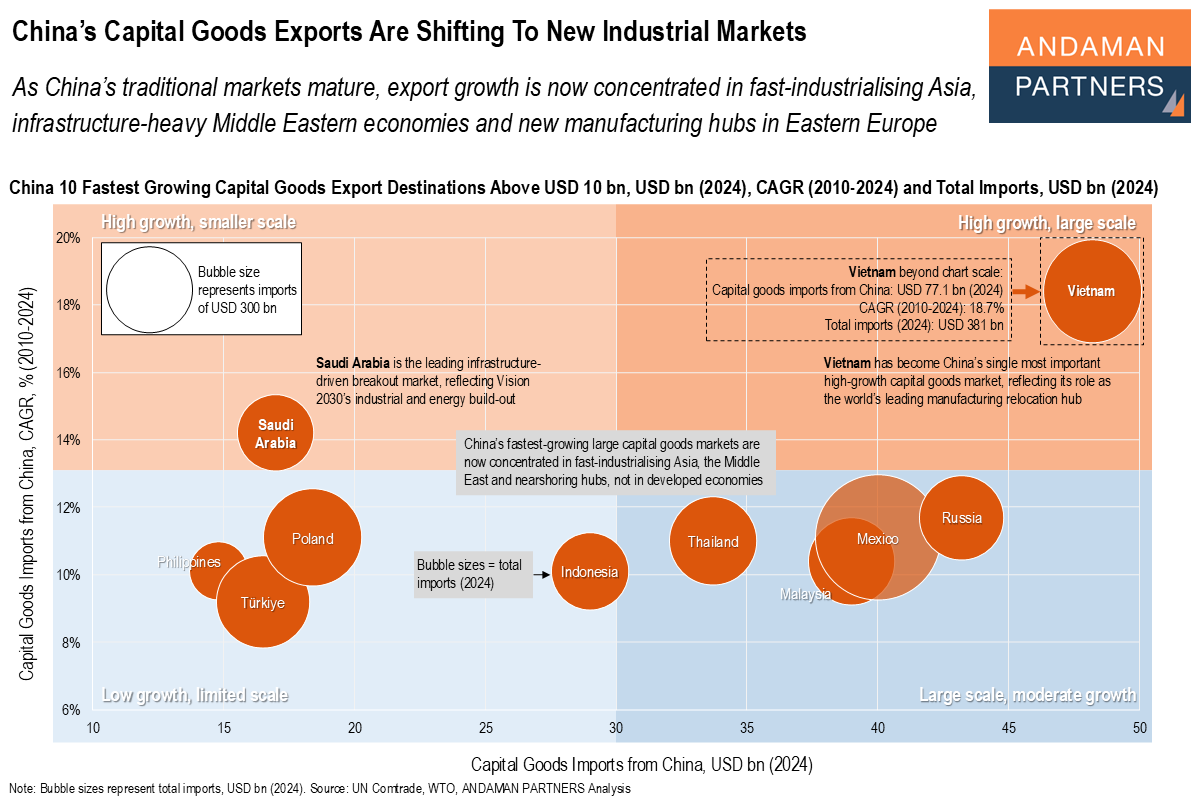
As China’s traditional markets mature, export growth is now concentrated in fast-industrialising Asia, infrastructure-heavy Middle Eastern economies and new manufacturing hubs in Eastern Europe.

China’s capital goods export growth is undergoing an unmistakable and structurally significant geographic reorientation. As China’s traditional developed markets mature, the fastest expansion is no longer coming from developed economies, but from a small group of fast-industrialising markets that are building the next wave of global manufacturing and infrastructure capacity.

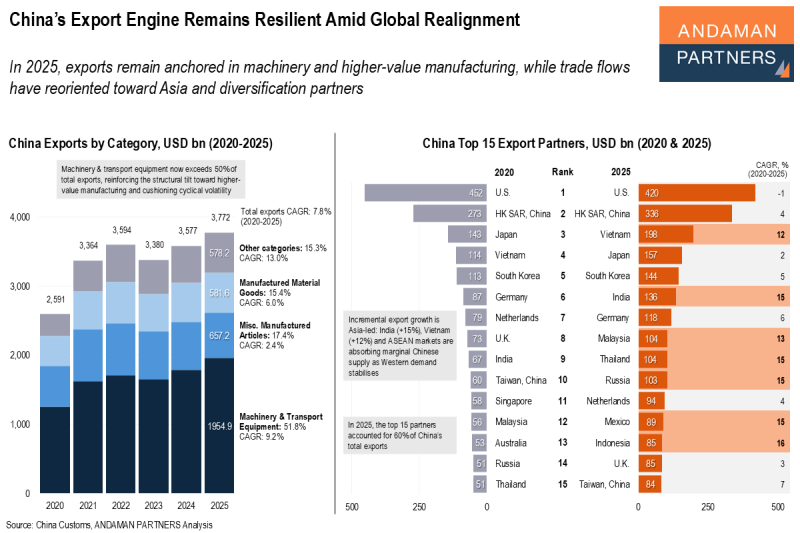
Scale and momentum now coincide most strongly in emerging industrial economies. Vietnam stands out as the dominant case. With imports exceeding USD 77 billion in 2024 and a CAGR of nearly 19% over 2010–2024, China has become its single most crucial high-growth capital goods destination. This reflects Vietnam’s role as the world’s leading manufacturing relocation hub, absorbing large volumes of machinery, equipment and production systems as global supply chains continue to diversify.

Across Southeast Asia, Indonesia, Thailand and Malaysia form a tight cluster combining meaningful scale with sustained growth. This concentration reflects the rapid build-out of manufacturing capacity across ASEAN, as multinational firms expand regional production networks in electronics, machinery, automotive and intermediate goods. Mexico plays a similar role from the nearshoring side, linking China’s capital goods exports directly to the reconfiguration of North American manufacturing.

In the Middle East, Saudi Arabia emerges as the leading infrastructure-driven breakout market. Its position reflects the scale of industrial, energy and construction investment under Vision 2030, which is generating sustained demand for heavy equipment, process machinery and industrial systems.

Equally important is what is no longer driving growth. Developed economies are mainly absent from the group of fastest-growing large markets. Export momentum is now structurally concentrated in fast-industrialising Asia, infrastructure-heavy Middle Eastern economies and new manufacturing hubs in Eastern Europe.

This matters because capital goods flows are a forward indicator of where future industrial capacity, supply chains and competitive ecosystems are being built. The centre of gravity of global industrial investment is shifting toward a new set of emerging markets, and China’s capital goods export engine is now firmly aligned with that new industrial geography.

Also by ANDAMAN PARTNERS:

ANDAMAN PARTNERS supports international business ventures and growth. We help launch global initiatives and accelerate successful expansion across borders. If your business, operations or project requires cross-border support, contact connect@andamanpartners.com.

Media
News & Events
Knowledge