
The Rise of BRICS in World Trade
The Rise of BRICS in World Trade: Catching Up With the G7
From 2000 to 2024, BRICS exports, led by China, have progressively advanced to current near parity with G7 exports. In 2024, BRICS accounted for 28% of world exports, near the share of the G7 of 32%, pointing to a momentous rebalancing of global trade with far-reaching implications for global businesses.
BRICS was formally constituted in 2009 with founding member states Brazil, Russia, India and China, and South Africa joined in 2010. In the following years, the BRICS bloc, although with a diverse group of member states, has become an engine of global growth and trade, and emblematic of an increasingly multipolar world. In 2024-2025, BRICS was bolstered by five new member states: Egypt, Ethiopia, Indonesia, Iran and the UAE.
In 2000, the collective exports of the five states that would constitute BRICS in 2010 amounted to USD 476 billion—a mere 8% of world exports—with China accounting for a share of 52%. At this time, the collective exports of the G7 states (Canada, France, Germany, Italy, Japan, the U.K. and the U.S.) amounted to USD 2.9 trillion, a share of 46% of world exports.
By 2010, BRICS exports amounted to USD 2.5 trillion, an increase of 18% from 2010, while G7 exports just exceeded USD 5 trillion. By this time, BRICS exports accounted for 17% of world exports, and the share of G7 exports had decreased to 34%.
By 2024, with the BRICS bloc now expanded to 10 member states, BRICS exports reached USD 5.9 trillion (of which China accounted for USD 3.6 trillion or 64%), accounting for 28% of world exports. G7 exports reached USD 6.7 trillion, accounting for 32% of world exports. From 2000 to 2024, BRICS exports grew 11.1%, while G7 exports grew only 3.6%.
BRICS economies, particularly China, India and Indonesia, are growing much faster than G7 economies in terms of both GDP and export volumes. It is likely only a matter of time until BRICS exports exceed G7 exports, a historic milestone that could occur within the next few years.
When BRICS exports surpass G7 exports, it would signal a momentous rebalancing of global trade and a structural shift with far-reaching implications. This shift would indicate that global production, logistics and consumer networks are being reshaped around emerging and developing economies, not developed economies.
For global businesses, the inexorable rise of BRICS points to the imperative of designing supply chains and market entry strategies that have BRICS at the centre, not the periphery.
ANDAMAN PARTNERS supports international business ventures and growth. We help launch global initiatives and accelerate successful expansion across borders. If your business, operations or project requires cross-border support, contact connect@andamanpartners.com.

How an Inland City Became One of China’s Top 5 Economies by ANDAMAN PARTNERS Co-Founder Rachel Wu
Analysis by ANDAMAN PARTNERS Co-Founder Rachel Wu on how Chongqing became one of China’s top 5 economies

China’s Role in Global Capex Project Procurement by ANDAMAN PARTNERS Co-Founder Rachel Wu
Analysis by ANDAMAN PARTNERS Co-Founder Rachel Wu on how China’s role has evolved in global capex project procurement

ANDAMAN PARTNERS Co-Founder Rachel Wu to Deliver Talk at SEP Global Reunion 2026 in Shanghai, China
Rachel will deliver a talk at the event entitled ‘Two SEPers in the Family – Building in China for 20+ Years’
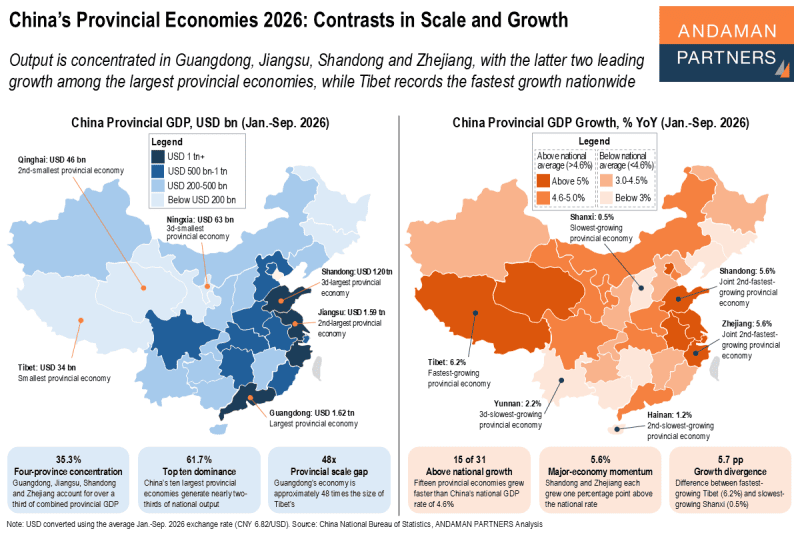
China’s Provincial Economies 2026: Contrasts in Scale and Growth
Output is concentrated in Guangdong, Jiangsu, Shandong and Zhejiang, while Tibet records the fastest growth nationwide
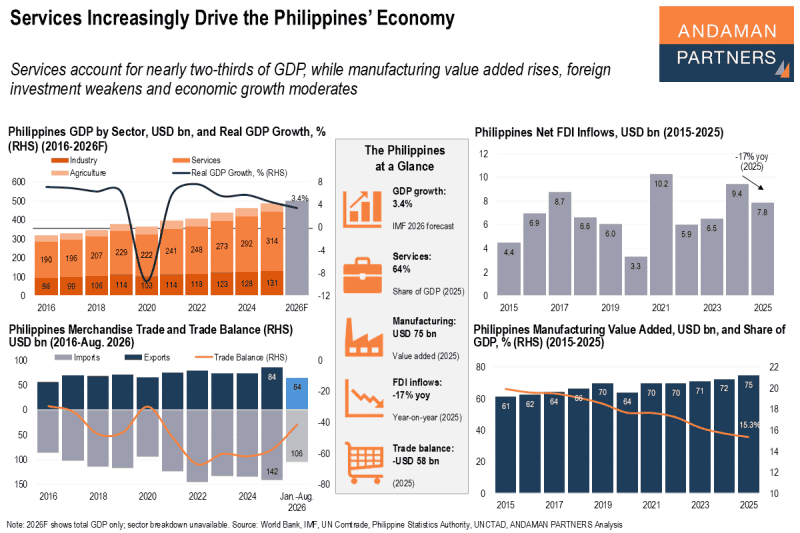
Services Increasingly Drive the Philippines’ Economy
Services account for two-thirds of GDP, while manufacturing value added rises, foreign investment weakens and growth moderates
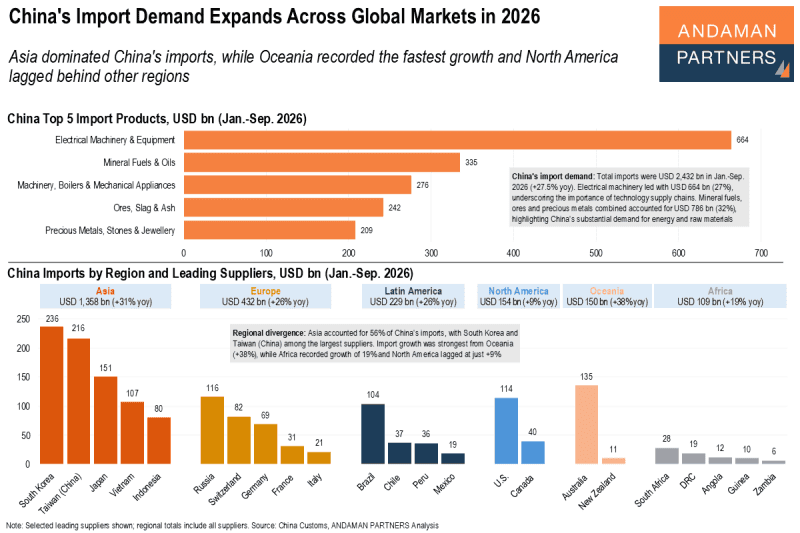
China’s Import Demand Expands Across Global Markets in 2026
Asia dominated China’s imports, while Oceania recorded the fastest growth and North America lagged behind other regions
Pingback: Brazil’s 70% Export Core | ANDAMAN PARTNERS