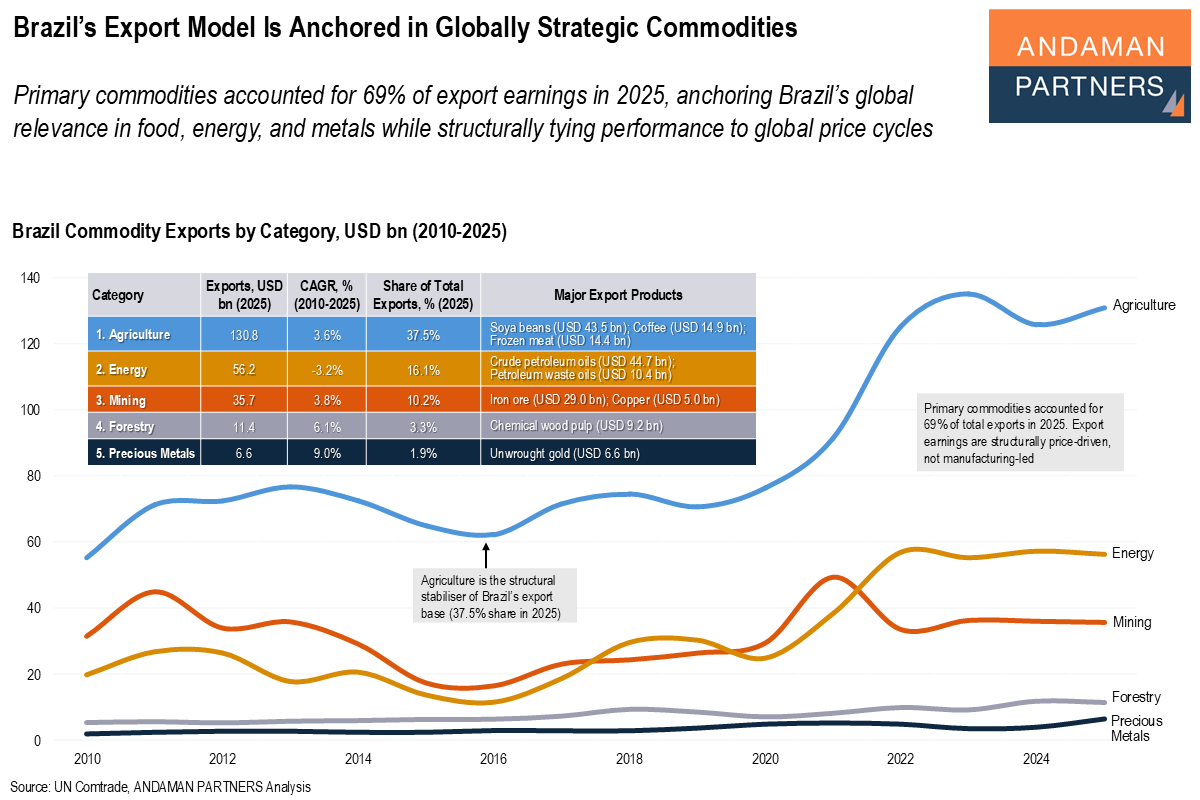

Primary commodities accounted for 69% of export earnings in 2025, anchoring Brazil’s global relevance in food, energy, and metals while structurally tying performance to global price cycles.
Brazil’s export structure is built on a broad and globally significant commodity base. In 2025, primary commodities accounted for 69% of export earnings, spanning agriculture (37.5% share, led by soya beans, coffee and meat), energy (16.1%, dominated by crude oil) and mining (10.2%, centred on iron ore and copper), with forestry and precious metals adding further depth.
This highlights both scale and cyclicality in Brazil’s exports: agriculture provides a steady structural anchor, while energy and mining amplify swings linked to global price cycles, visible in the mid-2010s downturn and the 2021–2022 commodity surge.
This breadth across food, energy and metals positions Brazil as a systemically important supplier to global markets. Strategically, however, export earnings remain structurally price-driven rather than manufacturing-led, meaning trade performance, fiscal dynamics and currency stability are closely tied to external demand and commodity cycles rather than diversified value-added exports.
Also by ANDAMAN PARTNERS:
ANDAMAN PARTNERS supports international business ventures and growth. We help launch global initiatives and accelerate successful expansion across borders. If your business, operations or project requires cross-border support, contact connect@andamanpartners.com.

ANDAMAN PARTNERS Attended the Australia Governance Summit 2026 in Sydney
ANDAMAN PARTNERS Co-Founder Kobus van der Wath attended the Australia Governance Summit (AGS26) in Sydney, Australia.

ANDAMAN PARTNERS Wishes You a Happy and Prosperous Year of the Horse!
Compliments of the Chinese Lunar New Year to all our clients, customers, suppliers and partners.

ANDAMAN PARTNERS to Attend Investing in African Mining Indaba 2026 in Cape Town
ANDAMAN PARTNERS Co-Founders Kobus van der Wath and Rachel Wu will attend Investing in African Mining Indaba 2026 in Cape Town, South Africa.

Africa’s Export Growth Remains Commodity-Led, with Scale Concentrated in a Handful of Economies
Exports have grown steadily since 2015, but minerals, fuels and metals still dominate, while five countries account for half of the total

Asia Moved From Demographic Scale in the 1990s to Global Economic and Trade Centrality in the 2020s
Asia’s share of global GDP and exports expanded sharply to 2025, bringing the region’s influence closer to its demographic scale.

Asia Is Driving the World’s Largest Expansion of Power Generation Capacity
Demand across Asia is driving simultaneous expansion in renewable generation, fossil fuel capacity and electricity grids