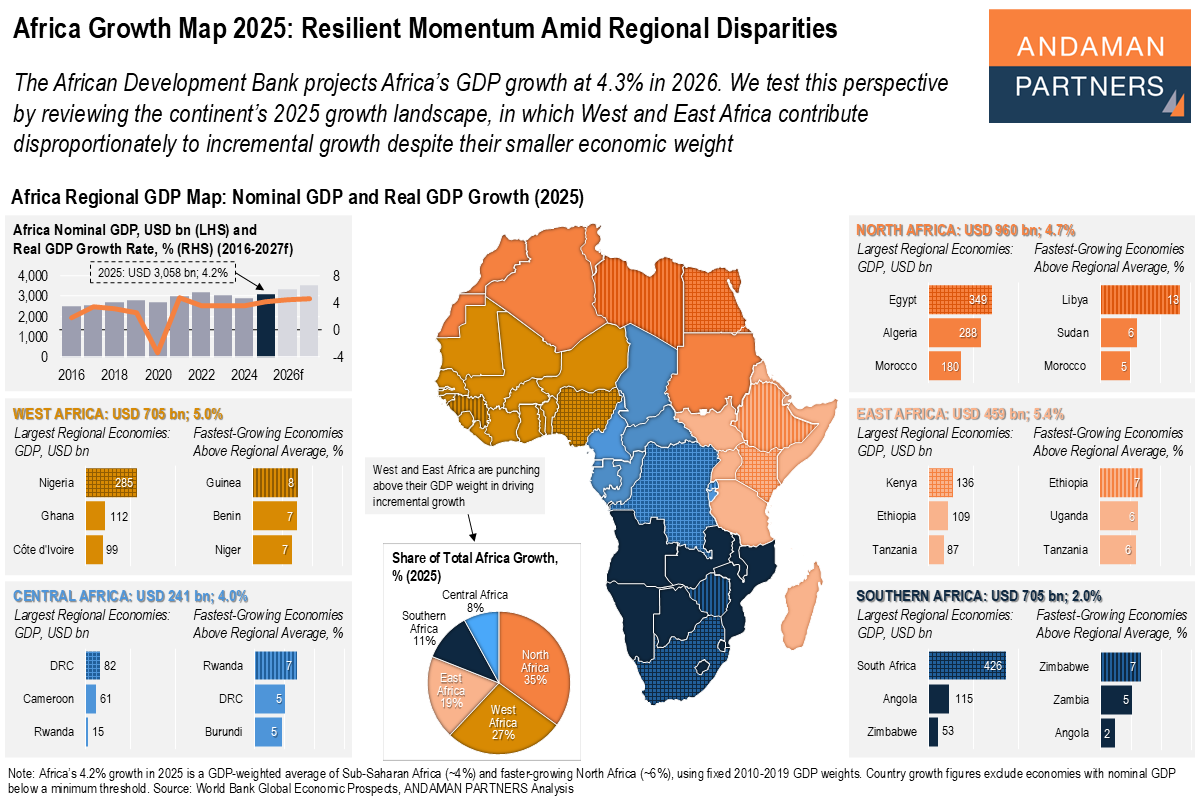
The African Development Bank projects Africa’s real GDP growth to reach 4.3% in 2026, up from 4.2% in 2025. ANDAMAN PARTNERS tests this growth outlook by reviewing Africa’s regional growth landscape in 2025.
While the continent’s growth is broad-based, the sources of incremental expansion differ markedly across regions in terms of scale, speed and contribution. West and East Africa contribute disproportionately to incremental growth despite smaller economic weight, while North Africa combines scale with strong momentum, and Southern Africa lags in slower expansion.
North Africa is expected to grow by around 4.7% in 2025 and accounts for roughly USD 960 billion in nominal GDP. The region delivers the single largest contribution to Africa’s GDP. Egypt, with a GDP of approximately USD 349 billion, anchors regional scale, supported by Algeria (USD 288 billion) and Morocco (USD 180 billion). On the momentum side, Libya stands out as the fastest-growing economy, expanding by around 13%, albeit from a smaller base. This combination of scale and strong growth makes North Africa a key engine of continental expansion.
West Africa, with a nominal GDP of about USD 705 billion, is projected to grow by roughly 5.0% in 2025. Nigeria dominates regional scale with a GDP of around USD 285 billion, followed by Ghana and Côte d’Ivoire. However, growth momentum is driven by smaller economies: Guinea has the fastest growth at around 8%, followed by Benin and Niger at roughly 7% each. As a result, West Africa contributes disproportionately to Africa’s incremental growth relative to its share of GDP.
East Africa is the fastest-growing region, expanding by an estimated 5.4% in 2025, with a nominal GDP of approximately USD 459 billion. Kenya (USD 136 billion), Ethiopia (USD 109 billion) and Tanzania (USD 87 billion) provide scale, while Ethiopia leads in momentum with growth of about 7%, alongside Uganda and Tanzania at around 6%. The region’s combination of size and sustained high growth underpins its outsized role in Africa’s growth outlook.
Central Africa is projected to grow by about 4.0% in 2025 and has a comparatively small economic base of roughly USD 241 billion. The DRC (USD 82 billion) and Cameroon (USD 61 billion) dominate regional GDP, while Rwanda is the fastest-growing economy at around 7%. Despite solid growth, limited scale constrains the region’s overall contribution.
Southern Africa, with a nominal GDP of around USD 705 billion, is expected to grow by only 2.0% in 2025. South Africa, by far the largest economy at approximately USD 426 billion, continues to weigh on regional performance with subdued growth. Zimbabwe is set to achieve the fastest at around 7%, but its smaller size limits its impact. Consequently, Southern Africa underperforms relative to its economic weight in driving Africa’s growth.
Overall, Africa’s 2025 growth story is one of resilience, but also of sharply differentiated regional roles in driving that outcome.