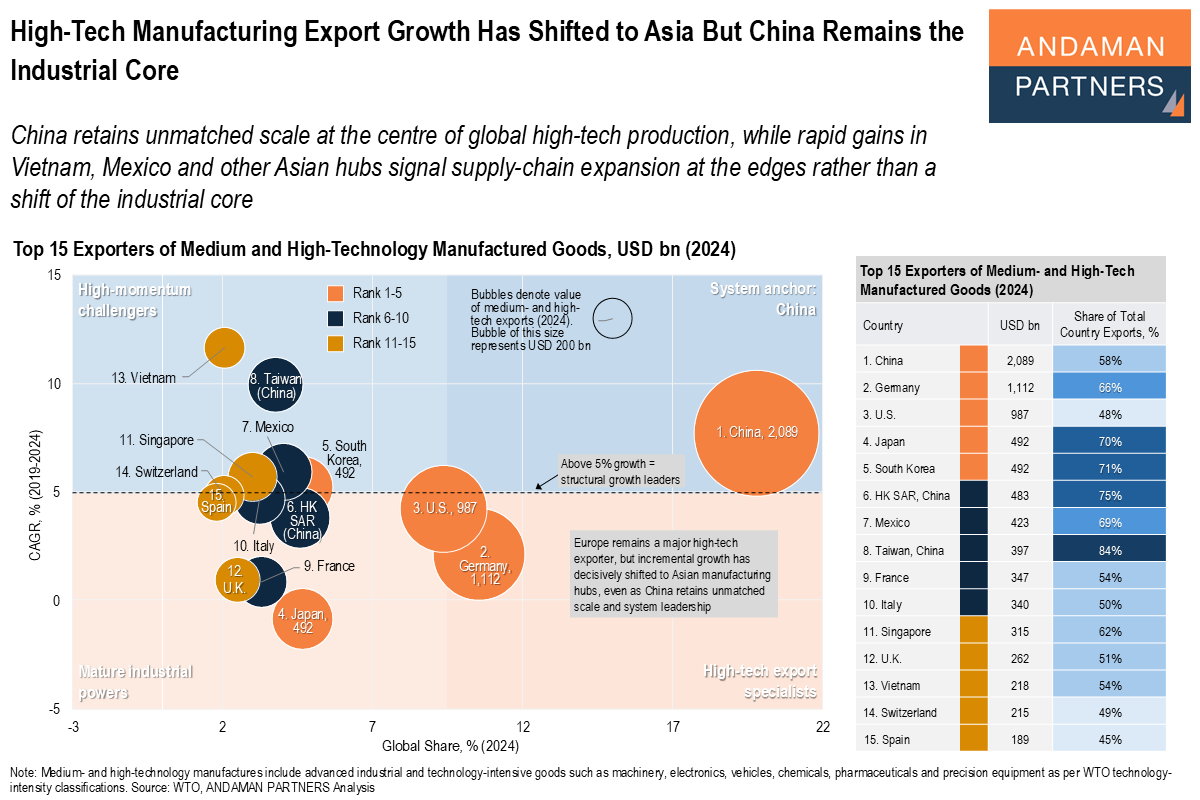
China retains unmatched scale at the centre of global high-tech production, while rapid gains in Vietnam, Mexico and other Asian hubs signal supply-chain expansion at the edges rather than a shift of the industrial core.
Global high-tech manufacturing is expanding geographically, but its centre of gravity has not moved. China stands apart on sheer scale, exporting more medium- and high-technology manufactures than any other country by a wide margin. Its recent growth is steady rather than spectacular, yet its size means it continues to anchor the global production network. This signals that the deepest supplier ecosystems, the broadest industrial capabilities and the highest capacity for rapid scale-up remain concentrated in China.
At the same time, momentum is clearly building elsewhere in Asia. Vietnam recorded the fastest sustained growth among major exporters (2019-2024 CAGR of 12%), while Taiwan (China) and South Korea pair strong growth with meaningful scale. Taiwan (China) is particularly striking: a large exporter whose national export basket is overwhelmingly high-tech (84% share), reflecting its pivotal role in advanced electronics and semiconductor value chains. Singapore and Mexico (both with a 6% CAGR) also show above-average expansion, pointing to Asian regionalisation and North American near-shoring dynamics.
Europe’s leading exporters, including Germany, France and Italy, remain large and technologically sophisticated, but are in the slower-growth tier along with Japan. These economies continue to matter enormously for quality, engineering depth and specialised equipment, but the fastest-compounding additions to global high-tech capacity are now occurring in Asian hubs rather than in Europe.
The emerging pattern for medium- and high-tech exports is a China-centred core surrounded by a widening ring of fast-growing Asian production nodes. Growth at the edges does not displace the core; it reinforces a broader, Asia-weighted manufacturing system.
For corporate strategy, that means diversification opportunities are increasing, but critical dependencies are also becoming more regionally concentrated. Decisions on sourcing, partnerships and investment will increasingly hinge on how effectively companies position themselves within this China-anchored, Asia-driven industrial ecosystem.
Also by ANDAMAN PARTNERS:
ANDAMAN PARTNERS supports international business ventures and growth. We help launch global initiatives and accelerate successful expansion across borders. If your business, operations or project requires cross-border support, contact connect@andamanpartners.com.

ANDAMAN PARTNERS Attended the Australia Governance Summit 2026 in Sydney
ANDAMAN PARTNERS Co-Founder Kobus van der Wath attended the Australia Governance Summit (AGS26) in Sydney, Australia.
ANDAMAN PARTNERS Wishes You a Happy and Prosperous Year of the Horse!
Compliments of the Chinese Lunar New Year to all our clients, customers, suppliers and partners.

ANDAMAN PARTNERS to Attend Investing in African Mining Indaba 2026 in Cape Town
ANDAMAN PARTNERS Co-Founders Kobus van der Wath and Rachel Wu will attend Investing in African Mining Indaba 2026 in Cape Town, South Africa.

The World’s Most Strategic Supply Chain Is Highly Concentrated and Interdependent
Integrated circuits exceed USD 1 trillion in global trade, with supply concentrated in Asia and demand in China, reinforcing structural dependencies.

China’s Long-Term Impact on Global Trade and the Reconfiguration of the World Economy
China’s rise from a minor exporter to the centre of global manufacturing redefined trade flows, reshaped supply chains and forced the global economy to evolve.

Global Trade Has Recovered To Scale, With Export Power Still Concentrated
Merchandise trade reaches USD 26 trillion in 2025, while the top 20 exporters account for 70% of global exports.