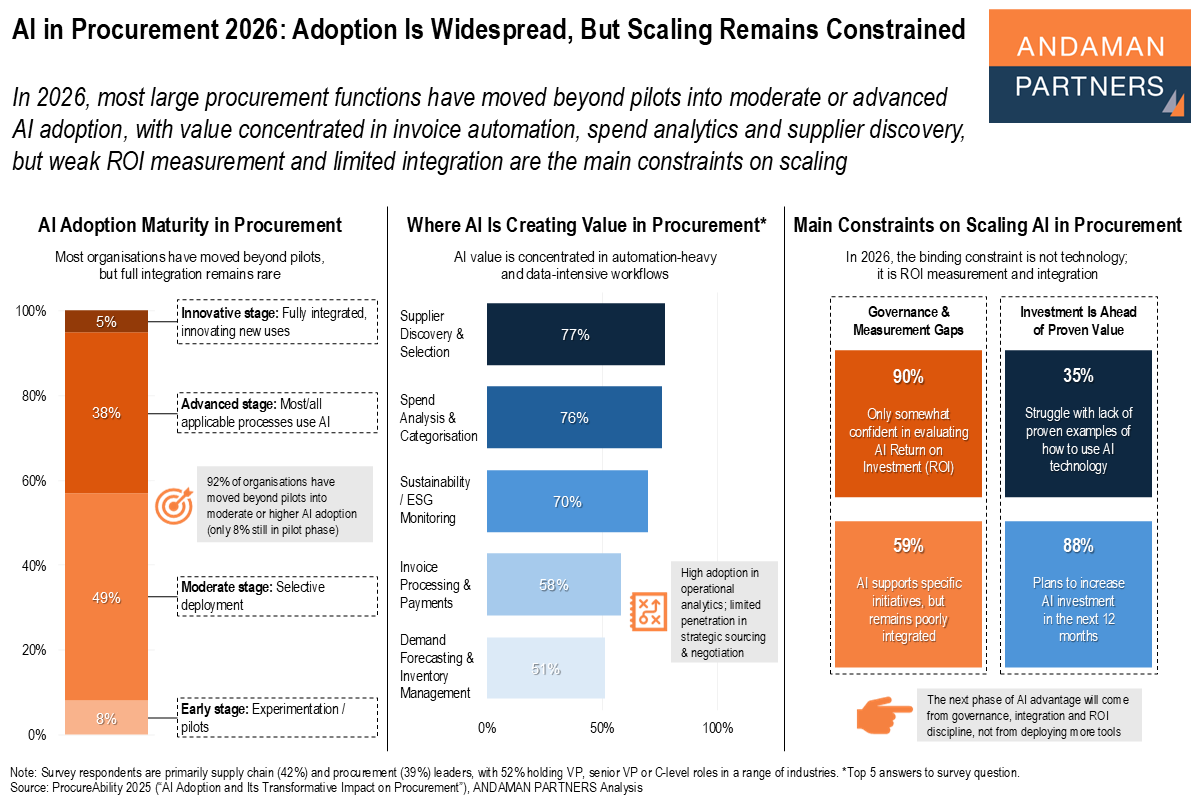

Most large procurement functions have moved beyond pilots into moderate or advanced AI adoption, with value concentrated in invoice automation, spend analytics and supplier discovery, but weak ROI measurement and limited integration are the main constraints on scaling.
In 2026, AI adoption in procurement is no longer the story. Scaling, integration and value discipline are.
Across large procurement functions, AI has moved decisively beyond pilots into mainstream deployment. The impact of AI remains concentrated, however, in a narrow set of operational workflows; weak return on investment (ROI) measurement and limited integration are now the binding constraints on further scaling.
The findings of the ProcureCon Insights/ProcureAbility survey published in 2025, AI Adoption and Its Transformative Impact on Procurement, provide a rare, practitioner-level view of how AI is actually being deployed inside procurement functions today. The survey primarily covers supply chain (42%) and procurement (39%) leaders, with more than half holding VP, senior VP or C-level roles across a broad range of industries and company sizes.
The AI maturity picture is already striking. Only 8% of organisations remain in pilot mode, while 92% have reached moderate adoption or higher. Nearly half are selectively deploying AI across core processes, and more than a third report advanced adoption across most applicable workflows. In other words, adoption is no longer the constraint.
Where AI is creating value, however, it is still highly concentrated. Usage is strongest in supplier discovery, spend categorisation, ESG monitoring, invoice processing and demand forecasting—all automation-heavy, data-intensive activities. By contrast, penetration remains limited in the strategic core of procurement, including sourcing, negotiation and RFX, underscoring that AI’s impact is still operational rather than transformational.
The main bottleneck is now governance. A complete 90% of organisations remain only somewhat confident in evaluating AI ROI, 59% report that AI still supports isolated initiatives rather than being fully integrated and 35% cite the lack of proven examples as their biggest roadblock, even as 88% plan to increase AI investment in the next 12 months.
The implication is clear: the next phase of AI advantage in procurement will come not from deploying more tools, but from governance, integration and ROI discipline.
Also by ANDAMAN PARTNERS:
ANDAMAN PARTNERS supports international business ventures and growth. We help launch global initiatives and accelerate successful expansion across borders. If your business, operations or project requires cross-border support, contact connect@andamanpartners.com.

ANDAMAN PARTNERS Attended the Australia Governance Summit 2026 in Sydney
ANDAMAN PARTNERS Co-Founder Kobus van der Wath attended the Australia Governance Summit (AGS26) in Sydney, Australia.
ANDAMAN PARTNERS Wishes You a Happy and Prosperous Year of the Horse!
Compliments of the Chinese Lunar New Year to all our clients, customers, suppliers and partners.

ANDAMAN PARTNERS to Attend Investing in African Mining Indaba 2026 in Cape Town
ANDAMAN PARTNERS Co-Founders Kobus van der Wath and Rachel Wu will attend Investing in African Mining Indaba 2026 in Cape Town, South Africa.

China’s Passenger Car Export Engine Accelerates, led by Electric Vehicles
A sharp post-2021 step-change in car exports is scaling rapidly and expanding China’s reach across developed and emerging markets.

Global Trade Imbalances Widen in 2025 as Surpluses Strengthen and Deficits Deepen
Surplus economies expanded export capacity, while deficit economies absorbed more goods despite selective adjustments across mid-tier markets.

The World Mines With Chinese Equipment: Scale in Core Inputs, Growth in High-Value Segments
China is no longer just a low-cost supplier; it now leads in high-growth segments while maintaining scale in consumables and components.