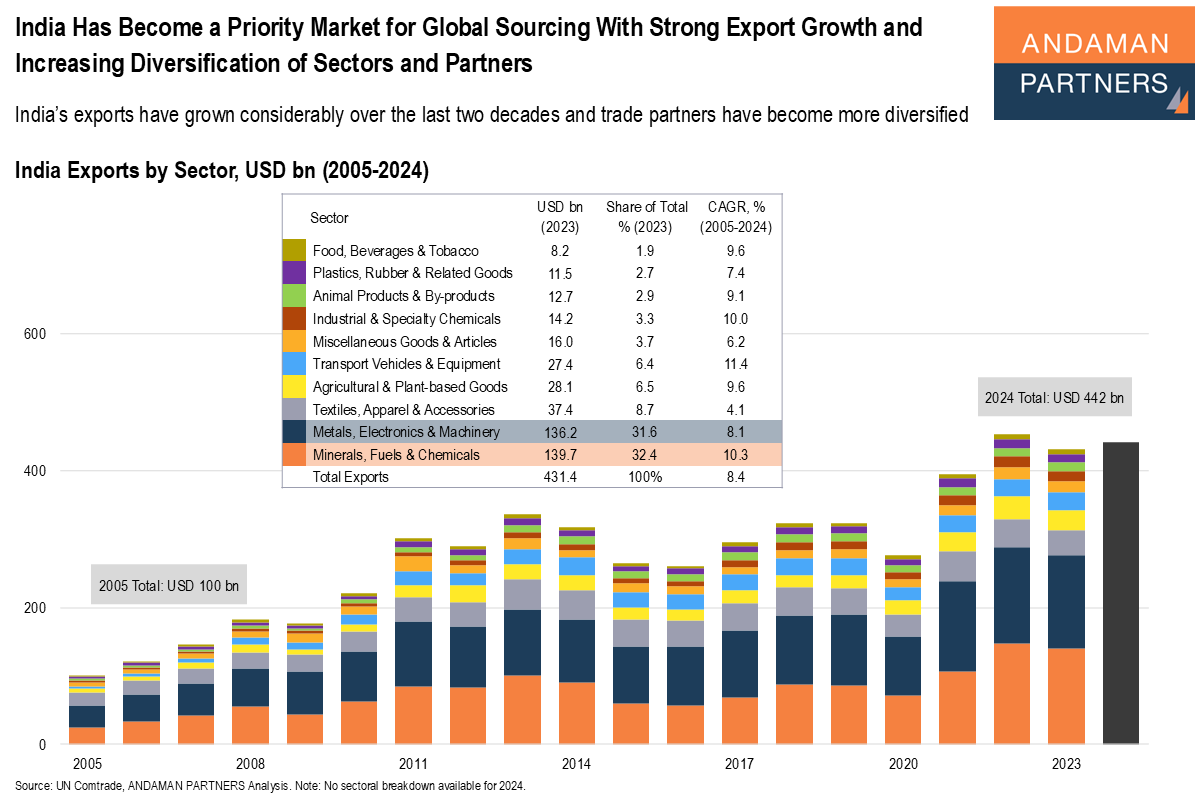
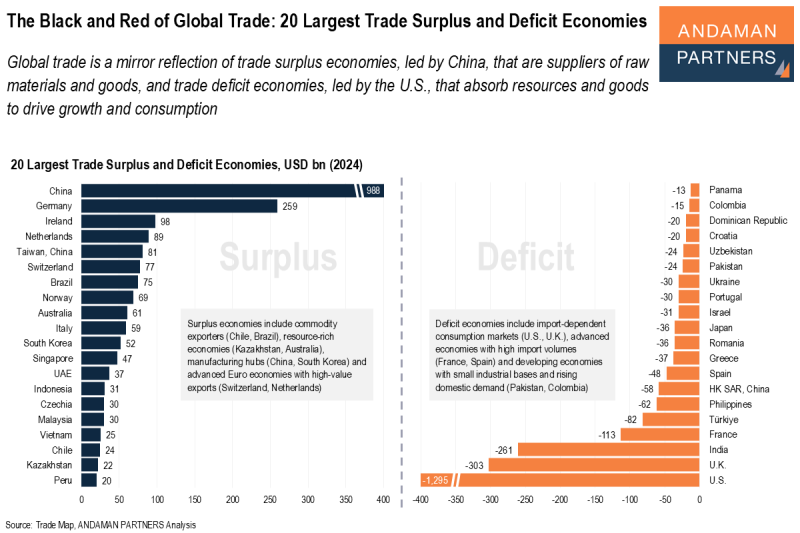
In 2024, India’s exports amounted to over USD 440 billion, compared to only USD 100 billion in 2005. Based on a sectoral breakdown for 2023 (total exports USD 431.4 billion), the country’s exports were mainly Minerals, Fuels & Chemicals (32.4% of the total, primarily refined petroleum) and Metals, Electronics & Machinery (31.6% of the total, primarily electronic goods).
From 2005 to 2024, these two export sectors grew rapidly (10.3% and 8.1%, respectively). While accounting for smaller segments of India’s total exports, other sectors grew even faster over this period, indicating the increasing diversification of the country’s export profile. For example, Transport Vehicles grew by 11.4%, Industrial Chemicals by 10% and Agricultural Goods by 9.6%.
India’s export partners have also become more diversified. Since 2005, the U.S. has consistently been one of India’s largest trading partners. In 2023, the U.S. was the largest export partner, accounting for 17.6% of India’s exports, followed by the UAE (7.7%) and the Netherlands (5.4%). The Netherlands has steadily risen as an export partner for India, from the 11th-largest partner in 2000 to 6th in 2010 and third in 2023.
In addition, several emerging markets and developing economies have become significant export partners for India, including China (15th-largest partner in 2000 to fourth-largest in 2023), Bangladesh (14th to seventh-largest) and Saudi Arabia (12th to eighth-largest). In 2023, Bangladesh accounted for 11.3% of India’s exports and Saudi Arabia for 10.8%.
India’s export ecosystem will continue to grow and diversify, positioning the country for further export-driven economic expansion in the coming years.
Companies across regions and industries must consider how to tap into India’s dynamic export industries and the country’s industrial and consumer markets. The following are potential key levers to engage the Indian economy:
- Potentially set up a sourcing office in India.
- Explore India for direct sourcing and consider its position in a China +1 or China +3 construct.
- Explore international distributorships for Indian products and brands.
- Identify market opportunities for exports to India.
- Pursue a deeper engagement with a presence or partnerships on the ground in India.
- Consider India as a strategic greenfield investment destination for international expansion initiatives.
- Explore potential acquisitions of existing businesses in India.
ANDAMAN PARTNERS supports international business ventures and growth. We help launch global initiatives and accelerate successful expansion across borders. If your business, operations or project requires cross-border support, contact connect@andamanpartners.com.