Disrupted Choke Points Are Forcing a Structural Rerouting of Global Trade
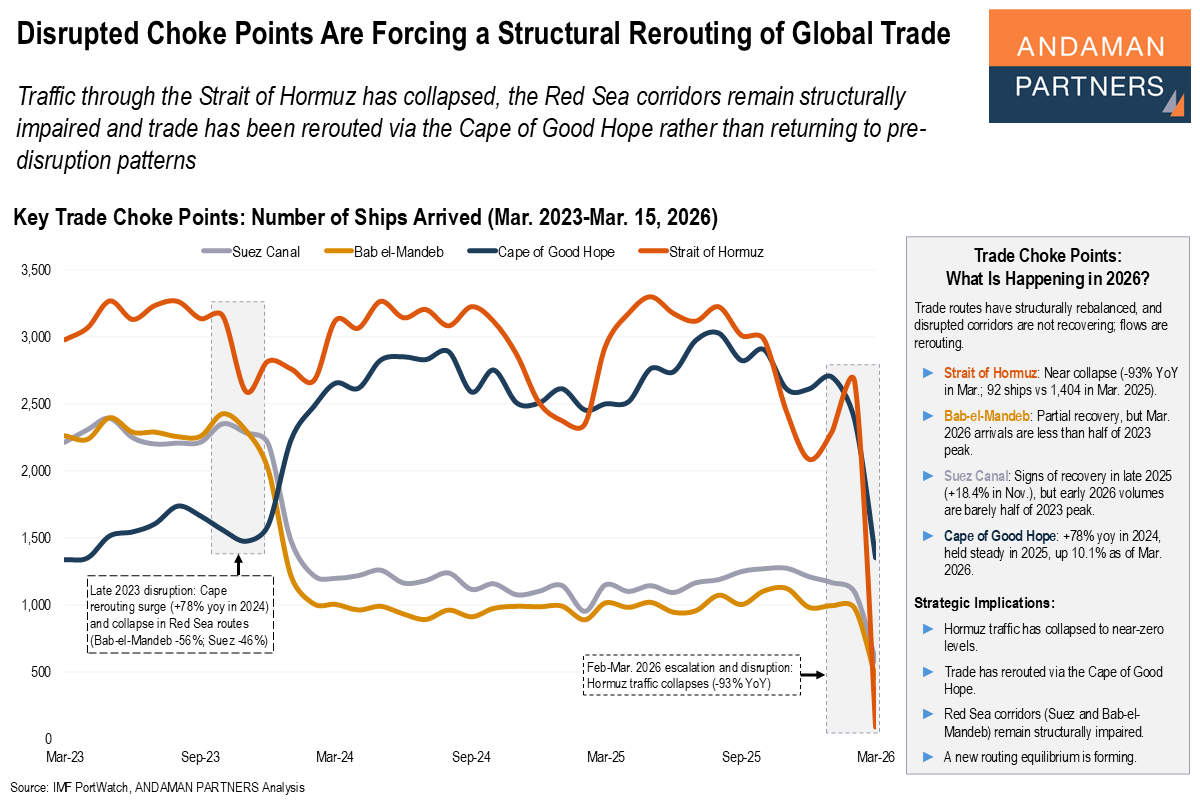
Traffic through the Strait of Hormuz has collapsed, the Red Sea corridors remain structurally impaired and trade has been rerouted via the Cape of Good Hope rather than returning to pre-disruption patterns.
Global shipping patterns have shifted decisively since late 2023, with disruptions at key maritime choke points driving a structural rerouting of trade flows. Traffic through the Strait of Hormuz collapsed in early 2026, with arrivals down 93% year-on-year in March, with just 92 ship arrivals during March 1–15 compared with 1,404 in the same period of 2025.
The Red Sea corridors (Suez Canal and Bab-el-Mandeb) were heavily disrupted in 2024, with traffic falling 46% and 56%, respectively. While both showed signs of recovery in late 2025, volumes in early 2026 remain at roughly half of their 2023 levels. In contrast, the Cape of Good Hope has absorbed this displacement, with ship arrivals rising 78% in 2024, remaining elevated through 2025 and still up 10.1% as of March 2026.
These trends indicate that global shipping networks are not reverting to pre-disruption routes but are stabilising along alternative pathways. For global companies, this shift implies longer transit times, higher freight costs and increased route concentration risk. All this reinforces the need to reassess logistics strategies, supplier footprints and inventory buffers in a trade environment that is adjusting to a new equilibrium.
Also by ANDAMAN PARTNERS:
ANDAMAN PARTNERS supports international business ventures and growth. We help launch global initiatives and accelerate successful expansion across borders. If your business, operations or project requires cross-border support, contact connect@andamanpartners.com.

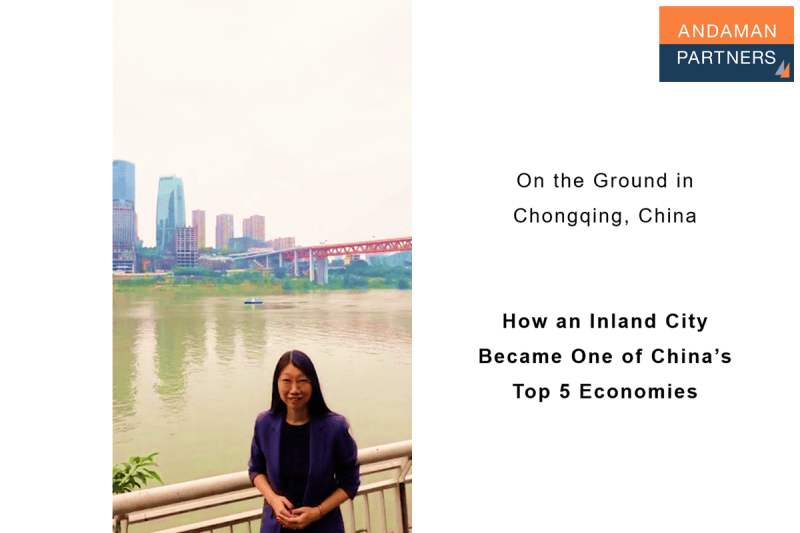
How an Inland City Became One of China’s Top 5 Economies by ANDAMAN PARTNERS Co-Founder Rachel Wu
Analysis by ANDAMAN PARTNERS Co-Founder Rachel Wu on how Chongqing became one of China’s top 5 economies
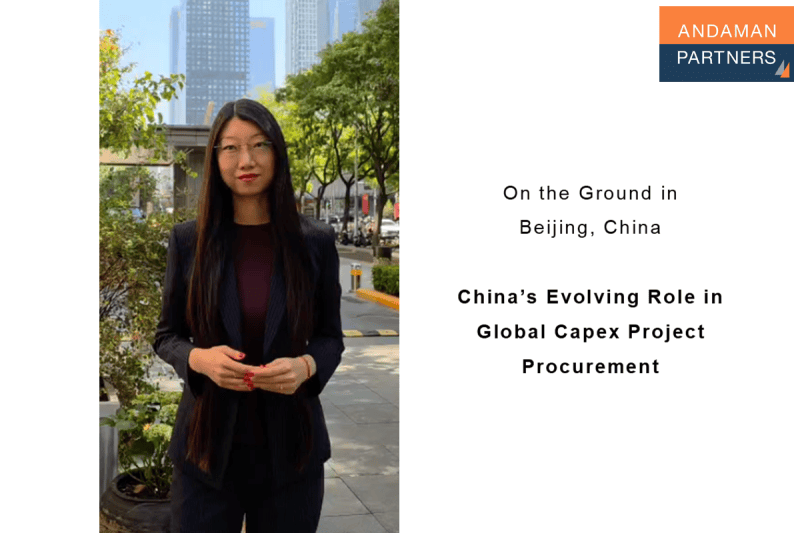
China’s Role in Global Capex Project Procurement by ANDAMAN PARTNERS Co-Founder Rachel Wu
Analysis by ANDAMAN PARTNERS Co-Founder Rachel Wu on how China’s role has evolved in global capex project procurement

ANDAMAN PARTNERS Co-Founder Rachel Wu to Deliver Talk at SEP Global Reunion 2026 in Shanghai, China
Rachel will deliver a talk at the event entitled ‘Two SEPers in the Family – Building in China for 20+ Years’
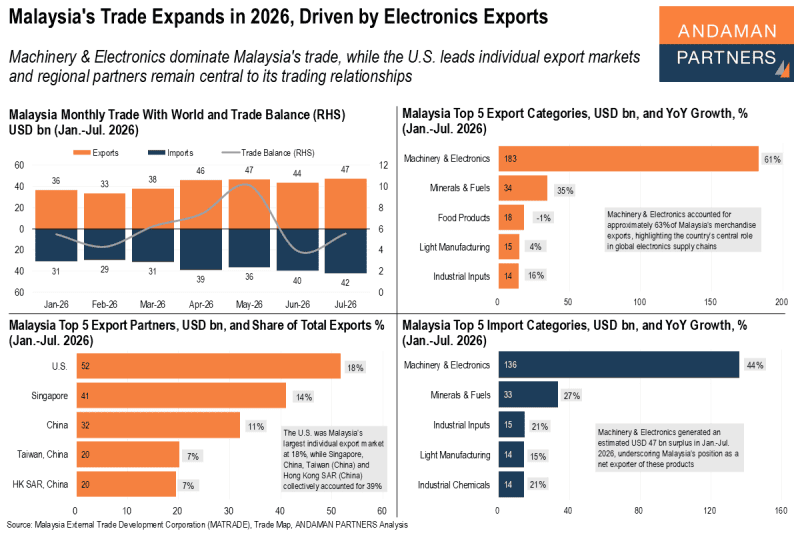
Malaysia’s Trade Expands in 2026, Driven by Electronics Exports
Machinery & Electronics dominate Malaysia’s trade, while the U.S. leads individual export markets
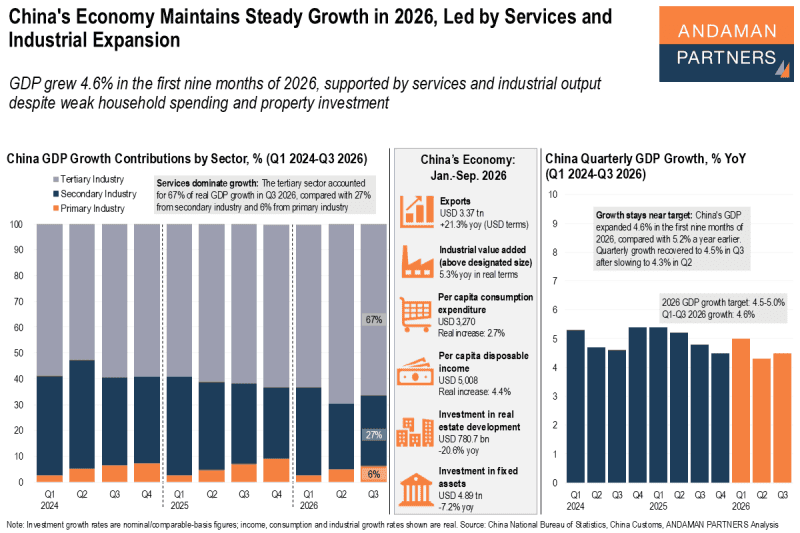
China’s Economy Maintains Steady Growth in 2026, Led By Services and Industrial Expansion
GDP grew 4.6% in the first nine months of 2026, supported by services and industrial output
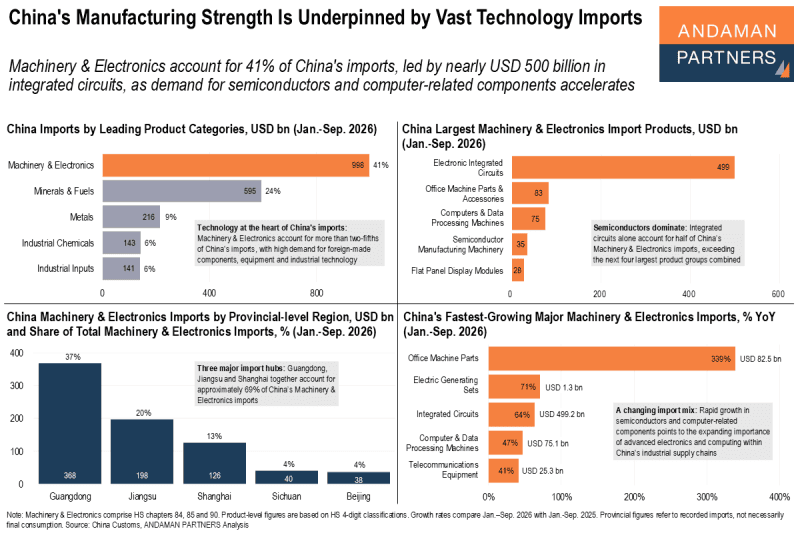
China’s Manufacturing Strength Is Underpinned by Vast Technology Imports
Machinery & Electronics account for 41% of China’s imports, led by nearly USD 500 billion in integrated circuits