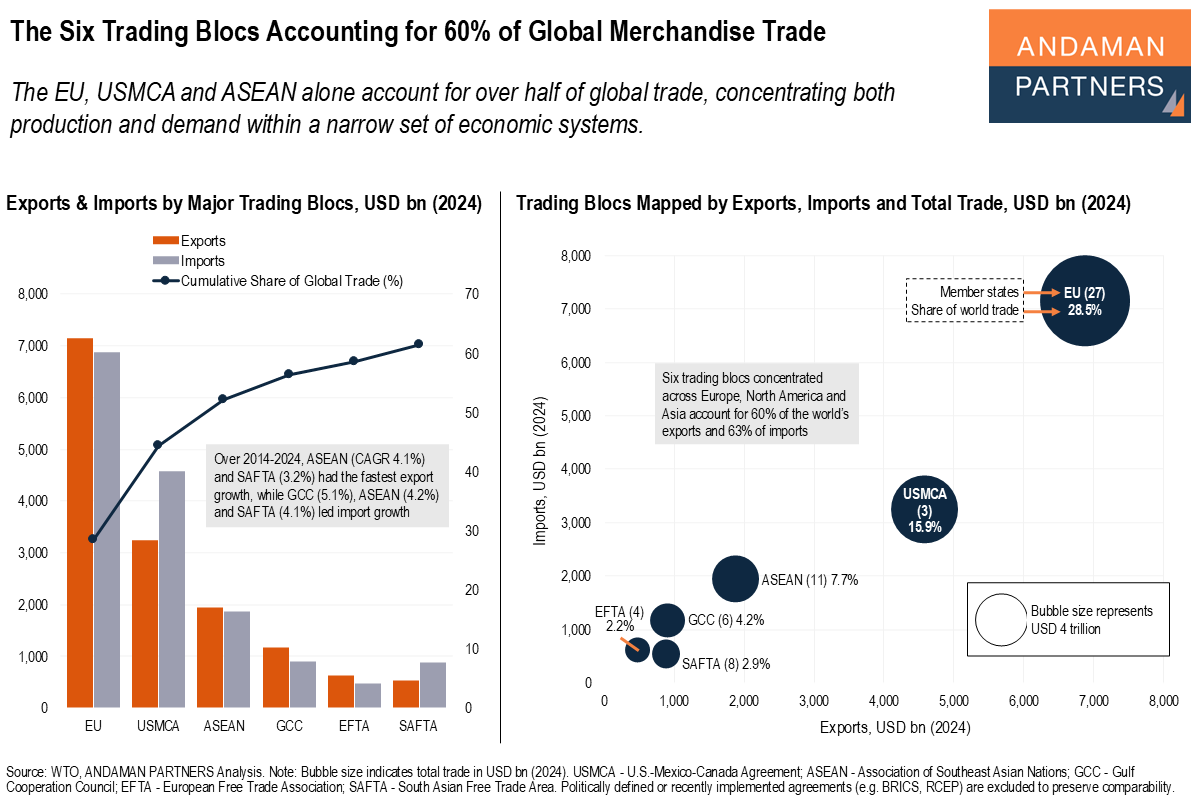
Global merchandise trade is highly concentrated. Just six trading blocs, namely the European Union (EU), U.S.-Mexico-Canada Agreement (USMCA), Association of Southeast Asian Nations (ASEAN), Gulf Cooperation Council (GCC), European Free Trade Association (EFTA) and South Asian Free Trade Area (SAFTA), account for roughly 60% of global exports and imports. The EU, USMCA, and ASEAN alone account for more than 50% of the world’s trade.
This concentration reflects more than scale; it highlights how production capacity and demand power are increasingly organised within a small number of large, multi-country economic systems that dominate global trade flows.
Within this top tier, structural differences are pronounced. The EU remains the world’s most complete trade system, combining export capacity with equally significant import demand. The USMCA is more demand-heavy, reflecting the pull of the U.S. market, while ASEAN stands out as the only emerging bloc operating at a comparable scale with a relatively balanced trade profile.
Resource-centric blocs such as the GCC retain importance through export intensity rather than breadth, while South Asia’s trade system remains import-skewed, underscoring different development and consumption dynamics.
By contrast, Africa’s regional trading blocs remain marginal globally. Even the continent’s largest groupings, the Southern African Development Community (SADC), the Common Market for Eastern and Southern Africa (COMESA) and the Economic Community of West African States (ECOWAS), each account for well under 2% of global trade, despite periods of faster growth.
The gap is one of scale and integration rather than volatility: African trade remains fragmented across multiple small blocs with limited intra-regional depth and industrial density.
European Union (EU)
- Members: 27 countries
- Trade profile: The world’s most complete trade system, combining a large export base with a large import market.
United States-Mexico-Canada Agreement (USMCA)
- Members: U.S., Canada, Mexico
- Trade profile: A demand-heavy trade system anchored by the scale of the U.S. consumer market.
Association of Southeast Asian Nations (ASEAN)
- Members: Indonesia, Thailand, Vietnam, Malaysia, Singapore, Philippines, Cambodia, Laos, Myanmar, Brunei, Timor-Leste
- Trade profile: Combines strong export growth with a relatively balanced import profile, reflecting its dual role as a manufacturing base and a fast-growing consumption market.
Gulf Cooperation Council (GCC)
- Members: Saudi Arabia, United Arab Emirates, Qatar, Kuwait, Oman, Bahrain
- Trade profile: Export-led system dominated by energy and petrochemicals.
European Free Trade Association (EFTA)
- Members: Switzerland, Norway, Iceland, Liechtenstein
- Trade profile: Small but highly trade-intensive bloc encompassing high-value manufacturing and energy exports (Norway) and financial and pharmaceutical specialisation (Switzerland).
South Asian Free Trade Area (SAFTA)
- Members: India, Pakistan, Bangladesh, Sri Lanka, Nepal, Bhutan, Maldives, Afghanistan
- Trade profile: India dominates the bloc’s trade flows, while cross-border trade within South Asia remains low relative to economic size.