
You are currently viewing EU-India Trade Entering Expansion Phase With New Free Trade Agreement

EU-India Trade Entering Expansion Phase With New Free Trade Agreement

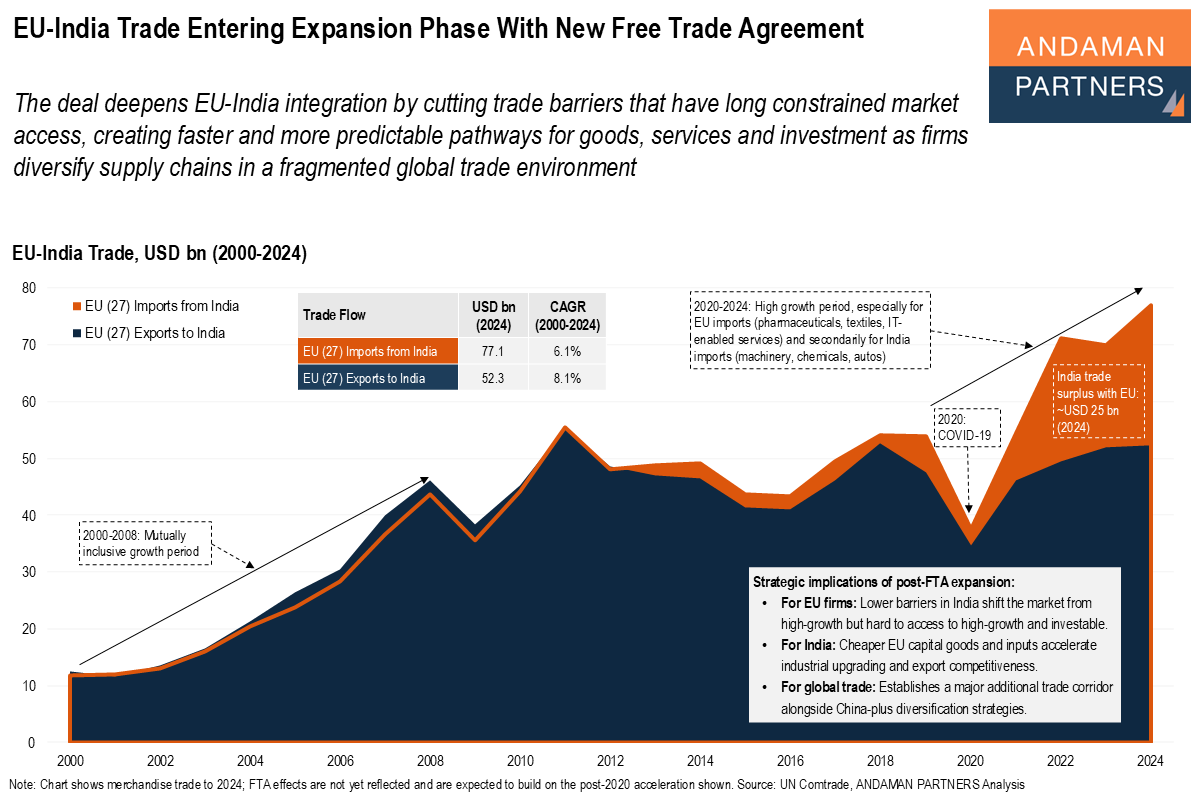
The deal deepens EU-India integration by cutting trade barriers that have long constrained market access, creating faster and more predictable pathways for goods, services and investment as firms diversify supply chains in a fragmented global trade environment.

Signed on 27 January 2026 in New Delhi after nearly two decades of negotiations, the India-EU Free Trade Agreement (FTA) marks the most significant upgrade of the bilateral economic relationship in decades. The deal centres on phased tariff reductions on industrial goods, improved access for services and investment, streamlined customs and regulatory procedures and stricter rules on intellectual property and public procurement. In practical terms, it lowers the cost and uncertainty of doing business across the corridor and gives firms clearer, rules-based access to two very large markets.

Two-way goods trade between the EU and India has expanded roughly sixfold since 2000, reaching around USD 130 billion in 2024. Growth has not been linear: after strong early integration in the 2000s and a long period of steady expansion, trade rebounded sharply after the 2020 pandemic shock and entered a new high-growth phase. Recent gains have been driven by EU imports of Indian pharmaceuticals, textiles and IT-enabled services, alongside rising EU exports of machinery, chemicals and vehicles to India. In 2024, India had a trade surplus with the EU of around USD 25 billion.

The new FTA is likely to amplify this momentum. India’s relatively high tariffs on EU industrial goods mean the largest immediate unlock is on the EU-to-India side, turning a high-growth but friction-heavy market into a more investable one. For India, cheaper access to European capital goods and inputs supports industrial upgrading and export competitiveness.

Strategically, this adds a major additional trade and sourcing corridor at a time when companies are diversifying supply chains beyond single-country dependencies. EU-India trade is shifting from opportunistic expansion to a more structurally sound, larger and more predictable cross-border business.

Also by ANDAMAN PARTNERS:

ANDAMAN PARTNERS supports international business ventures and growth. We help launch global initiatives and accelerate successful expansion across borders. If your business, operations or project requires cross-border support, contact connect@andamanpartners.com.

Media
News & Events
Knowledge