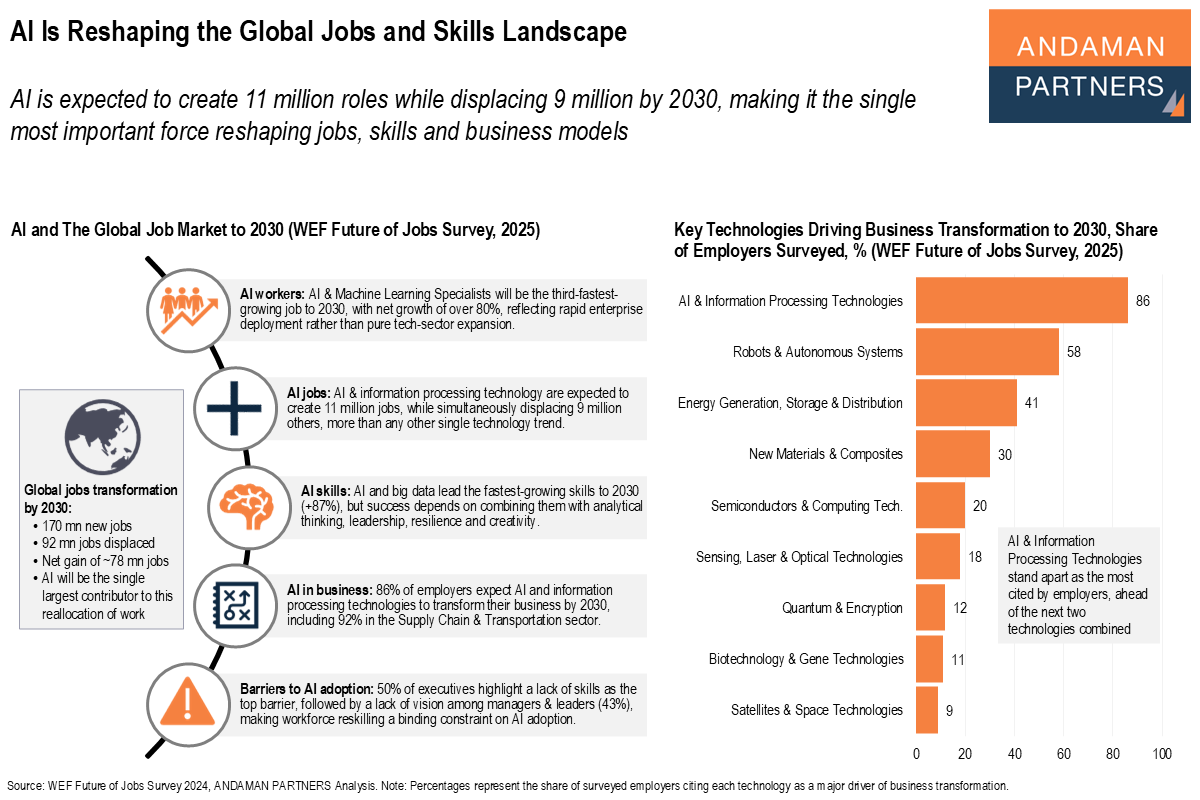
AI is expected to create 11 million roles while displacing 9 million by 2030, making it the single most important force reshaping jobs, skills and business models.
Artificial Intelligence (AI) is emerging as the single most powerful force reshaping the global labour market. According to the World Economic Forum (WEF) Future of Jobs Report, published in January 2025, based on 1,043 survey responses from global companies representing more than 14.1 million employees worldwide, by 2030, AI and information-processing technologies are expected to create roughly 11 million jobs while displacing around 9 million.
These findings point to a labour-market transition defined less by net job losses than by rapid recomposition of work, tasks and skill requirements. AI and machine-learning specialists rank among the fastest-growing roles globally, reflecting broad enterprise deployment rather than isolated technology adoption. At the same time, AI and big data have become the fastest-growing skills in terms of importance. However, the WEF report makes clear that these technical capabilities generate value only when paired with analytical thinking, leadership, resilience and creativity.
This AI-driven transformation is unfolding into a broader hierarchy of technologies shaping business strategy. Employers overwhelmingly identify AI and information processing technologies as the leading driver of business transformation, cited by 86% of respondents, well ahead of robots and autonomous systems, energy generation and storage technologies, and new materials and composites.
At the macro level, these forces are contributing to a significant reallocation of labour, with around 170 million jobs expected to be created globally and 92 million displaced by 2030, resulting in a net employment gain. Critically, the WEF report identifies skills gaps as the leading barrier to AI adoption, underscoring that the central challenge for executives is no longer whether AI will transform work, but whether organisations can build the workforce capabilities required to capture its gains.
Also by ANDAMAN PARTNERS:
ANDAMAN PARTNERS supports international business ventures and growth. We help launch global initiatives and accelerate successful expansion across borders. If your business, operations or project requires cross-border support, contact connect@andamanpartners.com.

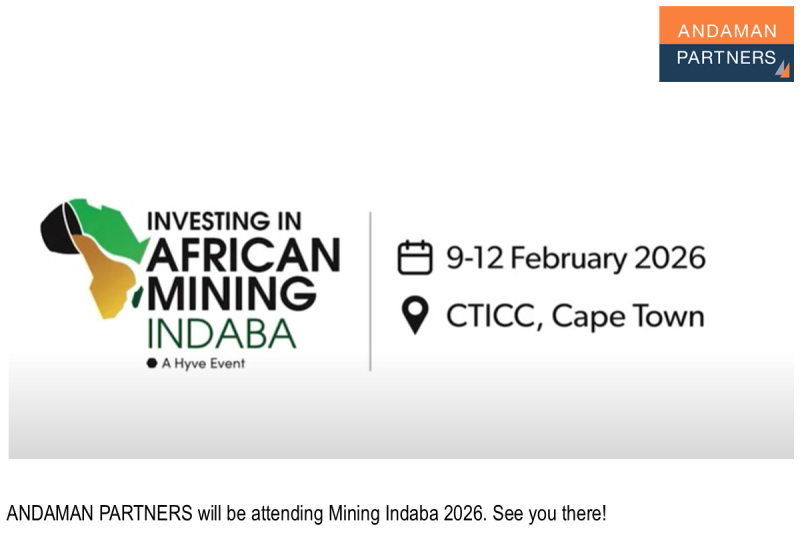
ANDAMAN PARTNERS to Attend Investing in African Mining Indaba 2026 in Cape Town
ANDAMAN PARTNERS Co-Founders Kobus van der Wath and Rachel Wu will attend Investing in African Mining Indaba 2026 in Cape Town, South Africa.
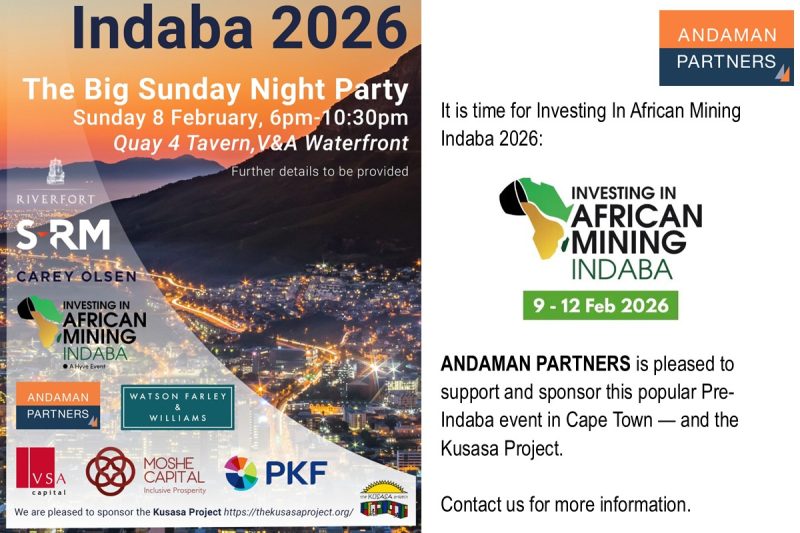
Join ANDAMAN PARTNERS at Networking Event in Cape Town Ahead of Mining Indaba 2026
ANDAMAN PARTNERS is pleased to support and sponsor this popular Pre-Indaba event in Cape Town.
AAMEG Event in Cape Town Ahead of Mining Indaba 2026
ANDAMAN PARTNERS is pleased to sponsor and support the AAMEG pre-Mining Indaba Cocktails & Canapes event.

China and the U.S. Dominate Global Capital Formation as High-Investment Emerging Markets Gain Ground
Sustained investment intensity and long-term growth are concentrating global capital formation in a small group of economies, led by China and the U.S.

Global Investment Patterns in 2025 Favoured Infrastructure Over Corporate Expansion
FDI and M&A remained concentrated in Asia and North America, while infrastructure attracted the bulk of project-financed investment.

Vietnam’s Rapidly Scaling Economy: Growth, Exports and Investment
Vietnam’s export-led growth reflects structural gains from China+1 supply-chain reallocation rather than cyclical trade expansion.