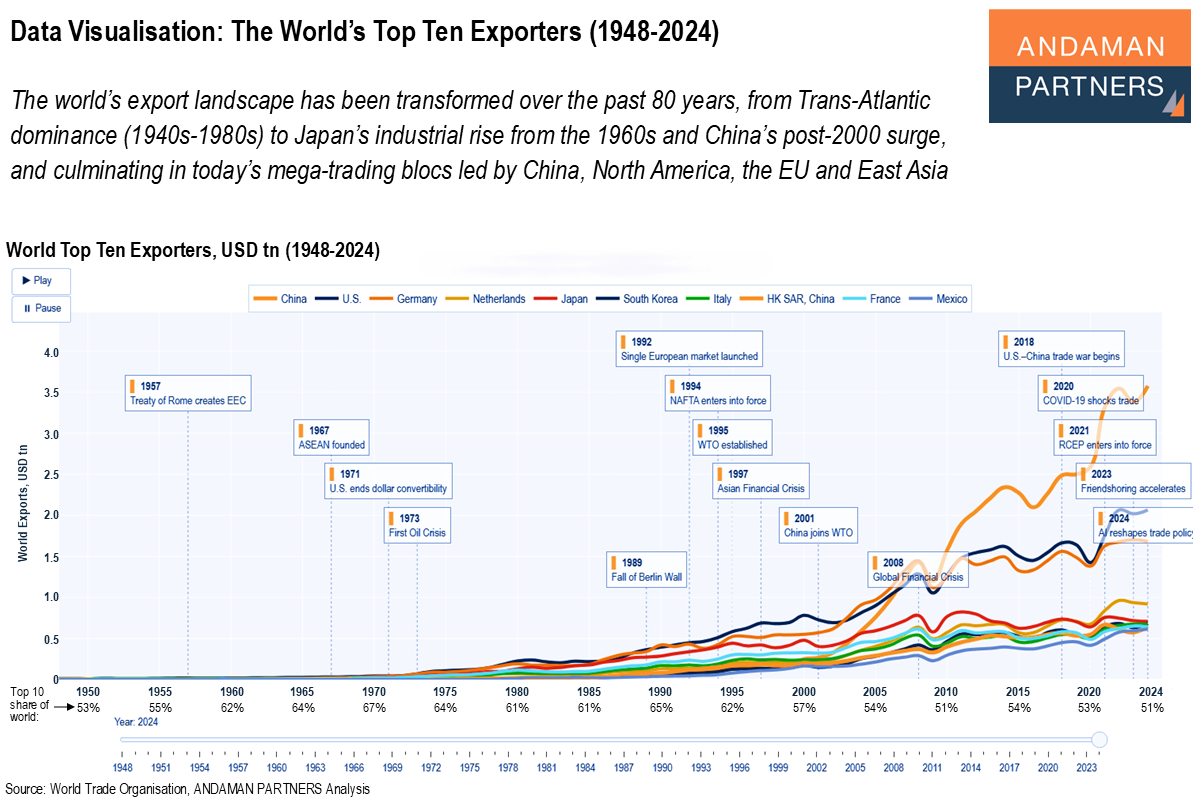
The world’s export landscape has been transformed over the past 80 years, from Trans-Atlantic dominance (1940s-1980s) to Japan’s industrial rise from the 1960s and China’s post-2000 surge, and culminating in today’s mega-trading blocs led by China, North America, the EU and East Asia.
From 1948 to the late 1980s, global exports were dominated by a trans-Atlantic industrial core led by the U.S. and Western Europe, with Japan emerging as the first major challenger from Asia. Trade volumes grew slowly at first, then accelerated after the 1957 creation of the European Economic Community (EEC), the rise of Japan’s export machine in the 1960s-1970s and the gradual liberalisation of global markets.
Major shocks, such as the end of the dollar’s convertibility (1971) and the oil crises (1970s), left visible dents on global trade levels. Still, the hierarchy of leading exporters remained broadly stable: the U.S., Germany and Japan were the leading exporters, with smaller advanced economies such as France, Italy and the Netherlands forming a consistent second tier.
From the 1990s onward, the structure of global exports was reshaped by three forces: European integration, China’s ascent and the diffusion of manufacturing across East Asia. The launch of the European Single Market (1992), the North American Free Trade Agreement (NAFTA, 1994) and the World Trade Organisation (WTO, 1995) expanded cross-border trade. Yet the defining break came with China’s WTO entry in 2001, triggering this country’s rapid rise to become the world’s largest exporter in 2009.
South Korea and Mexico also climbed the rankings as global supply chains deepened. The 2008 Global Financial Crisis and COVID-19 in 2020 caused sharp but temporary contractions, while more recent trends such as friendshoring, fragmentation and AI-driven policy shifts are beginning to shape the post-2020 landscape.
In 2024, the global export map was defined by a set of mega-traders: China, the U.S., the EU, Japan and South Korea, which anchor a multipolar, supply-chain-intensive trading system.
Also by ANDAMAN PARTNERS:
ANDAMAN PARTNERS supports international business ventures and growth. We help launch global initiatives and accelerate successful expansion across borders. If your business, operations or project requires cross-border support, contact connect@andamanpartners.com.

ANDAMAN PARTNERS Wishes You a Merry Christmas and Happy New Year!
Merry Christmas and Happy New Year from ANDAMAN PARTNERS!

AAMEG Sundowner Event in Cape Town Ahead of Mining Indaba 2026
ANDAMAN PARTNERS is pleased to sponsor and support the AAMEG Pre-Indaba Cocktail.

ANDAMAN PARTNERS to Attend Future Minerals Forum 2026 in Riyadh, Saudi Arabia
ANDAMAN PARTNERS Co-Founders Kobus van der Wath and Rachel Wu will attend the Future Minerals Forum (FMF) in Riyadh, Saudi Arabia.

ASEAN’s 4-Trillion-Dollar Trade System: East-West Crossroads of Global Commerce
ASEAN has almost doubled its trade since 2010 and has strengthened ties with China and the U.S., cementing the bloc’s position as an East-West trading nexus.

ASEAN’s 4-Trillion-Dollar Trade System: Balancing Regional Integration and Global Reach
ASEAN’s trade has surged to nearly USD 4 trillion in 2024 while developing a uniquely balanced structure.

Top 20 Global Mining Firms, 2015 vs. 2025: China’s Majors Have Become Global Heavyweights
Over the last decade, Chinese firms surged into the global mining elite, now accounting for 2 of the top 5.