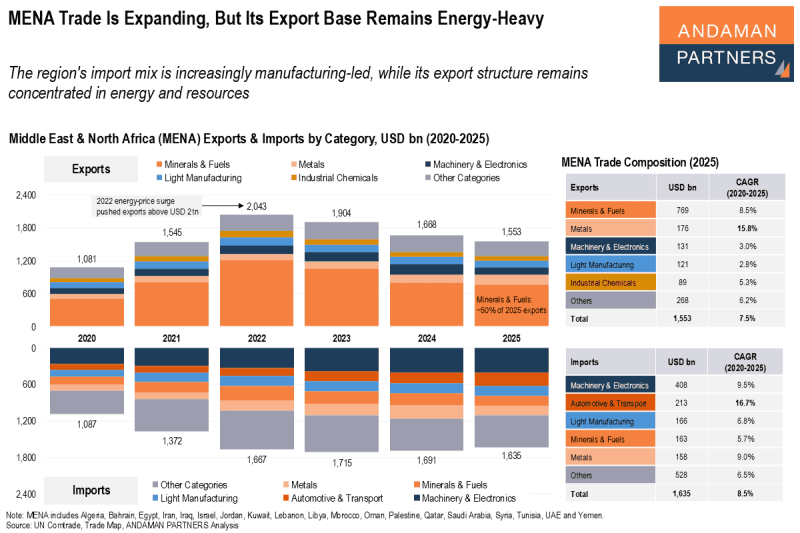
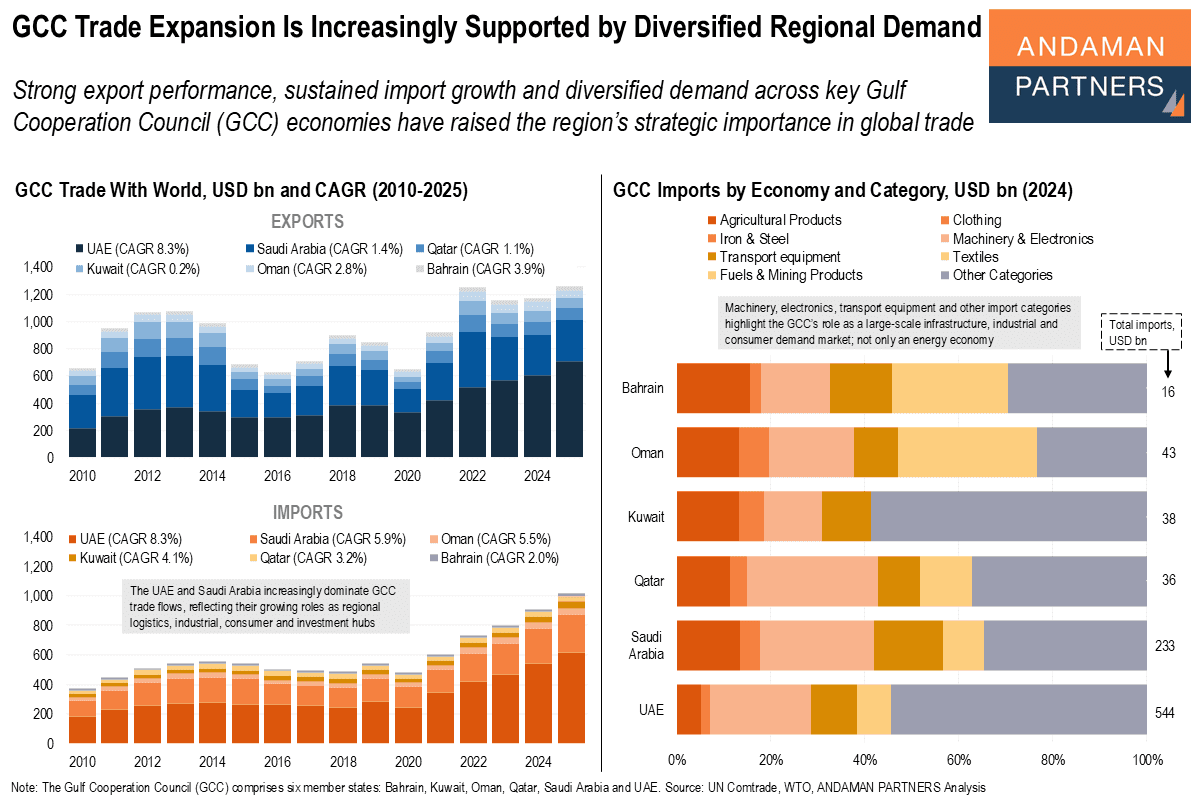

Strong export performance, sustained import growth and diversified demand across key Gulf Cooperation Council (GCC) economies have raised the region’s strategic importance in global trade.
The Gulf Cooperation Council (GCC), comprising Bahrain, Kuwait, Oman, Qatar, Saudi Arabia and the UAE, is expanding its role in global trade, supported by rising exports, sustained import growth and increasingly diversified regional demand.
The UAE and Saudi Arabia remain the dominant trade economies within the bloc, accounting for the majority of regional trade flows and reinforcing their positions as the GCC’s principal logistics, industrial and investment hubs.
Export performance across the region continues to be supported by hydrocarbons, but import patterns increasingly point to broader economic diversification and rising domestic demand. Machinery and electronics, transport equipment, industrial materials and consumer-oriented imports now account for a significant share of GCC import demand in most member economies. The UAE and Saudi Arabia dominate absolute import volumes, while economies such as Oman and Qatar also show increasingly diversified import structures linked to infrastructure expansion, industrial development and population-driven consumption growth.
The composition of imports highlights an important structural shift: the GCC is not only an energy-exporting region, but also a large-scale destination market for industrial equipment, technology, construction inputs and consumer goods. This has increased the region’s strategic importance for exporters, manufacturers, logistics providers and global investors seeking exposure to high-growth trade and infrastructure corridors.
The UAE remained the GCC’s largest import market in 2024, with imports reaching approximately USD 544 billion, more than double Saudi Arabia’s USD 233 billion. Oman (USD 43 billion), Kuwait (USD 38 billion), Qatar (USD 36 billion) and Bahrain (USD 16 billion) represent smaller but increasingly diversified import economies linked to growth in infrastructure, industrial and consumer demand.
At the same time, the concentration of trade, shipping and energy flows through the broader Middle East means regional instability and maritime disruption are becoming increasingly important considerations for companies and investors with exposure to GCC-linked supply chains and trade routes.
Also by ANDAMAN PARTNERS:
ANDAMAN PARTNERS supports international business ventures and growth. We help launch global initiatives and accelerate successful expansion across borders. If your business, operations or project requires cross-border support, contact connect@andamanpartners.com.

ANDAMAN PARTNERS Attended the Australia Governance Summit 2026 in Sydney
ANDAMAN PARTNERS Co-Founder Kobus van der Wath attended the Australia Governance Summit (AGS26) in Sydney, Australia.
ANDAMAN PARTNERS Wishes You a Happy and Prosperous Year of the Horse!
Compliments of the Chinese Lunar New Year to all our clients, customers, suppliers and partners.

ANDAMAN PARTNERS to Attend Investing in African Mining Indaba 2026 in Cape Town
ANDAMAN PARTNERS Co-Founders Kobus van der Wath and Rachel Wu will attend Investing in African Mining Indaba 2026 in Cape Town, South Africa.

China’s Imports Hit Record Levels in Early 2026, Led by Tech and Industrial Inputs
Rising imports of semiconductors, energy and industrial inputs point to renewed industrial activity.

GCC Trade Expansion Is Increasingly Supported by Diversified Regional Demand
Strong export performance, sustained import growth and diversified demand across the GCC have raised the region’s strategic importance.

India Remains Heavily Dependent on Imported Energy, Electronics and Industrial Inputs
Energy, electronics and industrial inputs continue to dominate India’s imports, highlighting persistent external dependence.