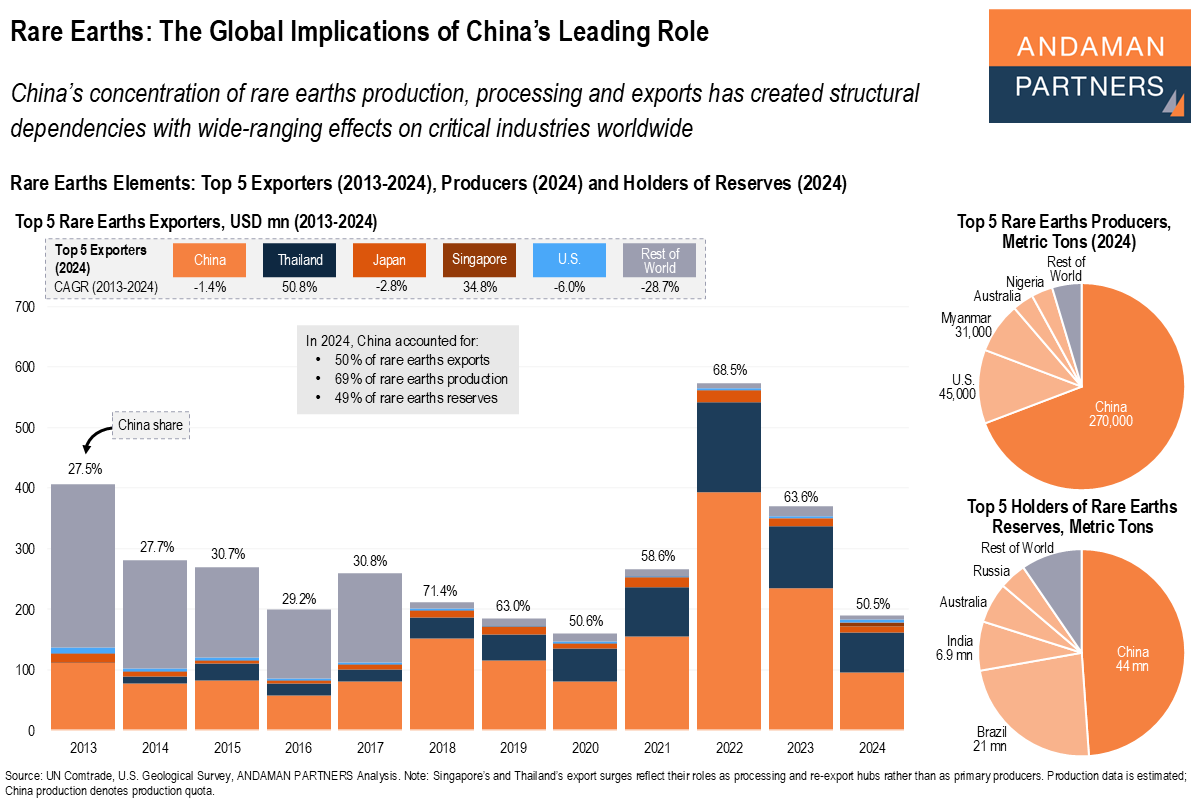
China’s concentration of rare earths production, processing and exports has created structural dependencies with wide-ranging effects on critical industries worldwide.
On 9 October 2025, China’s Ministry of Commerce announced expanded export controls on rare earth elements, magnets and related technologies, set to take effect in December. The new rules broaden licensing requirements to include additional rare earths and extend to foreign-made goods—from magnets to components used in electric vehicles (EVs), smartphones and wind turbines—that contain Chinese materials and technologies.
These measures highlight China’s central role in the supply chain of rare earths, a group of 17 soft and heavy metals crucial for modern technologies due to their unique magnetic, optical and conductive properties. China accounts for roughly 70% of global mine production, 49% of exports and more than 90% of processing and refining.
China also holds around half of global reserves. While large deposits exist in countries such as Brazil, India, Australia and Russia, only China has the integrated processing capacity at scale to bring rare earths to market.
Global Implications
The implications of China’s dominance of rare earths exports and production are far-reaching, even more so now with expanded export controls set to take effect in December.
The global economy is heavily exposed to disruptions in Chinese supply. Because most advanced manufacturing sectors—from clean energy to electronics and defense—depend on Chinese-produced or processed rare earths, any tightening of export rules or supply interruptions will have immediate downstream effects.
Even if countries increase their own mining, ores often still need to be sent to China for refining. Building alternative supply chains requires major investment, long lead times and technical expertise that China has developed over decades.
The concentration of rare earths production, exports and processing in China created a structural dependency for critical industries worldwide. Rare earths supply constraints in China can quickly lead to price spikes, production delays and higher costs across multiple industries, from wind turbines and EVs to semiconductors and medical devices.
Also by ANDAMAN PARTNERS:
ANDAMAN PARTNERS supports international business ventures and growth. We help launch global initiatives and accelerate successful expansion across borders. If your business, operations or project requires cross-border support, contact connect@andamanpartners.com.

AAMEG Sundowner Event in Cape Town Ahead of Mining Indaba 2026
ANDAMAN PARTNERS is pleased to sponsor and support the AAMEG Pre-Indaba Cocktail.

ANDAMAN PARTNERS to Attend Future Minerals Forum 2026 in Riyadh, Saudi Arabia
ANDAMAN PARTNERS Co-Founders Kobus van der Wath and Rachel Wu will attend the Future Minerals Forum (FMF) in Riyadh, Saudi Arabia.

ANDAMAN PARTNERS to Attend Investing in African Mining Indaba 2026 in Cape Town
ANDAMAN PARTNERS Co-Founders Kobus van der Wath and Rachel Wu will attend Investing in African Mining Indaba 2026 in Cape Town, South Africa.

Key Players in the Global Fuels & Mining Products Trade
In 2024, the top ten importers bought nearly USD 700 billion more than the top ten exporters supplied.

The Global Services Power Landscape: Leaders of the World’s Fastest-Growing Trade Arena
In 2024, the global commercial services trade reached nearly USD 9 trillion, led by a group of economies with deep capabilities.

China’s 10 Largest Mining Deals Since 2019: Large Gold, Copper and Lithium Acquisitions
Chinese mining M&A surged in 2019-2025, as China locked in supply-critical metals across Africa and Latin America.