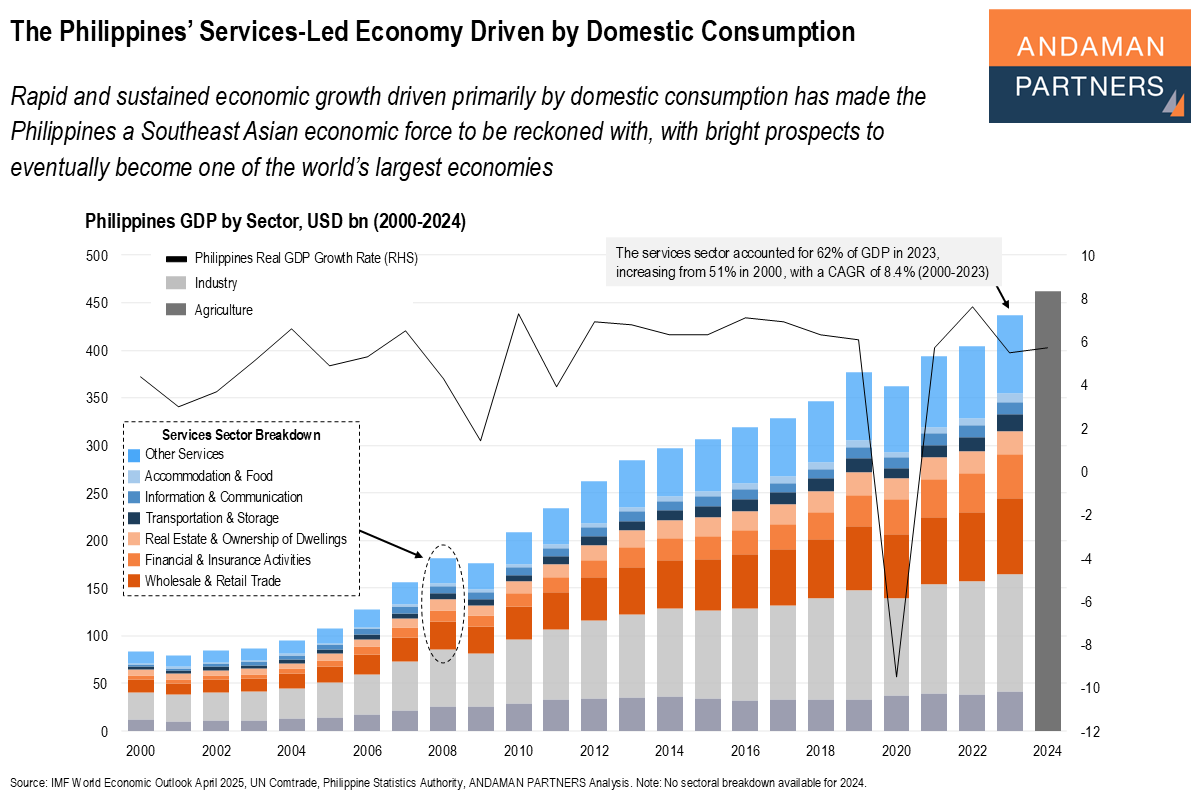

Rapid and sustained economic growth driven primarily by domestic consumption has made the Philippines a Southeast Asian economic force to be reckoned with, with bright prospects to eventually become one of the world’s largest economies.
With a relatively large and young population of 114.9 million people, of whom 66% are of working age and 28.6% are aged 14 or younger (compared to 16.6% in China), the Philippines has bright economic prospects.
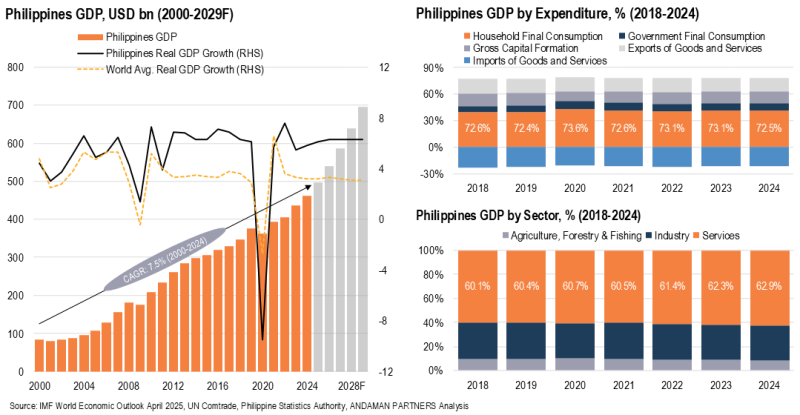
Since 2012, the Philippines’ real GDP growth has consistently exceeded 5%, except in 2020. In 2024, growth reached 5.8% and is projected to remain above this level through 2029. The economy grew from just over USD 80 billion in 2000 to USD 461 billion in 2024, and is projected to reach USD 695 billion by 2029, placing it just outside the world’s 30 largest economies.
The rest of the century could be an impressive growth story for the Philippines. By 2075, GDP is projected to exceed USD 6 trillion, making it the world’s 15th-largest economy.
Although the Philippines has increased its exports from below USD 40 billion in 2000 to almost USD 80 billion in 2022, its GDP is not dependent on export-led growth, as the country generally maintains a trade deficit with imports exceeding exports. Instead, a large and growing population is the foundation of the country’s economy, as domestic consumption accounts for more than 70% of GDP.
Sector-wise, the country’s economy is based on a rapidly expanding services sector, which accounts for well over 60% of GDP, compared to less than 30% for industry and less than 10% for agriculture.
As a result, the Philippines has become a global leader in providing services for Business Process Outsourcing (BPO), a practice in which companies contract business operations to third-party service providers. Such services include call centres, human resources management, legal services, accounting and payroll, customer services and marketing. Other prominent service sectors in the Philippines are tourism, financial services, information technology, retail and trade.
The country’s large workforce, proficiency in English and cultural affinity with Western and Asian markets are key advantages of its growing services sector.
In short, the Philippines could be one of the most significant economic growth stories of the 21st century, and a country that foreign businesses must pay close attention to.
ANDAMAN PARTNERS supports international business ventures and growth. We help launch global initiatives and accelerate successful expansion across borders. If your business, operations or project requires cross-border support, contact connect@andamanpartners.com.

ANDAMAN PARTNERS Wishes You a Happy and Prosperous Year of the Horse!
Compliments of the Chinese Lunar New Year to all our clients, customers, suppliers and partners.

ANDAMAN PARTNERS to Attend Investing in African Mining Indaba 2026 in Cape Town
ANDAMAN PARTNERS Co-Founders Kobus van der Wath and Rachel Wu will attend Investing in African Mining Indaba 2026 in Cape Town, South Africa.

Join ANDAMAN PARTNERS at Networking Event in Cape Town Ahead of Mining Indaba 2026
ANDAMAN PARTNERS is pleased to support and sponsor this popular Pre-Indaba event in Cape Town.

The New Geography of Global Sourcing: Demand Anchors, Rising Exporters and the Logistics Divide
Industrial demand is concentrated in the U.S., China and the EU, while a new generation of emerging markets is expanding in global production.

China’s Steel Industry Plateaus as Demand Growth Shifts to Emerging Economies
China’s crude steel output has stabilised near peak levels while India expands rapidly, reflecting a gradual rebalancing of global steel demand.

Supply Chains Are Digitising Rapidly as Automation Becomes the Next Technology Frontier
Surveys show that core digital systems are widely deployed across supply chains, and automation is expected to transform them in coming years.