
GDP Comparison: China’s Administrative Units vs World Economies
GDP Comparison: China’s Administrative Units vs World Economies of Comparable Size
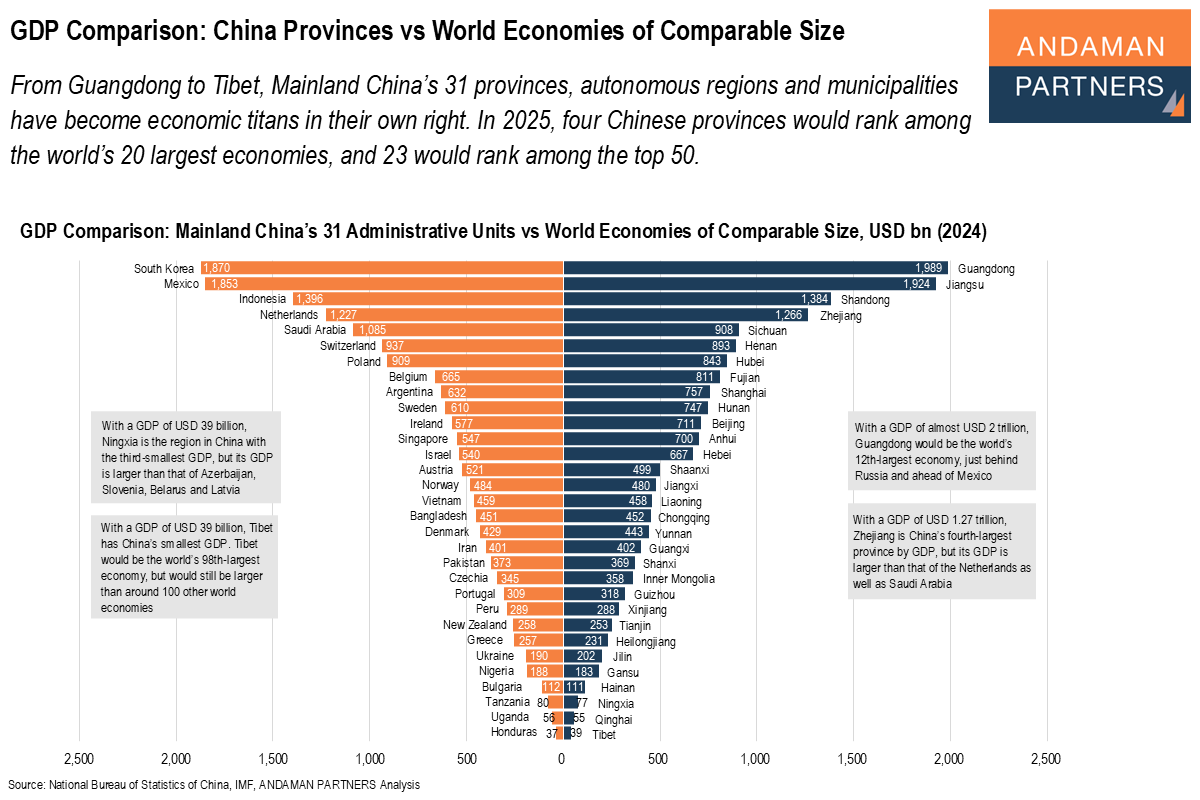
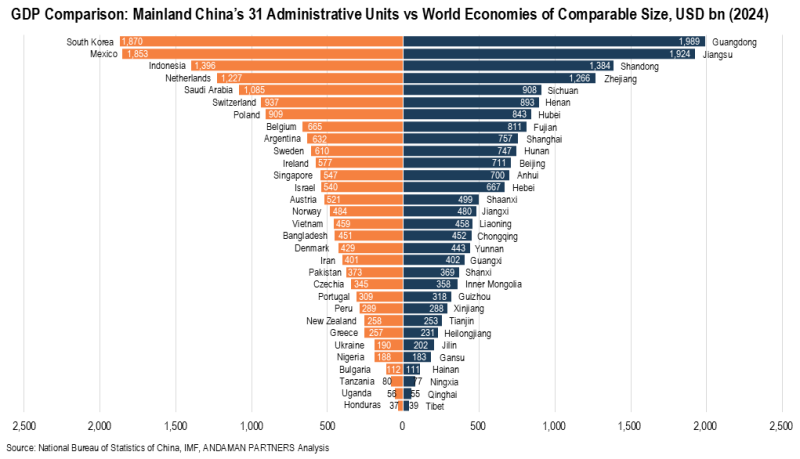
From Guangdong to Tibet, Mainland China’s 31 provinces, autonomous regions and municipalities have become economic titans in their own right. Four Chinese provinces would rank among the world’s 20 largest economies, and 23 would rank among the top 50.
China has the world’s second-largest economy, with a GDP of USD 18.80 trillion in 2024. On a regional basis, Mainland China’s GDP is distributed between 31 provinces, autonomous regions and municipalities, from the outsized economic centres of Guangdong and Jiangsu down to the outlying regions of Tibet and Ningxia:
- With a GDP of USD 1.99 trillion, Guangdong is slightly larger than the economy of South Korea, and if considered as a country, would be the world’s 12th-largest economy.
- Guangdong and second-largest Jiangsu (USD 1.92 trillion), whose GDP is comparable with that of Mexico, account for 10% each of China’s total GDP.
- Along with Guangdong and Jiangsu, China has two additional provinces with GDPs over a trillion US dollars: Shandong (USD 1.39 trillion) and Zhejiang (USD 1.27 trillion). These four provinces would currently rank among the world’s 20 largest economies by GDP.
- A total of 23 of China’s administrative units, up to and including the autonomous region of Xinjiang with a GDP of USD 288 billion, would currently rank among the world’s top 50 economies.
- The municipality of Beijing (USD 711 billion) has a larger GDP than the country of Belgium (USD 665 billion).
- At USD 39 billion, Tibet has China’s smallest GDP, although this autonomous region’s GDP would currently be the world’s 98th-largest world economy, and would be larger than around 100 other world economies.
With a GDP of over USD 29 trillion in 2024, the U.S. is the only world economy larger than China. According to data by the U.S. Bureau of Economic Analysis, three states in the U.S. currently have GDPs larger than that of Guangdong: California (USD 4.10 trillion), Texas (USD 2.71 trillion) and New York (USD 2.30 trillion).
Vermont, the U.S. state with the smallest GDP (USD 45.71 billion), has a smaller GDP than all Chinese administrative units except Tibet.
ANDAMAN PARTNERS supports international business ventures and growth. We help launch global initiatives and accelerate successful expansion across borders. If your business, operations or project requires cross-border support, contact connect@andamanpartners.com.

ANDAMAN PARTNERS to Attend China Mining 2026 in Tianjin, China
ANDAMAN PARTNERS will attend the China Mining Conference and Exhibition in Tianjin, China, on 10-12 September 2026

ANDAMAN PARTNERS at the Singapore Institute of Directors Annual Conference 2026
ANDAMAN PARTNERS at the Singapore Institute of Directors Conference 2026 in Singapore on 28 August 2026

ANDAMAN PARTNERS Attended the Australia Governance Summit 2026 in Sydney
ANDAMAN PARTNERS Co-Founder Kobus van der Wath attended the Australia Governance Summit (AGS26) in Sydney, Australia.
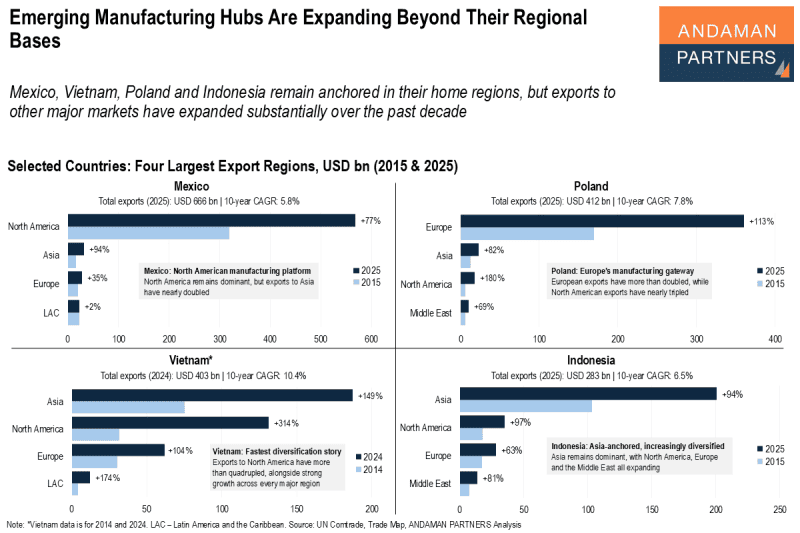
Emerging Manufacturing Hubs Are Expanding Beyond Their Regional Bases
Mexico, Vietnam, Poland and Indonesia remain anchored in their home regions, but exports to other major markets have expanded substantially
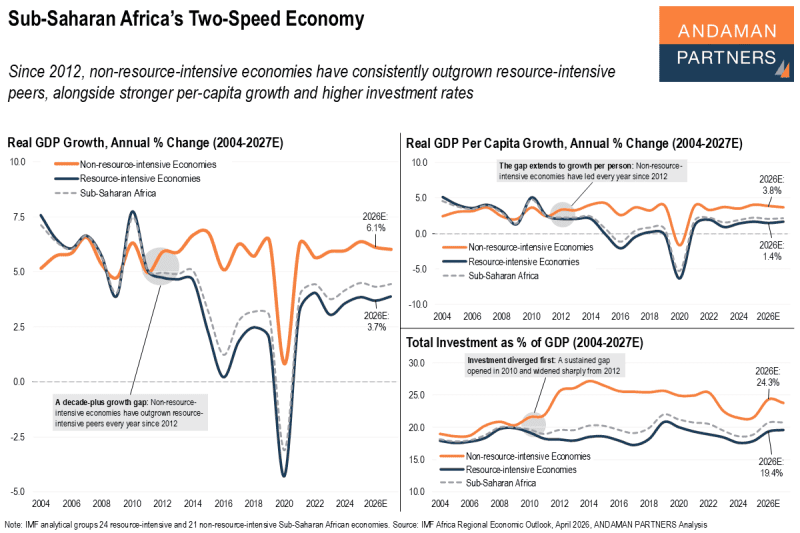
Sub-Saharan Africa’s Two-Speed Economy
Since 2012, non-resource-intensive economies have consistently outgrown resource-intensive peers
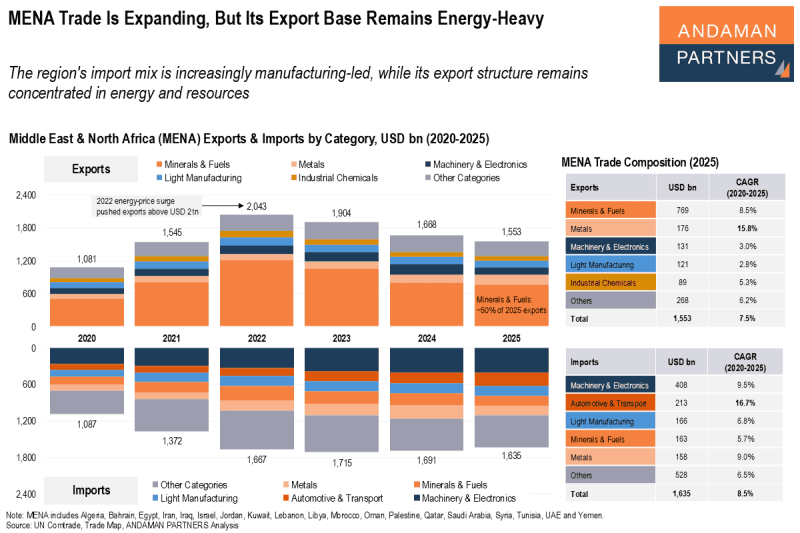
MENA Trade Is Expanding, But Its Export Base Remains Energy-Heavy
The region’s import mix is increasingly manufacturing-led, while its export structure remains concentrated in energy and resources.
Pingback: China’s Fastest- and Slowest-Growing Provinces | ANDAMAN PARTNERS